




Technology is evolving at an accelerated pace. In recent decades, computers have become smaller, faster, and capable of performing billions of operations per second.
However, some problems remain extremely difficult for traditional computers, requiring years—or even centuries—of processing time.
It is in this context that quantum computing gains prominence. Unlike classical computing, it uses principles of quantum mechanics to process information in a completely different way.
Although still under development, this technology promises to revolutionize areas such as artificial intelligence, medicine, logistics, digital security, finance, and scientific research.
Companies like IBM, Google, Microsoft, and Amazon are already investing billions of dollars in the development of quantum computers, while universities and research centers around the world are working to make this technology increasingly accessible.
In this article, you will understand what quantum computing is, how a quantum computer works, what qubits are, why concepts like quantum superposition and quantum entanglement are so important, and what applications are already being developed.
What is quantum computing?
Quantum computing is an information processing model based on the laws of quantum mechanics, a branch of physics that studies the behavior of particles at extremely small scales, such as electrons, photons, and atoms.
While a conventional computer works with bits that assume only two states — 0 or 1 — a Quantum computers use qubits., which can represent different states at the same time thanks to the properties of Quantum Physics.
This does not mean that a quantum computer will replace the traditional computer. On the contrary: each technology has specific applications.
Conventional computers remain the best choice for everyday tasks, such as browsing the internet, editing documents, or watching videos. Quantum computers, on the other hand, are designed to solve extremely complex problems that require numerous simultaneous combinations and calculations.
For this reason, experts consider quantum computing a complementary technology, not a replacement for classical computing.
Read also: From the Turing Machine to Quantum Computing: how computing has evolved over the decades.
How does a quantum computer work?
A traditional computer processes information using electronic circuits composed of billions of transistors.
Each transistor represents a bit that can only take one of the following values:
- 0
- 1
Every program that runs on a typical computer is made up of enormous sequences of these bits.
A quantum computer, however, works differently. Instead of relying solely on electrical signals, it manipulates extremely sensitive physical systems, such as trapped ions, superconducting circuits, or particles of light.
These systems store information in qubits, allowing the exploration of quantum phenomena impossible with traditional computing.
In practice, this makes it possible to evaluate many possibilities simultaneously during certain types of calculations.
It is precisely this characteristic that makes quantum computing so promising for problems involving thousands or millions of possible combinations.
What is a qubit?
The qubit (quantum bit) is the basic unit of quantum computing.
It plays a similar role to the traditional bit, but has much more sophisticated properties.
While a bit has only two possible states…
- 0
- 1
…a qubit can remain in a combination of these states until the moment of measurement.
This allows the system to explore various possibilities during processing.
It is important to emphasize that this characteristic does not mean that a quantum computer is simply "millions of times faster." The gain depends on the type of problem and the algorithm used.
Even so, for certain applications, the performance difference can be enormous.
What is quantum superposition?
One of the best-known concepts in quantum computing is... quantum superposition.
In traditional computing, a bit must be in only one state.
Imagine a coin on the table.
She can show:
- face;
- crown.
Now imagine that coin spinning rapidly.
As it spins, it represents a combination of the two states.
Although this analogy is not perfect from a scientific point of view, it helps to visualize the idea of superposition.
In quantum computing, a qubit can remain in this combination of states during information processing.
Thanks to this, certain algorithms are able to explore a much greater number of possibilities than would be possible using only conventional bits.
This is one of the main factors that makes quantum computing so different from classical computing.
What is quantum entanglement?
Another fundamental concept is quantum entanglement.
When two or more qubits become entangled, their states exhibit an extremely strong correlation.
Even though they are separated by great distances, the mathematical description of these qubits remains connected.
In practice, this allows the creation of systems capable of performing operations far more efficiently than those available in conventional computing.
Entanglement is considered one of the most important features of modern quantum computing and appears in virtually all relevant algorithms in the field.
Without it, many of the advantages promised by quantum computers simply wouldn't exist.
Why is quantum computing considered revolutionary?
The main difference lies in how certain problems can be solved.
Imagine needing to find the best route for thousands of trucks making deliveries in hundreds of cities.
A conventional computer typically analyzes numerous combinations until it finds a satisfactory solution.
As the number of possibilities increases, the time required grows rapidly.
In certain scenarios, a quantum computer can use specific algorithms to explore this solution space much more efficiently.
The same thing happens in areas such as:
- development of new medicines;
- discovery of innovative materials;
- molecular simulation;
- logistics optimization;
- financial forecast;
- artificial intelligence;
- cryptography.
Therefore, governments, universities, and large companies are continuously investing in research aimed at advancing quantum computing.
What are the main algorithms in quantum computing?
Algorithms are sets of instructions that guide a computer to solve a problem. In quantum computing, they are developed to take advantage of the properties of qubits, allowing calculations that would be infeasible or extremely time-consuming for traditional computers.
Although there are various quantum algorithms, Some stand out for their potential applications.
Shor's algorithm
Shor's algorithm aims to factor very large integers into their prime factors in an extremely efficient manner.
This capability caught the attention of the scientific community because many widely used encryption systems, such as RSA, rely on the difficulty of performing this type of calculation on traditional computers to ensure information security.
The possibility that sufficiently advanced quantum computers can perform this task efficiently is driving the development of so-called post-quantum cryptography, which seeks to create security methods capable of withstanding attacks carried out by quantum computers.
Grover's Algorithm
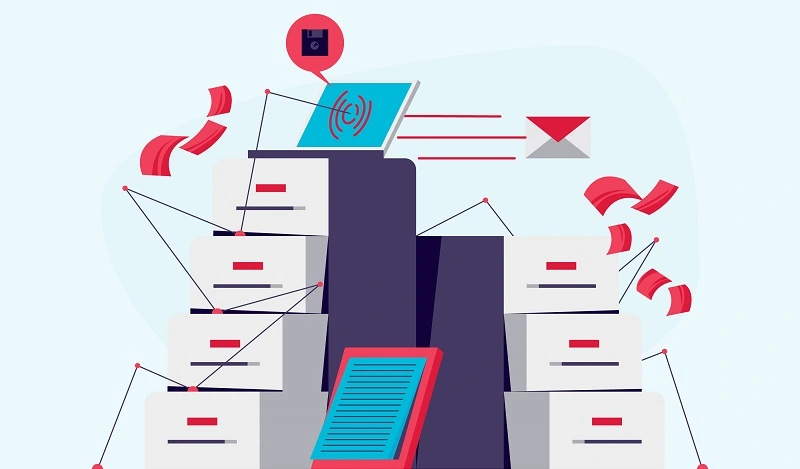
Grover's algorithm was created to perform searches in large datasets more efficiently than traditional methods.
Imagine trying to find a single specific document among millions of files. A conventional computer might need to check a large number of records before locating the desired file. Grover's algorithm, however, significantly reduces the number of checks required, making this process much more efficient for certain types of problems.
Where can quantum computing be applied?
Although still evolving, quantum computing is already showing potential to transform various sectors of the economy and science.
Check out some of the main ones. applications of quantum computing.
Drug development
The discovery of new drugs requires extremely complex simulations of the behavior of molecules and proteins.
Quantum computers can accelerate these simulations, allowing researchers to identify promising compounds more quickly. This could reduce costs and shorten the time needed to develop treatments for various diseases.
Artificial intelligence
Artificial intelligence models use large volumes of data to learn patterns and make predictions.
In the future, quantum algorithms may accelerate stages of this process, making the training of certain models more efficient and contributing to even more sophisticated solutions.
Logistics and transportation
Logistics companies face daily challenges related to route planning, cargo distribution, and the efficient use of resources.
These problems involve thousands, or even millions, of possible combinations. Quantum computing can help find more efficient solutions, reducing costs and increasing productivity.
Financial market
Financial institutions conduct complex analyses involving investments, risk forecasting, and portfolio optimization.
Quantum computing could contribute to processing this information more efficiently, allowing for decisions based on even more sophisticated mathematical models.
Scientific research
Several areas of science rely on computer simulations to understand natural phenomena.
Quantum computing can assist researchers in studies related to chemistry, physics, new materials, energy, nanotechnology, and many other areas.
Read also: ESEG student develops final project on Quantum Computing in Production Engineering.
What is Qiskit?
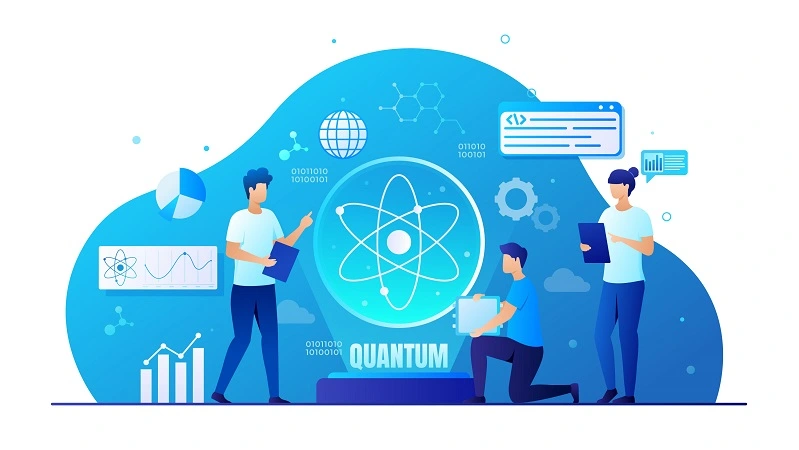
As quantum computing evolves, tools are also emerging that allow students and researchers to develop programs geared towards this new computational paradigm.
One of the best known is Qiskit.
Qiskit is an open-source framework developed by IBM that allows you to create, test, and run quantum algorithms.
Using the Python programming language, developers can assemble quantum circuits, perform simulations on conventional computers, and, in some cases, run their programs on real quantum computers provided by IBM itself through the cloud.
Thanks to its extensive documentation and large user community, Qiskit has become one of the leading tools for those wishing to begin studying quantum computing.
For this reason, it is frequently used in universities, research centers, and companies that work with technological innovation.
What does NISQ mean?
Another very common term when talking about quantum computing is NISQ, an acronym for Noisy Intermediate-Scale Quantum.
This concept describes the current generation of quantum computers.
The equipment available today has some important limitations:
- small number of qubits;
- sensitivity to external interference;
- Frequent occurrence of errors during processing;
- difficulty in maintaining quantum states for long periods.
Despite these limitations, NISQ-era computers already allow for testing algorithms, developing new applications, and conducting research that helps pave the way for more robust machines in the future.
In other words, we are living through a phase similar to the early years of classical computing: the equipment has not yet reached its full potential, but it is already driving important scientific advances.
What are the challenges of quantum computing?
Despite its enormous potential, quantum computing still faces several technological challenges.
Among them are:
- Reduce the error rate during calculations;
- increase the number of available qubits;
- Develop efficient error correction techniques;
- to keep the qubits stable for longer;
- to build equipment capable of operating on a large scale.
Furthermore, many quantum computers need to operate at temperatures close to absolute zero, utilizing advanced cooling systems.
These factors make the development of this technology extremely complex and require continuous investment in research.
Even so, the advances seen in recent years show that quantum computing is evolving rapidly and is likely to play an increasingly important role in the coming decades.
Quantum computing and the job market
With the growth of investments in technology, the demand for professionals capable of understanding concepts related to quantum computing is expected to increase.
Although it is still a highly specialized field, technology companies, financial institutions, research laboratories, and universities are already seeking professionals with knowledge in programming, mathematics, physics, artificial intelligence, and data science.
More than mastering all the concepts of quantum mechanics, it is important to develop a solid foundation in logic, algorithms, programming, and problem-solving. These skills remain fundamental for those who wish to keep up with the transformations in the technology sector and take advantage of the opportunities that will arise in the coming years.
Quantum computing at ESEG College
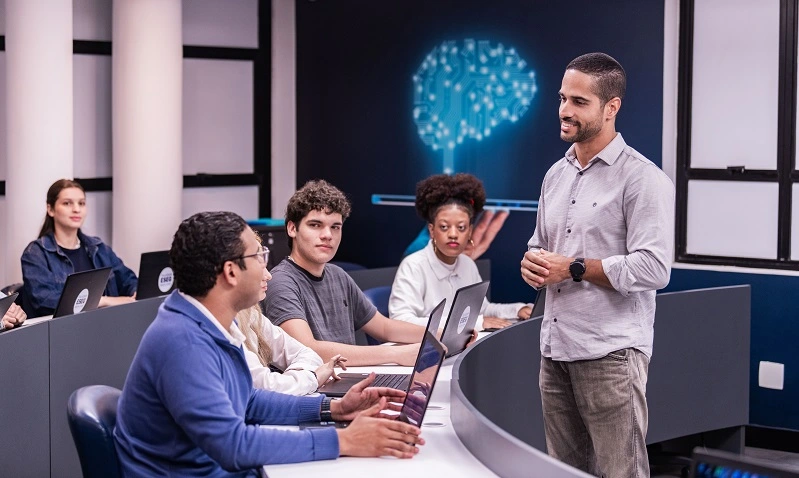
Quantum computing brings together knowledge from diverse areas such as mathematics, physics, programming, artificial intelligence, and data science. Therefore, professionals who wish to work in this market need a solid and multidisciplinary education.
At ESEG College, the Computer Engineering course It prepares students to keep up with the main technological trends.
The degree program includes courses focused on programming, Python, Data Science, Big Data, Artificial Intelligence, Internet of Things (IoT), software development and automation, as well as entrepreneurship projects that encourage innovation.
Students also have access to the Career Development Center, individualized support, English in the curriculum, and international partnerships—differentiating factors that contribute to an education aligned with the demands of the technology market.
This knowledge creates an important foundation for those who wish to understand emerging technologies, such as quantum computing, and follow their evolution in the coming years.
Frequently asked questions about quantum computing
What is quantum computing?
It is a computing model based on the principles of quantum mechanics, using qubits to solve certain problems more efficiently than conventional computers.
Will quantum computers replace traditional computers?
No. The two technologies have different purposes. Classical computers will continue to be the best option for everyday tasks, while quantum computers will be used for highly complex problems.
What is a qubit?
The qubit is the basic unit of information in quantum computing. Unlike the traditional bit, it can exploit properties such as superposition and entanglement.
What is Qiskit?
Qiskit is an open-source framework developed by IBM for creating and running quantum algorithms using Python.
Is quantum computing already in use today?
Yes. Although still in the development phase, universities, research centers, and large companies are already using experimental quantum computers to develop algorithms and study applications in various fields.