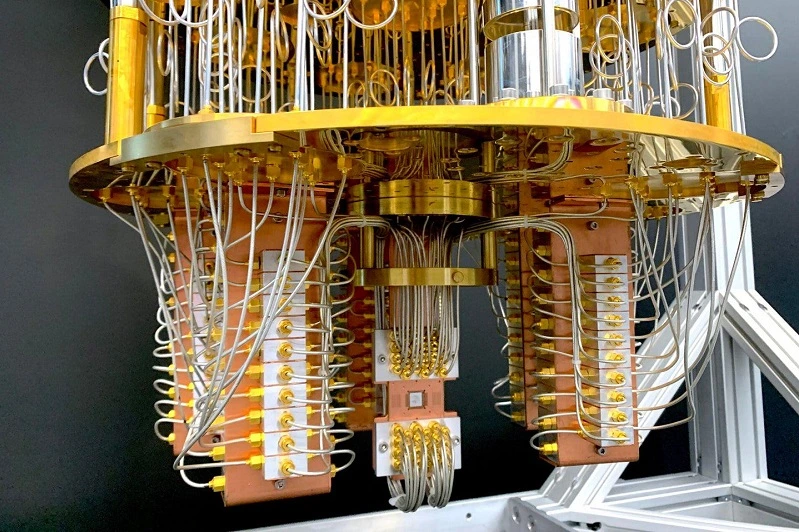





When we hear about quantum computing, one of the first concepts that comes up is... quantum superposition. She is often cited as one of the main reasons why quantum computers can solve certain problems much more efficiently than traditional computers.
Although it may seem like an extremely complex topic, the idea behind superposition can be understood using some basic concepts from Physics and Computer Science.
Understanding this phenomenon is essential for anyone who wants to learn more about how quantum computers work and follow one of the most promising areas of technology.
In this article, you will discover what quantum superposition is, how it works, and its relationship to... qubits, Why is it so important for quantum computing and how does it connect to other phenomena, such as... quantum entanglement and the wave function collapse.
Keep reading and learn more about this topic!
What is quantum superposition?
Quantum superposition is one of the fundamental principles of quantum mechanics.
It describes the ability of very small particles, such as electrons and photons, to exist in a combination of different states at the same time until they are measured.
Although this statement may seem strange at first glance, it has been confirmed by numerous experiments conducted over the last century and represents one of the foundations of modern physics.
In quantum computing, this property is utilized through qubits, which can explore different combinations of states during information processing.
It is precisely this characteristic that differentiates a quantum computer from a conventional computer.
An example to understand superposition.
Since quantum phenomena are not part of our everyday experience, it is common to use analogies to facilitate understanding.
Imagine a musician tuning a guitar before a show.
As he adjusts each string, there are several possible frequencies until the ideal tuning is reached. Only after completing the adjustment does each string assume its final frequency.
Superposition works similarly, but only as an analogy: during processing, the qubit can represent a combination of possibilities. When the measurement occurs, only one result is obtained.
It's important to remember that this comparison serves only to illustrate the general idea. The behavior of a qubit is described by the laws of quantum mechanics and does not have a perfect equivalent in the macroscopic world.
How did this concept come about?
At the beginning of the 20th century, scientists realized that the behavior of microscopic particles was very different from that observed in the everyday world.
While ordinary objects follow the laws of classical physics, subatomic particles exhibit probabilistic behaviors that defy our intuition.
It was in this context that quantum mechanics was born, a theory that revolutionized the way we understand the universe.
Several physicists contributed to this development, demonstrating that particles can be described by mathematical functions that represent different possibilities before a measurement.
From this understanding arose the concept of quantum superposition.
How does quantum superposition work?
Imagine a light switch.
In traditional computing, it has only two possible positions:
- connected;
- Off.
Computer bits work in a similar way: each bit represents only one value, 0 or 1.
A qubit can remain in a combination of these states during processing.
It is important to emphasize that this does not mean it is literally "0 and 1 at the same time" in the everyday sense of the expression. The qubit's state is described by a combination of probabilities, allowing quantum algorithms to explore different possibilities before measurement.
This characteristic is precisely what makes quantum computing so powerful for certain types of problems.
What is the difference between a bit and a qubit?
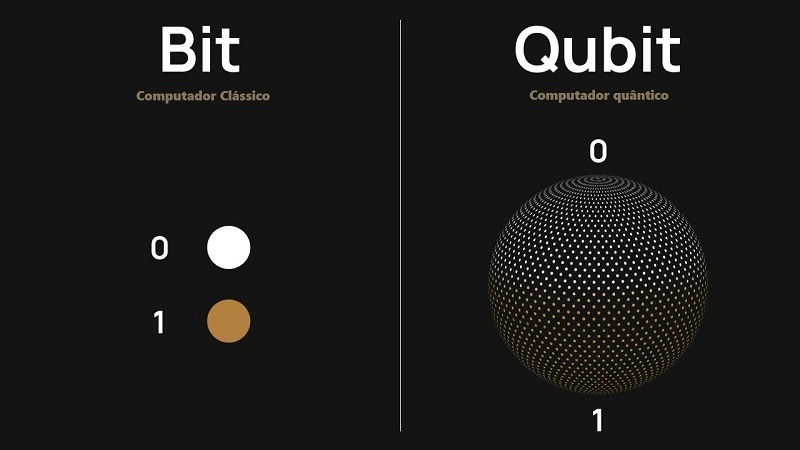
This is one of the most common questions for those starting to study quantum computing.
A bit is the smallest unit of information in classical computing and can only take on two values: 0 or 1.
The qubit, on the other hand, utilizes principles of quantum mechanics and can remain in superposition, representing a combination of these states during processing.
This does not mean that a single qubit replaces thousands of bits. In practice, the performance gain depends on the algorithm used and the nature of the problem.
Nevertheless, the use of qubits allows for the construction of algorithms capable of exploring possibilities much more efficiently in specific situations.
How does superposition help quantum computers?
The main advantage of superposition is that it allows quantum algorithms to handle a much larger set of possibilities during a computation.
Imagine a problem with countless possible combinations, such as finding the best route for a fleet of vehicles or simulating the behavior of a complex molecule.
On a conventional computer, these possibilities typically need to be analyzed sequentially or with limited parallelism.
A quantum computer uses the superposition of qubits to represent various possibilities throughout the execution of the algorithm, making certain calculations significantly more efficient.
This doesn't completely eliminate computational work, but it paves the way for solving problems that would be extremely difficult using only classical computers.
What is wave function collapse?
When studying quantum superposition, one concept appears quite frequently: the wave function collapse.
Although the name may seem complicated, the central idea can be understood in a simple way.
While a qubit is in superposition, its state is mathematically described by a wave function, which represents all the possibilities it can assume, each with a given probability.
At the moment a measurement occurs, this superposition ceases to exist, and the qubit then presents only one observed result, such as 0 or 1.
This process is called wave function collapse.
It is important to emphasize that this phenomenon does not mean that the observer "creates" reality. In quantum mechanics, there are different interpretations of what actually happens during a measurement, and this remains one of the most debated topics in modern physics.
In quantum computing, the most important thing is to understand that algorithms exploit superposition during processing and, at the end of execution, the measurement produces a result that can be used to solve a problem.
What is the relationship between superposition and quantum entanglement?

Although they are often cited together, quantum superposition e quantum entanglement They represent different phenomena.
Superposition describes the ability of a qubit to exist in a combination of states prior to measurement.
Entanglement occurs when two or more qubits share a very strong quantum correlation. In this situation, the state of one qubit is related to the state of the others, allowing them to act in a coordinated manner during the execution of an algorithm.
In other words, superposition allows each qubit to explore different possibilities, while entanglement connects these qubits to perform more complex operations.
It is precisely the combination of these two phenomena that makes quantum computing so different from classical computing.
Why is overlapping so important?
Without quantum superposition, quantum computers would be very similar to traditional computers.
This property allows the development of algorithms capable of solving certain problems much more efficiently.
It also paves the way for applications in various areas, such as:
- Molecular simulation for drug development;
- Optimization of logistics routes;
- artificial intelligence;
- discovery of new materials;
- scientific research;
- Finance and risk analysis;
- information security.
Although many of these uses are still in the research phase, the advances seen in recent years show that quantum computing can profoundly transform various sectors of the economy.
The challenges of quantum superposition
Maintaining a qubit in superposition is not a simple task.
Quantum states are extremely sensitive to their environment. Small interferences, such as vibrations, heat, or electromagnetic fields, can cause the superposition to be lost before the calculations are complete.
This phenomenon is known as quantum decoherence and represents one of the greatest challenges in current quantum computing.
Therefore, many quantum computers operate at temperatures close to absolute zero and use highly sophisticated systems to protect their qubits from external interference.
Overcoming these limitations is one of the main goals of research being conducted by universities and technology companies worldwide.
Read also: From the Turing Machine to Quantum Computing: how computing has evolved over the decades.
Quantum superposition and the future of technology
As technology evolves, quantum superposition is no longer just a concept studied in laboratories, but is becoming integrated into projects with the potential to impact different areas of knowledge.
Companies in the technology, healthcare, logistics, energy, and financial markets are already investigating ways to apply quantum algorithms to problems that require enormous processing power.
Although quantum computers still face technical limitations, understanding concepts like superposition will become increasingly important for professionals who want to keep up with the next generation of computing.
Read also: ESEG student develops final project on quantum computing in Production Engineering.
Quantum superposition at ESEG College

Understanding emerging technologies requires a solid background in mathematics, programming, and engineering.
In ESEG College, the Computer Engineering course It prepares students to deal with current and future technological challenges.
The degree program combines subjects such as programming, Python, Artificial Intelligence, Internet of Things (IoT), Data Science, Big Data, and Software Engineering, in addition to encouraging innovation and entrepreneurship projects.
This multidisciplinary training allows one to develop the logical reasoning and analytical skills necessary to keep up with constantly evolving fields, such as quantum computing.
Frequently asked questions about quantum superposition
What is quantum superposition?
It is a principle of quantum mechanics that allows particles, such as qubits, to be described by a combination of different states before a measurement is made.
Does superposition mean that a qubit is both 0 and 1 at the same time?
Not exactly. That's a simplification often used to introduce the concept. In reality, the state of a qubit is mathematically represented by a combination of probabilities that only produces a defined result when a measurement occurs.
What is the difference between overlapping and entanglement?
Superposition describes the possible states of a qubit. Entanglement establishes a quantum correlation between two or more qubits, allowing them to act in a coordinated manner during certain calculations.
What is wave function collapse?
It is the process by which superposition ceases to exist when a measurement is taken, causing only one of the possible results to be observed.
Is overlapping already in use today?
Yes. It is part of the operation of experimental quantum computers used by universities, research centers, and companies that develop this technology.