



Computers have profoundly transformed society in recent decades. Today, they are present in virtually every area of our lives, from smartphones to banking systems, scientific research, and artificial intelligence.
However, as technological challenges increase, so does the need for computers capable of solving problems that go beyond the limits of traditional computing.
It is precisely in this context that the quantum computer emerges. Unlike conventional computers, it uses principles of quantum mechanics to process information in a completely different way, offering new possibilities for extremely complex calculations.
Although this technology is still under development, companies like IBM, Google, Microsoft, Intel, and Amazon are investing billions of dollars in research to make quantum computers increasingly efficient.
In this article, you will understand What is a quantum computer?, How does it work, what is the role of qubits, what do terms like mean? IBM Quantum, Qiskit and NISQ, In addition to understanding the challenges and prospects of this technology.
So, keep reading to find out more!
What is a quantum computer?
A quantum computer is a device developed to perform certain types of calculations using the laws of quantum mechanics.
While a traditional computer works with bits, which only take the values 0 or 1, A quantum computer uses qubits., units of information capable of exploiting quantum properties during processing.
This allows some algorithms to solve problems much faster than would be possible using only classical computers.
It is important to emphasize that quantum computers were not created to replace conventional laptops, desktops, or servers.
In practice, it will be used as a complementary technology, primarily intended for solving extremely complex scientific, mathematical, and industrial problems.
How did quantum computing come about?
The idea of using quantum phenomena to perform calculations emerged in the 1980s.
Researchers realized that certain problems were so complex that they could take thousands or millions of years for traditional computers to solve.
Among them are:
- chemical simulations;
- discovery of new materials;
- logistics optimization;
- molecular modeling;
- cryptography;
- artificial intelligence.
It was then that scientists began to investigate how the properties of quantum mechanics could be used to create a new model of computing.
Decades later, universities and companies began building the first experimental quantum computers, initiating a technological race that continues to this day.
Read also: From the Turing Machine to Quantum Computing: how computing has evolved over the decades.
How does a quantum computer work?
Although its architecture is quite different from that used in traditional computers, the objective remains the same: to process information.
The difference lies in how this data is represented.
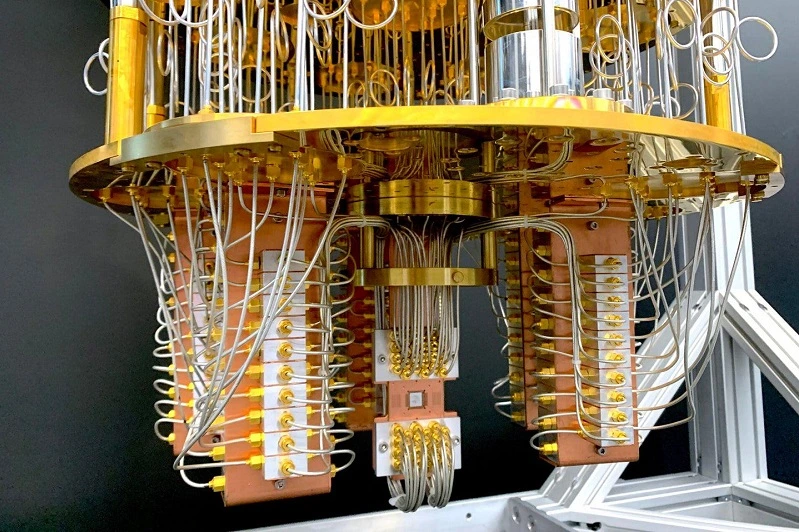
While a conventional computer uses billions of transistors to manipulate bits, a quantum computer works with extremely delicate physical systems, such as superconducting circuits, trapped ions, or photons.
These systems store information in qubits, allowing them to explore quantum mechanical phenomena during calculations.
To maintain these stable states, many quantum computers need to operate at temperatures close to absolute zero, using sophisticated cooling systems.
This is one of the reasons why they are still extremely expensive and complex pieces of equipment.
What is a qubit?
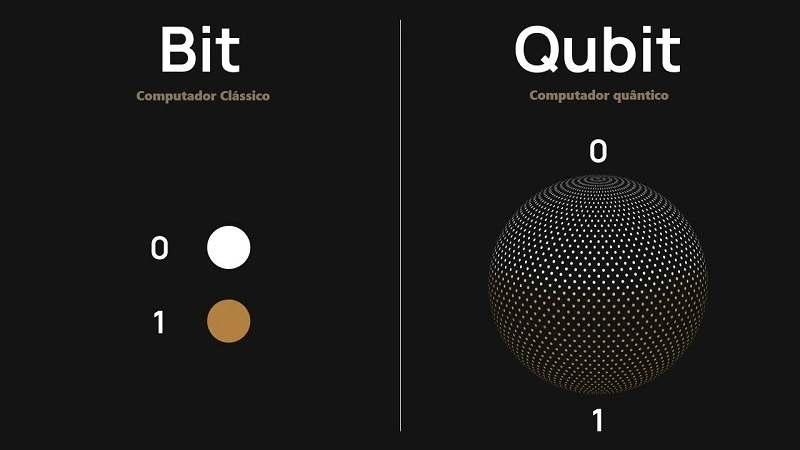
The qubit, or quantum bit, is the smallest unit of information in quantum computing.
It plays a similar role to the bit in classical computing, but it has properties that make it possible to perform much more sophisticated calculations.
While a bit can only assume two values, a qubit can explore different states during the execution of an algorithm.
Furthermore, multiple qubits can interact with each other through quantum phenomena, significantly increasing processing capacity for certain types of problems.
However, working with qubits is also a huge challenge.
They are extremely sensitive to the environment, and even small interferences can cause errors during calculations.
Therefore, much of the current research seeks to develop more stable and reliable qubits.
Is a quantum computer faster than a traditional computer?
This is one of the most common questions about the topic.
The answer is: it depends.
For common tasks, such as browsing the internet, editing documents, watching videos, or using applications, a conventional computer will continue to be the best option.
For extremely complex problems, involving millions or billions of possible combinations, a quantum computer can offer a significant advantage when using appropriate algorithms.
In other words, it's not just about speed, but about how the problem is solved.
It is precisely this difference that makes quantum computing so promising for areas such as scientific research, artificial intelligence, and process optimization.
Which companies already have quantum computers?
In recent years, several companies have begun investing heavily in this technology.
Among them is IBM, considered one of the pioneers in the development of quantum computers accessible to researchers and students.
The company makes some of its equipment available online through the platform. IBM Quantum, allowing users worldwide to run real-world experiments using quantum computers.
This initiative has helped to democratize access to technology and accelerate research in universities and innovation centers.
Besides IBM, other companies are also developing quantum computers, using different technological approaches to build their qubits.
These investments demonstrate that quantum computing has ceased to be merely a scientific theory and has become an important strategic area for the future of technology.
What is Qiskit?
To program a quantum computer, it is necessary to use specific tools capable of representing quantum operations and controlling qubits.
One of the most commonly used today is the Qiskit, a framework Open-source software developed by IBM.
Based on the Python programming language, Qiskit allows users to create quantum circuits, simulate algorithms on conventional computers, and run programs directly on quantum computers provided by IBM Quantum.
This combination of features has made the tool one of the main gateways for students interested in quantum computing.
Even those who have never had contact with a quantum computer can begin by learning the basic concepts through simulations and, later, test their algorithms on real equipment.
Another distinguishing feature of Qiskit is its active community. Developers, researchers, and teachers share examples, libraries, and study materials, making learning more accessible and collaborative.
What does NISQ mean?
When researching quantum computers, it's quite common to come across the acronym NISQ, which stands for Noisy Intermediate-Scale Quantum. This term was coined to describe the current generation of quantum computers.
The equipment available today can already run relatively complex algorithms, but it still has significant limitations.
NISQ-era systems allow for the validation of algorithms, the development of new programming techniques, and the testing of applications that could be used in more robust quantum computers in the future.
In other words, this phase represents an important transition period between the first prototypes and future machines capable of solving even more complex problems.
Where are quantum computers already being used?
Although not yet part of people's daily lives, quantum computers are already being used in research and experimental projects in different sectors.
Among the main applications are:
Quantum computers in the discovery of new drugs.
Simulating the behavior of molecules is one of the greatest challenges in traditional computing.
Quantum computers can help accelerate this process, allowing researchers to test new chemical combinations and develop drugs more efficiently.
Quantum computing in the development of new materials
Companies in the chemical and technology industries are studying materials that are more resistant, lightweight, and efficient.
Quantum computing can facilitate simulations involving extremely complex atomic structures, reducing the time required for this research.
Quantum computing in logistics
Routing, load distribution, and inventory optimization problems involve a huge number of possible combinations.
Quantum computers have the potential to find more efficient solutions, reducing operational costs in transportation and logistics companies.
Quantum computing in the financial market
Financial institutions use complex mathematical models to analyze risks, predict economic scenarios, and optimize investments.
Quantum computing could make these analyses even more sophisticated, especially in situations involving thousands of variables.
Quantum computing in artificial intelligence.
Another promising field is artificial intelligence.
Researchers are studying how quantum algorithms can accelerate certain stages of machine learning model training, contributing to more efficient solutions in the future.
What are the main challenges for quantum computers?
Despite the progress seen in recent years, there are still significant obstacles preventing quantum computers from being used on a large scale.
Among the main challenges are:
Error correction
Qubits are extremely sensitive to their environment.
Any interference can cause changes in their states, compromising the calculations performed.
Therefore, researchers are continuously working on developing error correction techniques capable of making quantum computers more reliable.
Scalability
Another major challenge is increasing the number of available qubits without compromising their stability.
The greater the number of qubits functioning correctly, the greater the computer's ability tends to be to solve complex problems.
Infrastructure
Many quantum computers need to operate at temperatures close to absolute zero.
This requires sophisticated refrigeration equipment and carefully controlled environments, making its construction extremely expensive.
As new technologies are developed, these systems are expected to become more efficient, accessible, and scalable.
Will quantum computers replace traditional computers?

Probably not.
Traditional computers remain far more efficient for everyday tasks, such as editing texts, accessing social networks, browsing the internet, or using corporate applications.
Quantum computers, on the other hand, were designed to solve specific problems that require enormous mathematical processing power.
In practice, the two technologies should coexist.
In many situations, a traditional computer can perform most of the processing, while a quantum computer will only be used to solve extremely complex steps of a given problem.
This integration is considered the most likely scenario for the coming years.
Quantum computing and the job market
The advancement of quantum computing also creates new opportunities for professionals in the technology field.
Companies, universities, and research centers are seeking specialists in programming, mathematics, engineering, physics, and data science capable of developing algorithms and applications geared towards this new generation of computers.
Furthermore, professionals who are proficient in languages like Python and tools like Qiskit tend to find an expanding market as the technology matures.
Although it is still a highly specialized niche, understanding the fundamentals of quantum computing can represent an important advantage for those who wish to build a career focused on innovation.
Quantum computers and Computer Engineering at ESEG
The evolution of quantum computers shows that the future of technology will increasingly depend on professionals capable of integrating knowledge of programming, mathematics, engineering, and data science.
In ESEG College, the Computer Engineering course It offers training aligned with market demands, preparing students to develop innovative solutions using technologies such as Python, Artificial Intelligence, Internet of Things (IoT), Data Science, Big Data, and Software Engineering.
In addition to technical training, students benefit from practical projects, encouragement of entrepreneurship, a Career Development Center, and constant contact with real-world market challenges, developing essential skills to keep up with the evolution of computing and emerging technologies.
Frequently asked questions about quantum computing
What is a quantum computer?
It is a computer that uses principles of quantum mechanics to process information through qubits, allowing it to solve certain problems more efficiently than conventional computers.
Will quantum computers replace traditional computers?
No. The two technologies have different purposes and should work in a complementary way.
What is a qubit?
The qubit is the basic unit of information in quantum computing and uses quantum properties to represent states during processing.
What is IBM Quantum?
It is IBM's platform that provides quantum computers via the cloud for students, researchers, and companies to develop experiments and applications.
What is Qiskit?
It is an open-source framework developed by IBM for creating, simulating, and executing quantum algorithms using the Python programming language.
What does NISQ mean?
NISQ stands for Noisy Intermediate-Scale Quantum and describes the current generation of quantum computers, which still have limitations such as noise, errors, and a reduced number of qubits.