



Few technologies have transformed society as much as computing. In less than a century, we have gone from machines capable of performing simple calculations to computers present in virtually every aspect of daily life.
Today, they assist in everything from scientific research and medical diagnoses to financial transactions, artificial intelligence, and space exploration.
This evolution, however, did not happen suddenly. It was built through mathematical discoveries, advances in engineering, and technological innovations that continually redefined the limits of information processing.
Among the most important milestones in this journey are... Turing Machine, which laid the foundations of modern Computer Science, and the Moore's Law, responsible for describing the extraordinary growth of computing power over the last few decades.
Now, a new chapter is beginning to be written with quantum computing, a technology that promises to tackle challenges considered virtually impossible for conventional computers.
In this article, you will learn about the history of computing, understand how it has evolved from early theoretical models to today's quantum computers, and discover why many researchers believe we are entering a new technological era.
Before computers: when calculating was a human task.
Long before the advent of computers, performing calculations was a slow and laborious task.
Complex mathematical operations were performed manually, using tables, slide rules, and mechanical machines. In large scientific and military projects, entire teams were responsible solely for performing calculations.
Interestingly, the term "computer" did not always refer to a machine.
For many years, this word was used to describe people whose job consisted precisely of performing mathematical calculations.
With the growth of science and industry in the early 20th century, the need to automate this process became evident.
It was in this context that the first ideas emerged that would give rise to modern computers, such as the quantum computer.
The Turing Machine and the birth of modern computing.
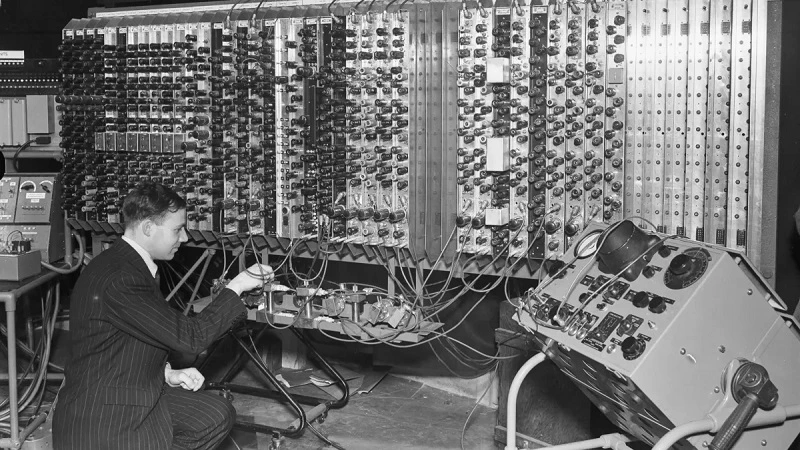
In 1936, British mathematician Alan Turing published a paper that would definitively change the history of computing.
In it, he presented a theoretical model known as the Turing Machine.
Although it was never physically built in the way it was described, this machine demonstrated that any computable problem could be solved through an organized sequence of instructions.
The Turing Machine consisted of three main elements:
- a potentially infinite tape divided into positions;
- a head capable of reading and writing symbols;
- a set of rules that determined each action of the machine.
Today this model may seem simple, but it represented a true revolution.
For the first time, there was a precise mathematical description of what it means to "execute an algorithm".
Many of the concepts currently used in programming, computer languages, and computer architecture have a direct origin in the ideas presented by Turing.
Therefore, he is considered one of the fathers of Computer Science.
World War II accelerated the evolution of computers.
A few years after the publication of Alan Turing's work, World War II significantly boosted the development of computing.
During the conflict, governments began investing in machines capable of performing complex calculations more quickly.
Alan Turing himself participated in teams responsible for developing methods to decipher encrypted codes used by German forces.
These studies demonstrated that computers could play a strategic role in situations requiring the rapid processing of large volumes of information.
After the war ended, the knowledge gained during that period served as the basis for the development of the first electronic computers.
From giant computers to personal computers.
The first generations of computers occupied entire rooms.
Equipment like ENIAC used thousands of electronic valves, consumed enormous amounts of energy, and required constant maintenance.
Despite these limitations, they represented a huge advance over calculations performed manually.
In the following decades, the replacement of vacuum tubes with transistors and, later, with integrated circuits, made it possible to reduce the size of equipment while increasing its processing capacity.
It was this evolution that made possible the emergence of personal computers, laptops, smartphones, and virtually all digital devices used today.
Computing ceased to be a tool exclusive to governments and universities and became part of the daily lives of millions of people around the world.
What is Moore's Law?
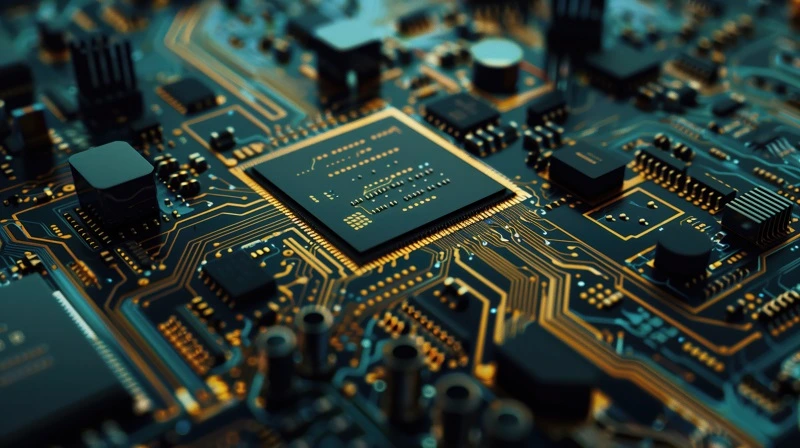
In 1965, engineer Gordon Moore observed a curious pattern in the evolution of integrated circuits.
He realized that the number of transistors on a chip had been doubling at relatively regular intervals, allowing computers to become faster, smaller, and cheaper over time.
This observation became known as Moore's Law.
Although not a law of physics, but rather a technological trend based on the evolution of the semiconductor industry, it has served for decades as a benchmark for the development of new processors and has profoundly influenced the advancement of computing.
How has Moore's Law driven the evolution of computing?
For many years, processor manufacturers have developed new generations of chips following the pace predicted by Moore's Law.
With the increase in the number of transistors in a single integrated circuit, computers have been able to offer greater processing capacity, consuming less energy and occupying less and less space.
This advancement allowed equipment previously restricted to laboratories and large companies to become accessible to the public, driving the emergence of personal computers, laptops, smartphones, and other devices that are part of everyday life.
Thanks to this continuous evolution, tasks that once required giant computers are now performed by devices that fit in the palm of your hand.
Is Moore's Law still valid?
For more than five decades, Moore's Law has served as a sort of guide for the technology industry.
As transistors became smaller, computers became faster, consumed less energy, and could run increasingly complex programs.
This advancement enabled the development of lighter laptops, more powerful smartphones, servers capable of processing enormous volumes of data, and systems that fueled the popularization of the internet, cloud computing, and artificial intelligence.
However, continuously reducing the size of transistors has become an increasingly greater challenge.
Today, the components in modern chips are only a few nanometers in size, approaching the scale at which quantum mechanical phenomena begin to influence their operation.
This means that the evolution of hardware no longer depends solely on the ability to manufacture smaller components. Issues related to heat dissipation, energy consumption, and the physical limitations of materials themselves have become significant obstacles to the continuation of this growth rate.
For this reason, many experts claim that Moore's Law is no longer evolving at the same rate observed in previous decades.
Although processors continue to become more efficient, much of the current gains come from new architectures, parallel processing, specialized chips for artificial intelligence, and other engineering strategies.
When traditional computers reach their limits.
Modern computers are extraordinarily powerful.
Even a smartphone has far superior processing power to that of the computers used to take humans to the moon in 1969.
Still, there are problems that remain extremely difficult for classical computing.
Among them are:
- simulations of the behavior of complex molecules;
- development of new materials;
- Optimization of large logistics networks;
- Prediction of chemical structures;
- certain encryption problems;
- some advanced artificial intelligence models.
The challenge lies not only in the processor speed, but in the sheer number of combinations that need to be analyzed.
In many cases, even using supercomputers, the time required to find a solution can be prohibitive.
It was precisely in the face of these limitations that researchers began to look for new computing models.
The emergence of quantum computing

In the 1980s, scientists like Richard Feynman and David Deutsch proposed a groundbreaking idea: instead of trying to build ever faster traditional computers, why not use the laws of quantum mechanics themselves to process information?
This proposal gave rise to the field of quantum computing.
Instead of using only bits, capable of representing the values 0 or 1, quantum computers work with qubits, exploiting properties of quantum mechanics to solve certain types of problems.
This change represents a new computational paradigm.
Just as the Turing Machine redefined the concept of algorithms and Moore's Law propelled the growth of classical computing, quantum computing ushers in a new stage in the quest for greater processing power.
Will quantum computing replace traditional computing?
A very common misconception is that quantum computers will completely replace conventional computers.
In practice, this scenario is unlikely.
Traditional computing will continue to be indispensable for everyday activities such as browsing the internet, using applications, editing documents, playing games, or watching videos.
Quantum computers, on the other hand, are expected to be used for very specific tasks, especially those involving extremely complex mathematical and scientific problems.
Instead of competing, the two technologies tend to act in a complementary way.
This integration will allow us to leverage the best of each approach to solve challenges that require different types of processing.
The future of computing
Looking at the trajectory of computing, it becomes clear that its evolution has always occurred through major transformations.
First came the theoretical models, such as the Turing Machine.
Then came electronic computers, followed by transistors, integrated circuits, personal computers, the internet, smartphones, cloud computing, and artificial intelligence.
Now, quantum computing is emerging as one of the technologies with the greatest potential to drive the next big revolution.
Although challenges related to the stability of still exist qubits, With advancements in error correction and the increased capacity of quantum computers, investments made by universities, companies, and governments show that this field will continue to evolve in the coming years.
Regardless of how quickly these changes occur, understanding this historical trajectory helps to understand why computing remains one of the most dynamic areas of science and engineering.
From theory to innovation: the role of training in Computer Engineering.
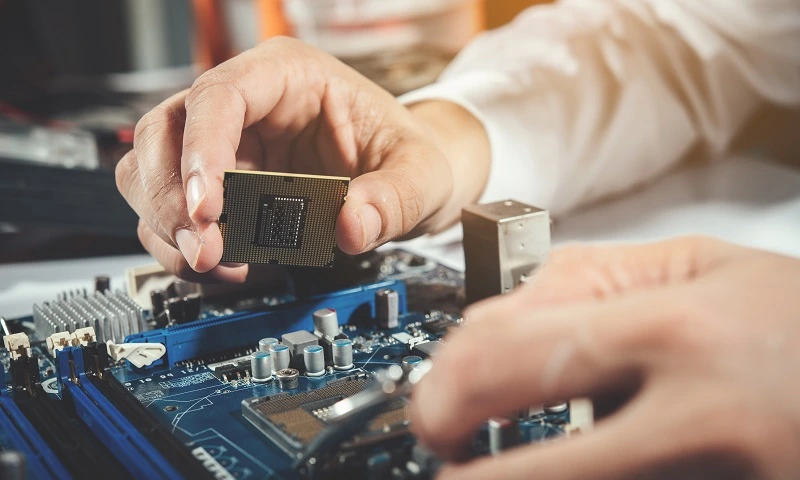
The history of computing demonstrates that great technological advances have arisen from the combination of scientific knowledge, innovation capacity, and problem-solving abilities.
To keep up with this evolution, it is essential to develop a solid foundation in programming, mathematics, electronics, computer architecture, and software engineering.
In ESEG College, the Computer Engineering course This program prepares students to work in a constantly transforming market. The degree brings together subjects focused on programming, Python, Artificial Intelligence, Internet of Things (IoT), Data Science, Big Data, and software development, encouraging the creation of innovative solutions for real-world challenges.
With a multidisciplinary education connected to technological trends, students develop skills that help them keep up with everything from the fundamentals of classical computing to emerging technologies such as quantum computing.
Frequently asked questions about the history of computing.
What is a Turing Machine?
The Turing Machine is a theoretical model created by mathematician Alan Turing in 1936. It demonstrated that computable problems can be solved through an organized sequence of instructions, becoming one of the foundations of Computer Science.
What is Moore's Law?
Moore's Law is an observation made by Gordon Moore in 1965. It indicated that the number of transistors on a chip would periodically double, increasing computer performance and reducing their costs over time.
Is Moore's Law still valid?
Although computers continue to evolve, the pace originally predicted by Moore's Law has slowed due to the physical challenges related to the miniaturization of transistors.
How did quantum computing emerge?
Quantum computing emerged in the 1980s, when researchers proposed using principles of quantum mechanics to develop a new way of processing information.
Will quantum computing replace current computers?
No. Quantum computers should act in a complementary way to traditional computers, being used mainly in highly complex scientific and mathematical problems.