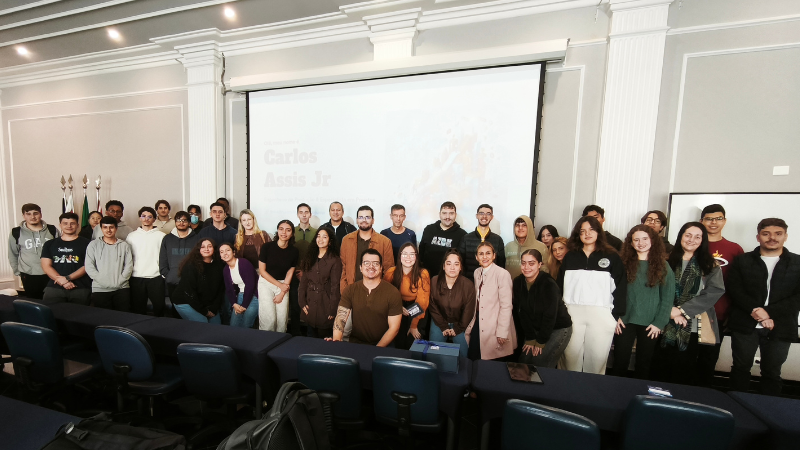
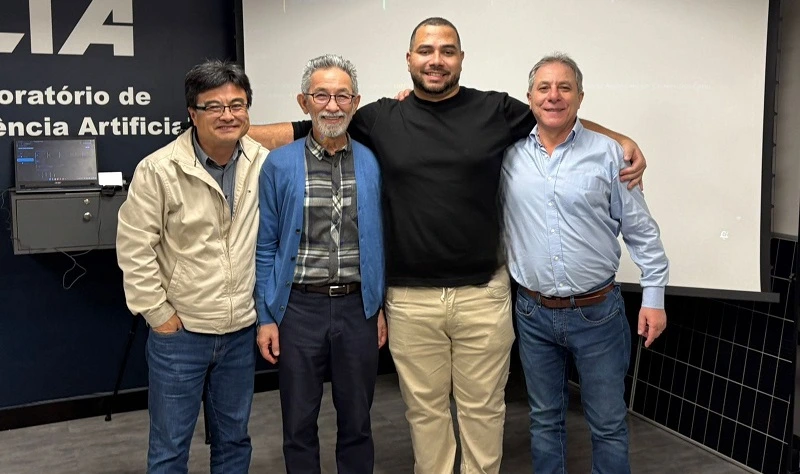
A topic considered one of the main frontiers of global technology was the focus of the Final Course Project (TCC) by Felipe Vieira Baptista, a student of Production Engineering at ESEG.
Developed over approximately three semesters in the institution's Development Centers, the project addressed the application of Quantum Computing in Production Engineering and was evaluated with the highest possible score in all criteria by the examining board.
The research began as an undergraduate research project and matured throughout the course, allowing the student to delve deeper into an area that is still relatively unexplored at the undergraduate level.
According to Felipe, the idea arose after watching a news report about Quantum Computing and realizing its potential to solve classic problems in Production Engineering.
“In the news report, they mentioned that the Traveling Salesman Problem, a classic problem in Production Engineering, could be solved by this technology. That caught my attention and sparked my curiosity to understand how this would be possible,” Felipe recalled.
Despite initial interest, the student says the topic wasn't his first choice for his final thesis.
“"My intention was not just to do a final project to complete the course. I wanted to develop an innovative work that could serve as a reference for other students who are also unfamiliar with Quantum Computing," he stated.
According to Professor João Chang Junior, coordinator of the Development Centers and supervisor of the research, the project evolved gradually during Felipe's stay at the Centers.
“The project began when Felipe joined the ESEG Development Centers with the intention of carrying out a Scientific Initiation project. From the start, he demonstrated an interest in developing something truly innovative that went beyond the traditional themes of Production Engineering,” the professor highlighted.
For Chang, one of the distinguishing features of the work is precisely the time dedicated to research development. This perception is shared by Felipe, who emphasizes the importance of this period for deepening studies in a topic that is still little explored at the undergraduate level.
“If I had only started in the last semester to work on my thesis, I would hardly have been able to study such a new topic with the depth it requires. In the research groups, I was able to research, discuss ideas with Professor Chang, change course when necessary, and arrive at my thesis with a much more solid foundation.”
Felipe also highlighted the importance of Professor João Chang's guidance throughout the project's development.
“"Professor Chang was fundamental in keeping the research focused. Quantum computing has a huge risk of becoming pure theory, and he always brought me back to Production Engineering, to what really made sense within the course and to what an engineer needs to understand," he concluded.
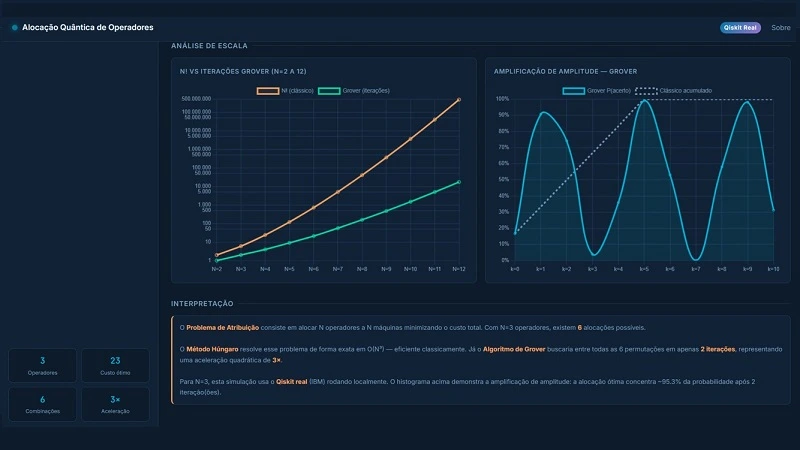
In addition to the theoretical review, Felipe developed a web application integrated with Qiskit, IBM's Quantum Computing framework, which simulates the operation of Grover's Algorithm, one of the best-known algorithms in the field.
The tool was created to facilitate the understanding of concepts that are normally presented in a rather abstract way and to complement the content developed in the thesis.
“The idea for the application arose precisely to materialize some of the concepts presented in the work and bring the reader closer to the technology. My intention was to develop material designed for Production Engineering students, showing the concepts in a more accessible way and applied to our field. It was not developed as a product or a ready-made solution, but as a way to bring the reader closer to the technology and make the demonstration more concrete,” explained Felipe.
According to the student, the choice of Grover's Algorithm was precisely due to its didactic potential, allowing for an intuitive demonstration of how a quantum computer can find more efficient solutions to certain types of problems.
Although still in its development phase, Quantum Computing has the potential to transform various areas of Production Engineering, especially those related to process optimization.
Applications include problems in logistics, route planning, production scheduling, resource allocation, inventory management, and operations research.
According to Professor João Chang, this is one of the reasons that makes the research relevant.
“The work is not limited to a literature review. Felipe developed a web application that allows students to visually understand extremely complex concepts. Furthermore, the project has scientific continuity. Our next step will be to run the algorithm on a real IBM quantum computer and compare the results with the simulation developed. This transforms the undergraduate thesis into a research project with the potential for international publication,” he stated.
Even after the thesis is completed, the research will continue.
The next step involves running the experiments on an IBM quantum computer to compare the results obtained in the simulations with those produced by real quantum hardware.
According to Felipe, this step will allow for a better understanding of the differences between the simulated environment and a physical quantum computer, as well as providing support for new research and the preparation of a scientific article.
“This has always been a focus for me and Professor Chang. Now, with the work completed, we want to turn it into a scientific publication,” the student concluded.
For João Chang, the project represents more than just a graduation thesis.
“More than just producing an excellent undergraduate thesis, the project inaugurates a research line in Quantum Computing within the Production Engineering department of the institution. This work places ESEG in a technological area considered one of the frontiers of global computing. Our expectation is to expand this research line and contribute to strengthening the institution's scientific output,” declared the professor.
Reflecting on his journey, Felipe highlighted that the project reinforced the importance of curiosity and continuous learning, and offered advice to the students of... ESEG College.
“Today we have a lot of technology available and practically any subject can be learned if there is dedication. My advice is not to be afraid to choose a challenging topic. At first it may seem difficult, but it is very rewarding to realize how much you have evolved and to know that your work can contribute to other people,” concluded the graduate.
According to Professor Chang, research in Quantum Computing applied to Production Engineering is part of a set of projects developed in the ESEG Development Centers.
Currently, the institution also conducts research in areas such as Artificial Intelligence applied to healthcare, machine learning to support clinical decision-making, optimization of hospital processes using Lean Six Sigma, econometrics, data science, and Big Data.
“"ESEG offers students an environment where research begins long before the final thesis. The Development Centers allow students to work on Scientific Initiation projects for several semesters, significantly increasing the quality of research and opening opportunities for scientific publications," concluded the professor.
The work developed by Felipe reinforces ESEG's commitment to encouraging innovative projects that go beyond the limits of undergraduate studies, stimulating scientific production and bringing students closer to strategic themes for the future of Engineering.
A graduate in Production Engineering from ESEG, Felipe Vieira Baptista began his professional career in 2024, when he joined Unilever as an intern in the Finance area, where he remained for a year and a half.
According to the student, the preparation offered by ESEG was important for his success in the selection process.
“"During the selection process, I had the support of ESEG, especially Simone from Student Support, who prepared me for the interviews, and Professor Edgar Rodrigues, who was also very important in this achievement, guiding me through the technical stages of the process."”
Currently, Felipe works as an entrepreneur.
“"This experience has allowed me to put into practice a lot of knowledge from Production Engineering, mainly in the areas of management, processes and data analysis, in addition to showing another side of the profession." which also motivates me,” he concluded.