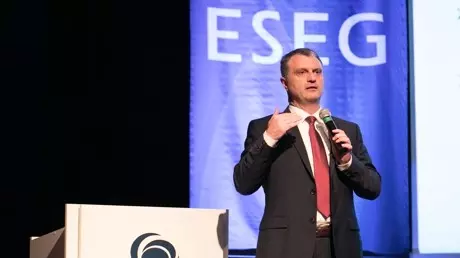
The second semester at the School of Engineering and Management (ESEG) began with a keynote lecture on August 7th, featuring a presentation on the challenges of global logistics by Douglas Tacla, Vice President of Logistics at Kuhne-Nagel.
One of the aspects highlighted by the guest speaker was the evolution of the term logistics, which previously only considered activities such as the transportation and storage of products. According to Douglas Tacla, this has changed, and logistics has come to be seen as the integration of transportation and distribution processes, and has expanded to include the planning of the various phases of a company's supply chain.
According to Douglas Tacla, logistics directly influences competitiveness, which is why the company with the best logistics system guarantees its products a place on the shelves. "If before the role of logistics was only to deliver the right product, to the right place and at the right time, now it needs to add value to the final product," he comments.
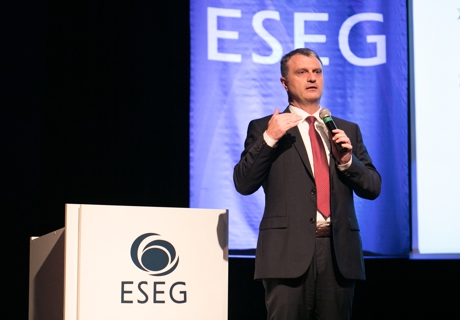
According to Douglas Tacla, the biggest challenges for large companies in terms of logistics are: maintaining standards in all markets in which they operate and determining which sectors of the production chain can be managed by logistics operators.
As an example, he cited the parts sequencing process at a car manufacturer, which is managed by a logistics company. In this case, the role of the logistics operator is to ensure the arrival of parts at each stage of the car production chain, preventing delays.
In the case of Brazil, logistics operators face a rather peculiar scenario compared to more developed countries due to infrastructure problems such as poor road conditions, an outdated truck fleet, large distances between major ports, among others.
“"Brazilian companies have extra expenses of R$ 17.1 billion annually because of this, and that same amount could be reinvested to solve the main problems affecting Brazilian logistics," says Tacla.
On the other hand, it is possible to offset these expenses with good supply chain management. “Logistics operators have the role of understanding the entire business chain of the company and proposing solutions to optimize transportation, warehousing, distribution processes, or any other relevant area. Therefore, logistics is an evolving area with great potential for improvement and growth,” concludes Tacla.