By Renata Heining
24/09/2026
Browse by topic
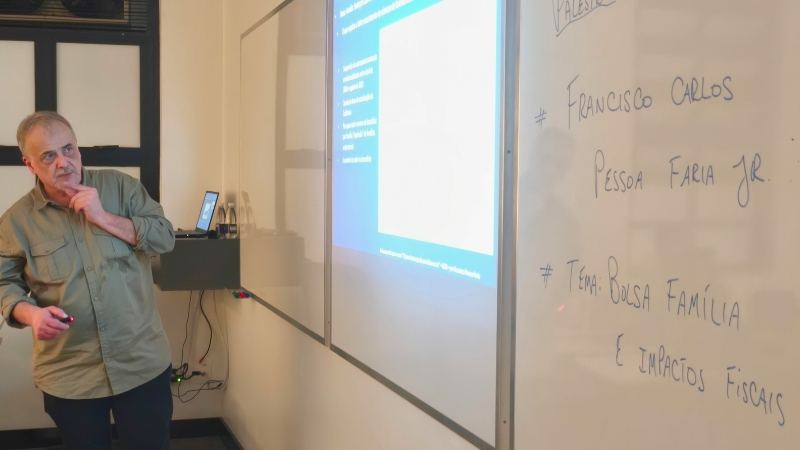
On September 21, 2026, ESEG College, part of the Etapa Group, received Francisco Carlos Pessoa Faria Jr., Master in Economics by the University of São Paulo (USP), partner at Logos Economia and associate researcher at FGV-IBRE, for a special class on the subject. “"Contemporary Topics in Economics".
The lecture, titled "An Introduction to the Bolsa Família Program and its Fiscal Impacts," is part of a series of lectures conducted by... Professor Robson Rodrigues to bring the discussion of current topics into the classroom.
With this theme, the aim was to present information, data, and different issues related to the program, encouraging students to analyze the topic from economic, social, and fiscal perspectives. Because it involved a public policy currently under national debate, the activity also provided an opportunity for questions and different viewpoints presented by the students.
Throughout the meeting, Francis emphasized that the intention was not to define a position on the program, but to offer elements so that participants could better understand its functioning and formulate their own analyses. According to the economist, contact with different information can contribute to each person developing a more informed opinion on a given subject.
“"Studying more may or may not change your opinion, but your opinion tends to be better informed," the guest stated.
During the lecture, the economist presented the main characteristics of the Bolsa Família program, addressing access criteria, eligibility rules, and the so-called conditionalities in the areas of health and education.
Currently, the program serves millions of families across the country. In September 2026, for example, payments reached 19.29 million families, according to data released by the Ministry of Social Development, Assistance, Family and Fight against Hunger (MDS).
Among the requirements are minimum school attendance for children and adolescents, compliance with the national vaccination schedule, and monitoring of the nutritional status of children under seven years of age.
Based on these mechanisms, Francisco presented the students with data and graphs related to the program's operation, the changes that occurred before and after the pandemic, and the entry and exit of...
beneficiaries.
The discussion also touched on issues frequently present in public debate, such as the criteria used to define who can receive the benefit, possible irregularities, the increase in the number of people in the program, and the relationship with informal employment.
Another point highlighted during the meeting was the relationship between Bolsa Família and different areas of the economy and the administration.
For Francisco, understanding the program can contribute to both economics training and... graduation eAdministration, since the topic involves issues such as income generation, employment, tax collection, consumption, and impacts on different regions and sectors of the economy.
“"While the macroeconomist is concerned with revenue, employment, and income levels, the administrator is thinking: who am I going to sell to? When am I going to sell? For how much can I sell? So, talking about Bolsa Família is completely related to both professions," he stated.
According to the speaker, the complexity of the topic is also related to the possibility of analyzing it from different perspectives.
“"It's a topic that involves political, social, economic, and even philosophical issues."”
The activity also included a discussion on public spending, fiscal impact, and primary expenditure. During the lecture, Francisco also mentioned the BPC (Continuous Benefit Payment) and lifetime monthly income among the topics that attract the attention of future economists.
Student participation was one of the highlights of the lecture. Throughout the meeting, students raised questions related to the growth in the number of beneficiaries, informality, employment, and the criteria used to determine who enters or remains in the program.
The questions also allowed for discussion of how different interpretations can arise from the same data and what factors need to be considered in the analysis of a public policy.
For Francisco, this process is part of the learning experience itself.
“I loved the questions. I always prepare for class, and I ended up learning a little more myself. You're always adding another brick to your knowledge,” Francisco concluded.
To Samira Corrêa de Abreu, 8th semester Business Administration student, The activity contributed to broadening the understanding of public policies and different perspectives related to the topic.
“"It clarified a lot about public policies. It brought graphs, analyses, and data so we can understand that not everything is just one side. Everything is a matter of perspective and choices, of what Brazil will need and be able to give up and choose so that we can have a better society," said the student.
Samira also highlighted the teaching methods used during the meeting and the way the content was presented. "I thought he was a great speaker, I loved his sense of humor, I loved how he put things in a way that we could understand in an uncomplicated way," said the student.
Already Henrique Santos, an 8th-semester Business Administration student, He highlighted the opportunity to discuss a complex topic using data. "He brought up such a relevant, yet controversial topic, with many opinions, but in a very clear way, with data," he emphasized.
For students, the lecture-style classes on Contemporary Topics in Economics complement their academic training by connecting the content studied throughout their undergraduate studies with current societal discussions.
The lecture reinforces the proposal of ESEG College to promote spaces for discussion on current topics, bringing students closer to professionals and experts and encouraging the analysis of different issues based on academic knowledge, data and professional experiences.

Stay informed about relevant topics and what's happening at ESEG College.
Your data is safe.
Unavailable
Institutional
Infrastructure
Entry methods
Relationship
Key differentiators
We use cookies to improve your browsing experience.