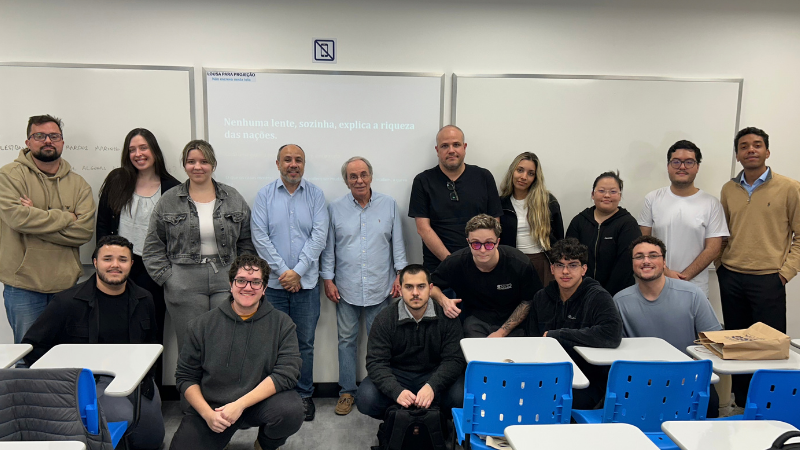
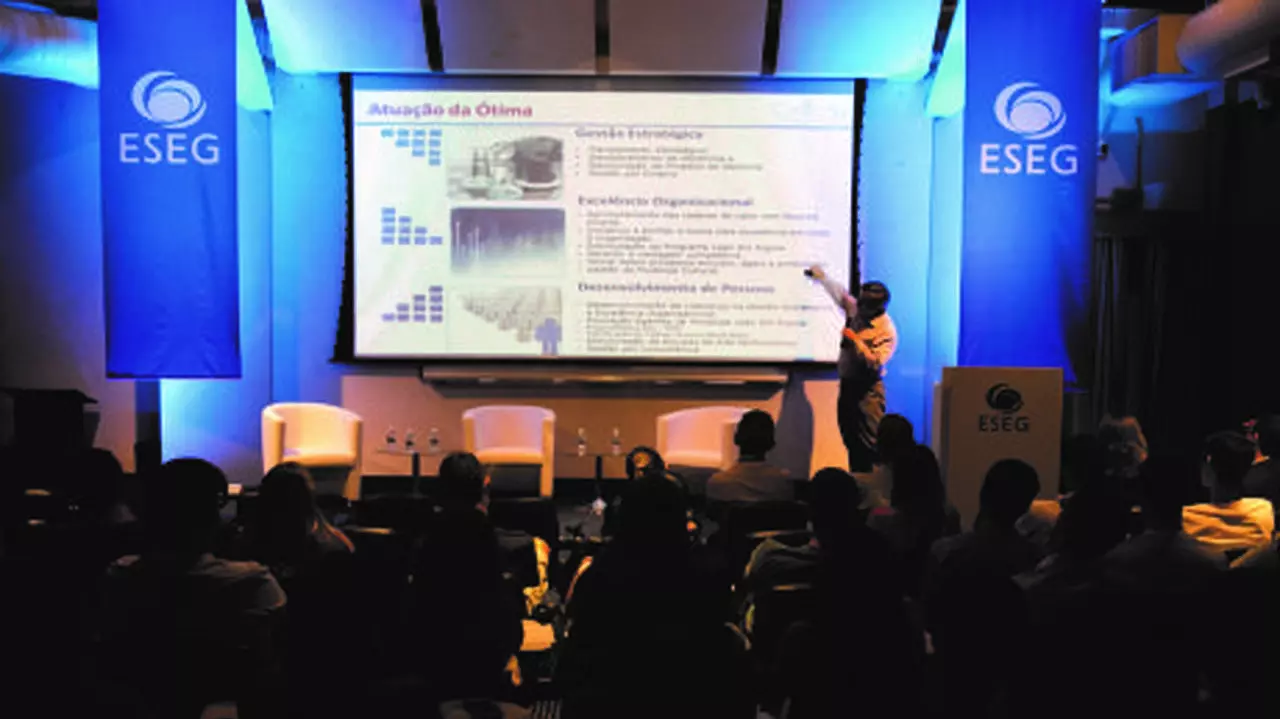
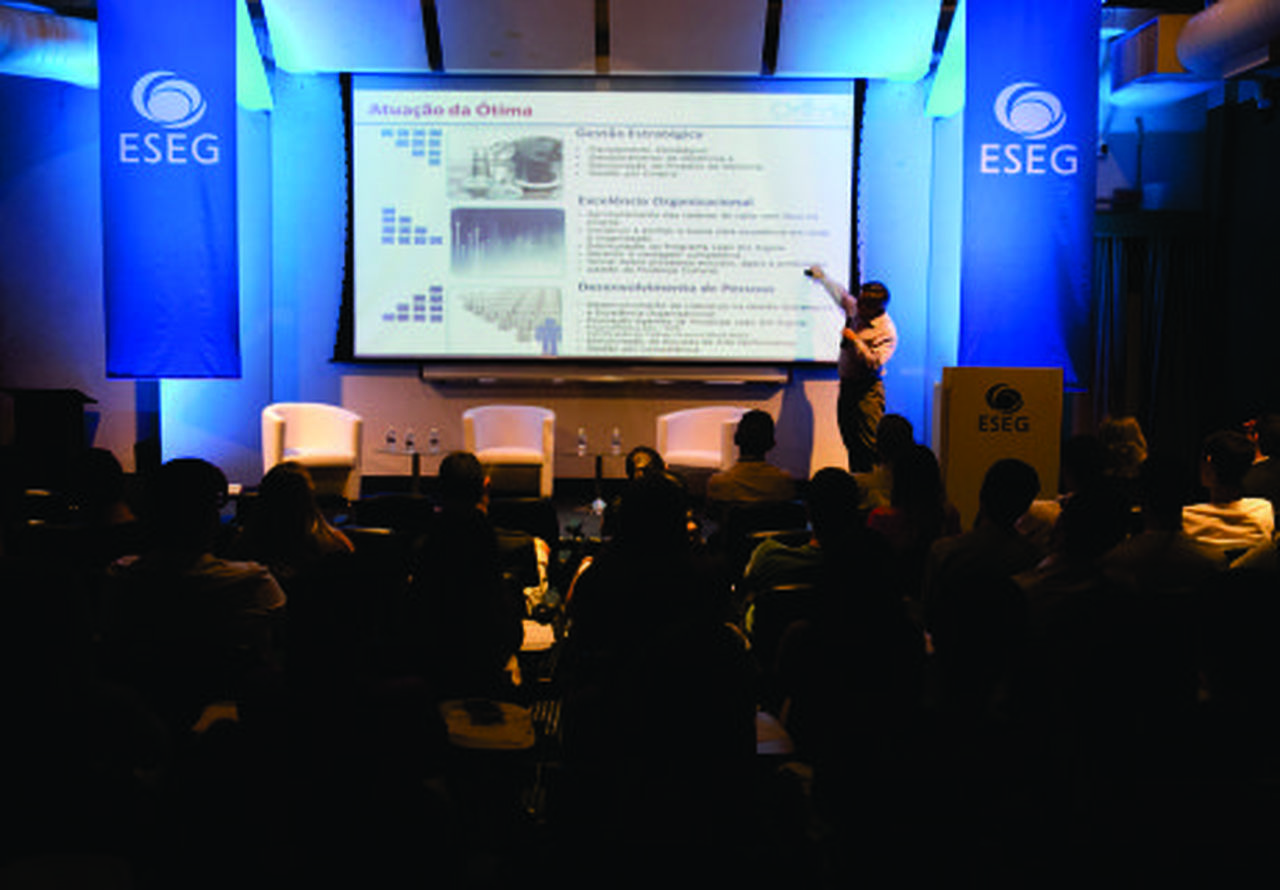
The start of the first semester of 2017 at ESEG featured a keynote lecture given on March 8th, in the morning, by strategy and management consultant Luis Oliveira, who spoke about the application of Lean and Six Sigma methodologies, aimed at improving the efficiency and productivity of companies.
With the participation of professors Flávio D'Angelo and Silvia Boarin, from ESEG, the event was aimed at students and faculty from the morning period. “Those who are currently seeking qualifications and a better position in the job market need to be aware of the methodologies and trends related to the management of production and quality processes, and how to apply them,” stated Luis, a graduate in Statistics, with a postgraduate degree in Business Administration and certified as a quality engineer by the American Society for Quality (ASQ).
From companies with 10 employees to large global corporations in all sectors, anyone can use and benefit from applying methodologies such as Lean, which, in Luis's words, "involves the use of tools, concepts, and methods that form a new work philosophy.".
The consultant points out that, by applying such methods, it is possible to achieve the elimination or significant reduction of waste, time savings (increased productivity), and improvements in the quality of the product or service.
In the presentation, which took place in the ESEG Lecture Hall, the specialist explained that the Lean system, developed in Japan over 100 years ago in the post-war period, during a time of resource scarcity, has a strong cultural and behavioral component. "It's something that becomes internalized over time, causing everyone involved in the production process to use fewer resources and deliver more and better results, exceeding customer expectations," he added.
To explain the methodology, a game simulating the production flow in a company was used. Students were able to see, in practice, what is truly important and generates value, and what hinders production processes in both manufacturing and the office.
According to the consultant, every company has seemingly small problems that end up acting as real "time thieves." These are everyday situations that hinder or stall the progress of business and generate frustration among employees for not having been able to accomplish all the planned tasks.
The biggest challenge, according to what was presented in the lecture, is identifying waste, defined as "anything that has a cost without adding a corresponding benefit." In general, the biggest wastes observed in organizations can be divided into eight categories: overproduction; waiting (stopped processes); unnecessary movement; excessive inventory; defective products; deficient processes; transportation; and (the inadequate use of) people's talent.
Once identified, waste of time, resources, and energy can be more easily eliminated. "Lean is like a deep clean, which can be applied to 100% of the company's processes," concludes the expert.
Created in the United States in the 1980s, Six Sigma consists of a statistical scale ranging from 1 to 6 based on the concept of "standard deviation"—with 1 being the worst level and 6 the best. It is a methodology that assesses the occurrence (or probability of occurrence) of failures in the execution of company processes, impacting business results.
“These statistical techniques are adopted with the aim of reducing variability (or deviations) to the lowest possible degree, which ultimately leads to better quality results at lower costs. Companies that incorporate Six Sigma usually start at scale 2, with errors of 308,537 parts per million, and gradually reach scale 6, which allows only errors of 3.4 parts per million,” explains Luis.
Since it's a method that involves statistical concepts, Luis advises against starting a review of a company's efficiency and quality processes with the implementation of Six Sigma. "It's possible to solve smaller problems with other, less complex methods, such as Lean," he states.
According to the expert, the biggest challenge for companies is correctly diagnosing the problems they face and which ones need to be solved. Even so, he indicates that the human factor is always more critical than the technical aspects, which can be resolved through training, development, and monitoring.
In his view, applying the Lean and Six Sigma combination implies a change in organizational culture that involves the social, psychological, and behavioral aspects of employees at all levels. "It's important that people buy into the idea, that they are convinced that it will help. Once that's done, it becomes easier to train them for the implementation, dissemination, and deepening of the adopted methodologies," he states.
Finally, he left a message for ESEG students who are preparing to enter the job market or to improve their positions in the market: “It is essential that new generations have the vision that methodologies such as Lean and Six Sigma, and others like Canvas and Design Thinking, can have a great impact on companies, and know how to apply them. It is not something to be used for a period and then stopped; it is something that must be continuously improved,” he concludes.