




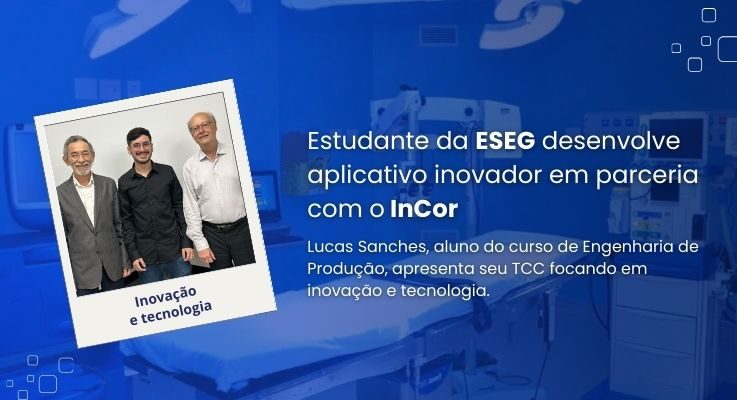
InCor adopts operating room time calculator developed in a final year project at ESEG Faculty, of the Etapa Group.
A graduate in Production Engineering for the ESEG College, from the Etapa group, developed, as a Final Course Project (TCC), a project aimed at optimizing the distribution of time and staff in operating rooms during procedures. In partnership with the InCor (Heart Institute of the Hospital das Clínicas), The software was implemented by the medical institution.
Entitled “"Development of a Machine Learning Computational Tool for Weather Prediction in Patients with Congenital Heart Disease", the final course project of Lucas Toribio Sanches presented Operating Room Time Calculator. The software uses Artificial Intelligence (AI) to analyze patient data and thus calculate how much time each room will need to be allocated for each procedure.
Lucas developed the work with guidance from John Chang Junior, teacher of Production Engineering and coordinating professor of ESEG Faculty Development Center, and with mentoring from Dr. Alfredo Manoel da Silva Fernandes, former administrative director of InCor.
Advantages of an Operating Room Time Calculator
O InCor He was one of the major supporters for the development of the project. Lucas. The hospital is looking for a way to optimize services – and the calculator allows for improved time management in operating rooms, a complex and strategic task of balancing multiple variables, such as the availability of medical teams, equipment, and schedules, while dealing with emergencies and unforeseen events.
This organization directly impacts hospital efficiency, patient experience, and financial sustainability. However, with the developed app, the aim is to revolutionize how operating room usage time is calculated and managed, bringing practical benefits to both hospitals and patients.
How does the Operating Room Time Calculator work?
The app's main function is to calculate operating room usage time. With this, the Operating Room Time Calculator It aims to provide more accurate data on the duration of surgical procedures, enabling the medical team to better manage the time required to rent the operating room and, consequently, improve the organization of the patient waiting list, resulting in better performance in scheduled surgeries.
Developed by Lucas Sanches, The calculator is a web application (application or app) that monitors operating room usage time through... AI, based on information previously provided by patients when registering on the app.
Challenges for the student
To Lucas, The biggest challenge of the project was related to programming and AI integration. “Programming is an area I had no experience in, but I found myself drawn to it and really enjoyed it. Since my knowledge wasn't very in-depth, I had to catch up and learn programming languages, understand how they work, and put them into practice,” highlighted the graduate. Production Engineering from the ESEG College, from the Etapa Group.
Regarding the calculator's usability, the student wanted to make the platform as user-friendly and intuitive as possible, allowing people to use it without difficulty. "The interface is very intuitive and simple. It has an initial screen with all the information that needs to be filled in about the patient so that the Artificial Intelligence can calculate the time needed to use the operating room," Lucas explains about the calculation process.
Scientific development in partnership with InCore and professors.
The project proposal arose from conversations between the student Lucas Sanches and the Professor João Chang Junior, who has done previous work with InCor alongside the then administrative director Doctor Alfredo Manoel da Silva Fernandes.
Among the activities of ESEG Faculty Development Center, The professor helped achieve several important milestones, such as international publication. Predictors of in-ICU length of stay among congenital heart defect patients using artificial intelligence model: A pilot study. The pilot study explores the use of AI to predict the length of stay in the ICU for patients with congenital heart defects, indicating the potential of this technology as an aid in hospital management and clinical decision-making.
According to Prof. Chang, The publication opened many doors for the students. "This project enabled the enrollment of seven students from..." ESEG College in scientific initiation programs, via ESEG Development Center, "At the Faculty of Medicine of USP, this will broaden academic training and practical application in the field of artificial intelligence applied to healthcare," the professor highlights.
Looking back at the beginning, Lucas He says the initial idea for the project came from Prof. Chang and that gave him the opportunity to challenge himself to develop the software. "In conversation with the Prof. Chang, he said that in InCor "I needed something like that [a calculator], and if I was interested, we could join forces on this project. The hospital part came from him [the need], but the AI part was something that emerged from my ideas," the student recalls about the beginning of the project.
Implementation of the Operating Room Usage Time Calculator at InCor
The application developed by the student of Production Engineering from the ESEG, Lucas Sanches, will be implemented in the systems of InCor aiming to solve problems and automate operating room time.
For the former director of the Heart Institute Dr. Alfredo Manoel da Silva Fernandes, The expected impact of implementing this tool is significant, as it aims to optimize the use of operating rooms. "There are waiting lists for elective surgeries, and it's impossible not to seek to optimize these available resources, in addition to the fixed costs of these hospital facilities being extremely high," explains the specialist.
Regarding the importance of partnerships and opportunities between educational institutions and hospitals, Dr. Alfredo praises these collaborations for the benefit of society. “It is a challenge to bring academia closer to service providers in the search for feasible solutions for the benefit of society. My expectation is that these partnerships will contribute to the development of a product, in this case, software, whose methodology is reproducible for other outcomes of interest to hospital and healthcare managers,” he emphasizes.