





Production Engineering is among the most versatile degrees on the market. This is because professionals trained in this area are able to integrate knowledge of engineering, management, technology, and innovation to make processes more efficient, reduce costs, increase productivity, and develop strategic solutions for companies in a wide variety of sectors.
A Faculty of Production Engineering ESEG's program was developed to prepare professionals with analytical skills and leadership abilities, capable of working in industries, logistics companies, technology, services, consulting firms, and organizations of different sizes.
Throughout their undergraduate studies, students develop skills in areas such as production management, logistics, automation, data science, programming, continuous improvement, and entrepreneurship, always with training aligned with market needs.
In this article, you will learn about the Production Engineering program at ESEG, the duration of the degree, its curriculum, the program's distinguishing features, and career opportunities for those who choose this profession.
So keep reading and learn about our course!
How long does the Production Engineering course at ESEG last?
O Production Engineering course at ESEG has a duration of 10 semesters (five years) and offers classes during the periods day and night, providing greater flexibility for students.
Classes take place on the Ana Rosa and Paraíso campuses in São Paulo, offering adequate infrastructure for practical training connected to the demands of contemporary engineering.
During their five-year undergraduate program, students develop a solid foundation in engineering, management, technology, and data analysis, preparing them to face the challenges of Industry 4.0 and new business models.
What is the Production Engineering Faculty like at ESEG?
A Production Engineering at ESEG (in-person) It offers a modern, interdisciplinary education focused on the realities of the market.
The course goes beyond traditional engineering disciplines, incorporating content related to digital transformation, data analysis, automation, business intelligence, and strategic management.
The goal is to train professionals capable of analyzing processes, identifying opportunities for improvement, and implementing innovative solutions that increase the competitiveness of organizations.
Throughout their undergraduate studies, students develop a broad understanding of the production chain, encompassing everything from production planning to the logistical, financial, and technological management of companies.
Another distinguishing feature is the integration between engineering, administration, and technology, allowing future engineers to act as process managers, team leaders, and agents of innovation.
Read also: Does Production Engineering involve a lot of calculations?
Benefits of studying Production Engineering at ESEG
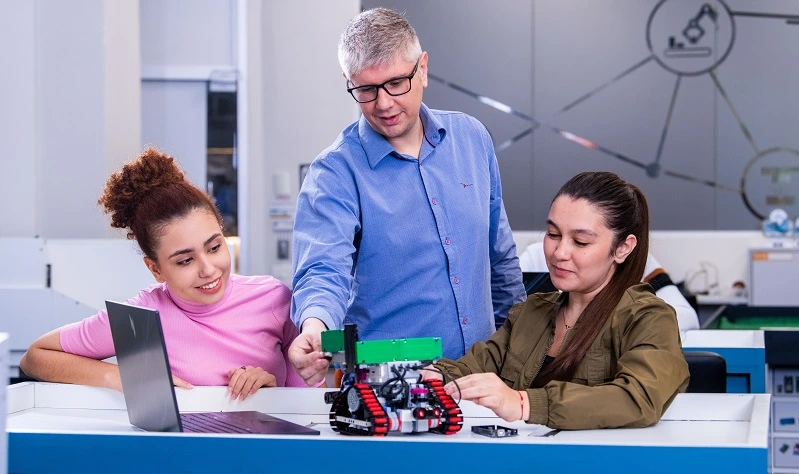
ESEG College offers an education that combines academic excellence, professional development, and constant contact with the technologies used by companies.
See below the main advantages of studying with us!
Training focused on logistics and supply chain.
Logistics is one of the most promising fields for production engineers.
During their undergraduate studies, students learn about supply chain management, production planning, inventory control, distribution, transportation, and optimization of logistics processes.
This knowledge enables individuals to work in industrial companies, distribution centers, logistics operators, and national and international trade organizations.
Learning in Lean Manufacturing and Six Sigma
Among the distinguishing features of the training are methodologies widely used by the world's largest companies, such as:
- Lean Manufacturing;
- Six Sigma;
- continuous improvement;
- quality management;
- process optimization.
These tools help future engineers identify waste, reduce costs, and increase operational efficiency.
Contact with automation, IoT and Industry 4.0
Digital transformation has changed the way companies produce and manage their processes.
At ESEG College, students study technologies such as:
- Internet of Things (IoT);
- industrial automation;
- robotics;
- systems integration;
- intelligent manufacturing.
This knowledge brings the student closer to the reality of Industry 4.0.
Programming, Python, and Data Science
The use of data has become indispensable in decision-making.
Therefore, the degree program includes content related to programming, data analysis, and the use of... Python, in addition to the fundamentals of Data Science, preparing students to interpret strategic information and develop data-driven solutions.
ESEG course recognized by CREA-SP and MEC.

When choosing an engineering degree, it is essential to verify that the course has the necessary recognition to practice the profession.
O The Production Engineering course at ESEG is recognized by CREA-SP. (Regional Council of Engineering and Agronomy of São Paulo) and had its renewal recognition published in SERES/MEC Ordinance No. 13/2026.
This registration guarantees that the diploma is valid nationwide and meets the quality standards established by the Ministry of Education.
In addition to ensuring training aligned with the demands of the profession, this recognition is essential for graduates to apply for their professional registration with CREA, a requirement to legally practice as an engineer in various market sectors.
Entrepreneurship projects
Throughout the course, students participate in projects that stimulate creativity, innovation, and the development of new businesses.
This experience strengthens skills such as leadership, problem-solving, teamwork, and project management.
English in the curriculum
Proficiency in English is a significant advantage for engineering professionals.
At ESEG College, language is an integral part of academic training, broadening access to technical literature, international certifications, and opportunities in multinational companies.
Individualized support for the student
Students receive close support from professors throughout their degree program, which enhances learning and provides a more personalized academic experience.
This support contributes both to academic performance and professional development.
Career Development Center
Another major difference is... Career Development Center (CDC).
The department offers support to students through:
- Guidelines for creating a resume;
- Interview simulation;
- Preparation for selection processes;
- development of professional skills;
- career planning.
Exclusive platform with partner companies
Students also have access to an exclusive platform with internship and job opportunities offered by the institution's partner companies.
This contact facilitates entry into the job market even during undergraduate studies.
Production Engineering curriculum at ESEG
The Production Engineering curriculum at ESEG combines classic engineering fundamentals with content geared towards the new demands of the market.
Traditional subjects include:
- Calculation;
- Physical;
- Statistic;
- Linear Algebra;
- Chemical;
- Strength of Materials;
- Operations Research;
- Production Planning and Control (PPC);
- Economic Engineering;
- Quality Management;
- Cost Management;
- Logistics;
- Supply Chain Management;
- Factory Design Project;
- Ergonomics;
- Environmental Management.
In addition to this foundation, ESEG incorporates innovative content that broadens students' education, such as:
- Lean Manufacturing;
- Six Sigma;
- Robotics;
- Industrial Automation;
- Internet of Things (IoT);
- Schedule;
- Python;
- Data modeling and analysis;
- Data Science;
- Innovation Management;
- Entrepreneurship;
- Integrated Projects.
Throughout their Production Engineering degree, students develop practical projects that simulate real-world organizational challenges, strengthening technical and managerial skills that are fundamental to the job market.
Where can a production engineer work?
Production engineers possess one of the most comprehensive educational backgrounds among the engineering disciplines.
Their work can take place in virtually any organization that seeks to increase productivity, reduce costs, optimize processes, or implement innovation.
Among the main areas of Production Engineering they are:
- manufacturing industries;
- automotive companies;
- food industry;
- pharmaceutical companies;
- hospitals;
- technology companies;
- consulting services;
- banks;
- fintechs;
- Logistics companies;
- Logistics operators;
- e-commerce;
- Energy companies;
- civil construction;
- startups;
- public bodies.
It is also an excellent option for those who wish to start a business or work in business consulting.
Job titles for a production engineer

After graduation, various career opportunities can be pursued.
Among the main positions are:
- Production Engineer;
- Process Engineer;
- Quality Engineer;
- Continuous Improvement Analyst;
- Lean Manufacturing Specialist;
- Six Sigma Specialist;
- Supply Chain Analyst;
- Production Manager;
- Industrial Manager;
- Operations Coordinator;
- Logistics Analyst;
- Process Consultant;
- Automation Engineer;
- Data Scientist;
- Business Intelligence (BI) Analyst;
- Project Manager;
- Management Consultant;
- Entrepreneur.
The combination of engineering, management, and technology makes this professional highly valued by companies in different sectors.
Read also: How much does a production engineer earn? Salary and job market.
Conclusion about the on-campus Production Engineering course at ESEG.
Production engineering in ESEG College It offers comprehensive training for those who wish to work in a dynamic, technological, and constantly evolving market.
Throughout the five years of their undergraduate program, students develop skills in production management, logistics, supply chain, lean manufacturing, Six Sigma, automation, programming, Python, data science, and entrepreneurship, combining technical knowledge with a strategic vision.
In addition to an updated curriculum, the institution offers unique features such as English language instruction, individualized mentoring, a Career Development Center, mock interviews, resume writing support, and an exclusive platform for opportunities with partner companies.
For those seeking one of best colleges of Production Engineering, ESEG combines tradition, innovation, and training that is connected to the demands of industry and business.
If you want to know more about the Production Engineering course at ESEG, To check the tuition fees for ESEG degrees or learn more about admission processes, visit the institution's official website and discover how to take the first step towards a successful career in engineering.