





You've probably already noticed that artificial intelligence is everywhere.
She answers questions, creates images, automates processes, organizes information, and already participates in decision-making within companies.
But there's a question that frequently comes up when the topic moves a little beyond everyday use.
If AI models are trained to serve millions of people, how can they deliver specific answers for such different contexts?
The answer lies in a concept that has been gaining traction among companies, technology professionals, and innovation teams: Fine-Tuning.
This process allows for the adaptation of artificial intelligence models to more specific objectives, increasing relevance, context, and performance.
And this is transforming how organizations use AI to generate real value.
In this article, you will understand what Fine-Tuning is, how specialized model training works, and why this topic has become strategic for businesses.
Stay here to learn more about this topic!
What is Fine-Tuning?
Fine-tuning is the process of adjusting a previously trained artificial intelligence model to perform more specific tasks., such as providing customer service via chatbots, analyzing legal documents, classifying medical exams, or generating customized content for a company.
Instead of building a model from scratch, companies use an already developed base and conduct new training cycles with data targeted towards a specific objective.
In practice, it's like taking someone who already has extensive training in a subject and offering them a specialization.
General knowledge continues to exist.
But it is then refined to deliver answers that are more appropriate to a specific context.
Therefore, when someone asks "what is fine tuning," the simplest answer would be:
It is the process of customizing artificial intelligence models for specific needs.
This concept gained traction primarily with the advancement of generative AI and the application of artificial intelligence in business.
Read also: Agent AI: what is it and how does it work?
How does fine-tuning work in AI?
To understand how fine-tuning works in AI, it's helpful to imagine a model that has already learned general patterns of language, behavior, or recognition.
From there, he receives a new, more targeted set of data.
This additional training alters internal parameters so that the model develops greater adherence to the desired context.
For example.
A company can use an existing model and adapt it to:
- Answer customer questions;
- Generate technical reports;
- Interpreting legal documents;
- To produce specialized content;
- Automate internal processes.
The goal is not to teach everything again.
It's about refining skills.
This detail makes fine-tuning more efficient in many business scenarios.
How does specialized data training work?
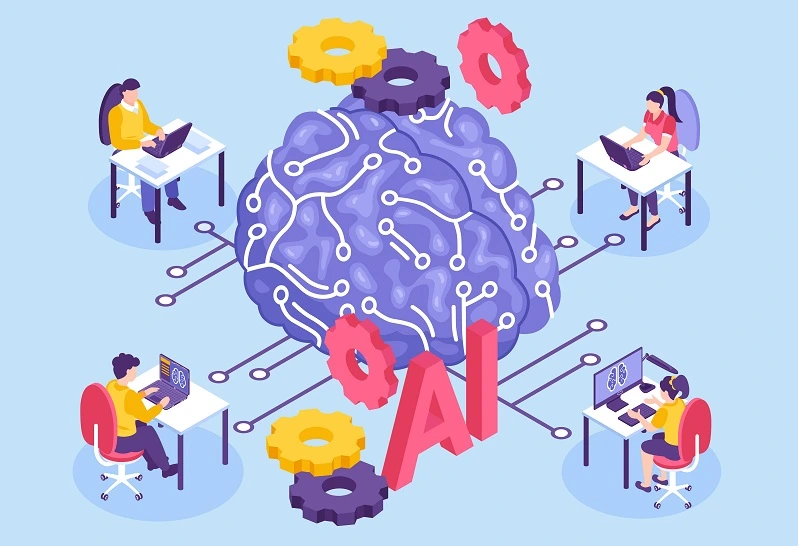
Specialized training depends directly on the quality of the data used.
This is one of the most important points in artificial intelligence projects.
Models learn patterns. If the data has inconsistencies, the results tend to reflect those limitations.
See below how this data training works.
Artificial intelligence models
Artificial intelligence models work by identifying relationships between large volumes of information. After initial training, they can make predictions, generate content, or interpret requests.
However, generalist models don't always understand the specificities of certain sectors. Tools like Chat GPT, Gemini, and others are trained to handle a wide variety of topics. On the other hand, AI developed specifically for areas like marketing, healthcare, or sales tends to provide more precise answers aligned with the needs of that context.
And it is precisely at this point that fine-tuning becomes valuable.
Data training
Data training means presenting organized examples so that the model learns desired behaviors.
This process involves preparation, validation, and continuous evaluation.
The more aligned the dataset is with the project objective, the higher the quality of the response tends to be.
This is where one of the most important concepts for the practical application of AI comes in: personalization.
AI Personalization
AI personalization allows for the creation of more contextualized experiences.
An education company can adapt models to support students. A financial organization can focus on specific analyses., such as fraud detection, credit risk assessment, and personalized investment recommendations. An industry can optimize operations.
Customization means bringing technology closer to the reality of the business.
The more companies seek to customize artificial intelligence applications, the greater the demand becomes for professionals capable of understanding technology in a practical and strategic way.
It's not just about knowing how to use AI tools.
It is necessary to understand how systems work, how data influences results, and how to transform technology into solutions.
Therefore, training programs focused on areas such as Computer Engineering And other technology-related courses are gaining popularity among those who want to keep up with the evolution of artificial intelligence and work on projects that connect innovation and business.
Generative AI in business
Generative AI in business has further increased interest in fine-tuning.
Companies have realized that simply accessing ready-made AI platforms is not enough.
There is value in creating applications that are aligned with the specific context.
This movement is accelerating the emergence of new professional profiles and increasing the demand for artificial intelligence specialists capable of connecting technology and strategy.
What is the difference between fine-tuning and traditional training?
Although both processes involve machine learning, they have different objectives.
In traditional training, a model is built and trained from the beginning.
This typically requires large volumes of data, robust infrastructure, and high computational investment.
In Fine-Tuning, the model already exists. The focus is on adapting it.
This approach reduces development time and accelerates practical applications.
That's why many companies prefer this approach when they want to implement AI more quickly.
Read also: Artificial Intelligence and Machine Learning in Computer Engineering
What is the difference between Fine-Tuning and RAG (Retrieval-Augmented Generation)?
This comparison is becoming increasingly common because Fine-Tuning and RAG solve similar problems in different ways.
In Fine-Tuning, knowledge is incorporated directly into the model through additional training. In RAG, the model consults external sources when generating the response.
In other words, fine-tuning adjusts the model's behavior. RAG expands access to information by seeking other data sources.
In practice, companies often combine both approaches.
A template can be customized and, at the same time, consult updated databases when necessary.
This combination increases precision and flexibility.
How do companies use fine-tuning?

Companies are using fine-tuning for much more than just automating customer service. Today, this technology is already being applied in... data analysis, Product recommendations, education, marketing, document management, fraud prevention, and decision support.
By adapting artificial intelligence models to their needs, organizations can increase productivity, improve the quality of responses, and create more personalized experiences for customers and employees. As a result, the demand for professionals capable of developing, implementing, and managing these solutions is also growing.
Fields such as data science and analytics, solution architecture, digital infrastructure, and artificial intelligence are assuming an increasingly strategic role within companies. After all, the potential of AI depends not only on the models used, but also on the technological infrastructure that supports its operation.
This relationship between artificial intelligence, infrastructure, and innovation was one of the topics of the first episode of... ESEG Talks, a podcast from ESEG College. In conversation with the president of Equinix Brazil, Victor Arnaud., The challenges of enabling AI applications for large-scale businesses and the importance of robust digital infrastructure to accelerate business transformation are discussed.
In this scenario, training programs that combine technology, analytical reasoning, and business acumen are becoming increasingly relevant for professionals who want to keep up with the evolution of artificial intelligence and contribute to organizational innovation.
Conclusion on what Fine-tuning is
For a long time, artificial intelligence seemed like a technology far removed from the reality of businesses. Today, it is part of processes, decisions, and experiences that impact organizations across all sectors.
However, the real difference lies not only in using AI tools, but in understanding how to adapt them to generate value for the business.
Fine-tuning represents exactly this evolution: instead of generic solutions, companies now have access to customized models capable of delivering more precise, relevant results aligned with their goals.
For professionals and students, this movement reinforces the importance of developing an integrated vision between technology, data, and strategy. Understanding how these areas connect will be a key differentiator for those who wish to work in a market increasingly driven by AI.
Would you like to continue following discussions about artificial intelligence, innovation, and the impact of new technologies on the market?
Explore the contents of ESEG College And follow the Tech & Business: Intelligence in Action season of the podcast. ESEG Talks to delve deeper into topics that are transforming companies and careers.
Watch the full episode about Digital Infrastructure and the AI Revolution: