In its ninth edition, the Entrepreneurship & Finance course has already had the participation of more than 700 high school students.
Offered since 2013, the Entrepreneurship & Finance course is an extracurricular activity at Colégio Etapa, taught to 11th-grade students at the São Paulo and Valinhos campuses. The course lasts 30 weeks and is organized by Pablo Ganassim, a professor at ESEG – Faculdade do Grupo Etapa – specializing in Business Management. Professors Carlos Coelho and Douglas Giglioti, also from ESEG, coordinate the course.
“We bring the level of expertise from undergraduate programs to high school students through this course. The structure is supported by the Entrepreneurship Center and the Economics and Finance Center of ESEG – Faculdade do Grupo Etapa,” explains Professor Pablo Ganassim. “At the end of the course, each group needs to develop a startup project and goes through four elimination phases, and from phase 2 onwards, we invite professionals and entrepreneurs who evaluate them and share their experiences.”.
The course is divided into two parts, one focusing on Entrepreneurship and the other on Finance, each further divided into two phases. The Entrepreneurship phase covers soft skills – communication, leadership, teamwork, and negotiation – and hard skills – with methodologies to help students develop a business. The Finance phase teaches students about personal finance, basic economic concepts, investments, and how to create a financial plan within a startup's business plan.
“All this theoretical knowledge culminates in the challenge, which is the formation of a startup. It's an experience to put everything they've learned into practice. In phase 1, they present to the finalist students from the previous year. In phase 2, they face a panel of market professionals; this year we brought in people from Facebook, Google, and other companies to evaluate the students. In phase 3, we bring in CEOs of startups from all over Brazil. In phase 4, it's the moment of the popular vote; the audience defines the standout group of 2021, with votes from the general public and a panel of mega-investors,” comments Professor Carlos Coelho.
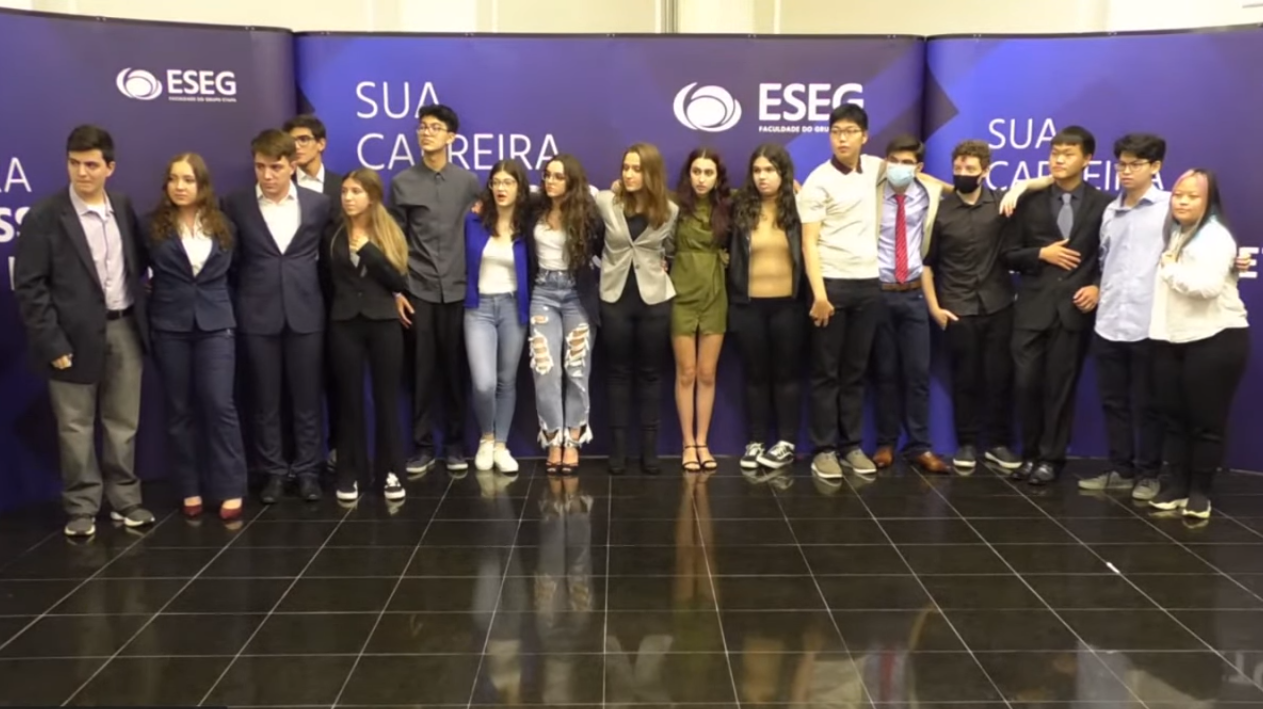
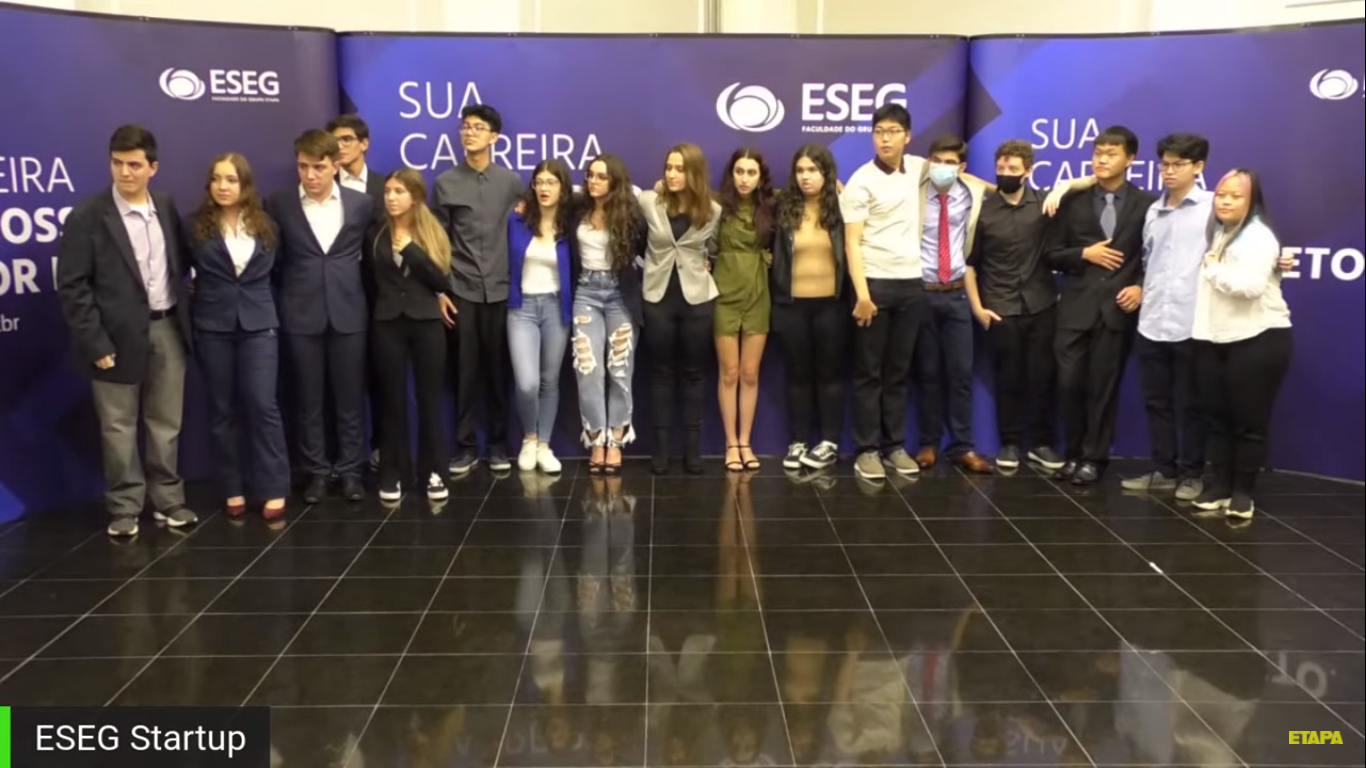
This year, the final phase took place on December 8th at the ESEG Startup Summit, with the groups Acetech, an app for people with disabilities to identify accessible locations; Non-Aggressive Plastics (NAP), producing biodegradable 100% plastic in four months – both from São Paulo; and Sun Light For All – from Valinhos –, offering a rental service for photovoltaic solar panels. The presentation was held in person at the Leonardo da Vinci Hall of ESEG – Faculdade do Grupo Etapa – and was also streamed so that the public could vote remotely.

“The biggest lessons I take away from the course are organization and time optimization, because we only had one week to organize ourselves from one phase to the next, to improve our project,” comments Julia Fogolin, from Acetech. “This course greatly changed my worldview, it helped me in many ways, both in terms of the job market and teamwork; it was a super valuable experience.”.
“I enjoyed developing my group communication skills. Going through this experience was really cool,” says Íris Melero, from Acetech. “The course helped me realize that I don’t want to go into Economics, but it was an experience that added a lot, both because of the professionals I met and the content, because it’s important to learn how to deal with stocks and financial planning. It’s a course that adds a lot of value.”.
“"To put it briefly, what I learned most from the course was teamwork," says Henrique Guth of Sun Light For All.
“Although I want to study Medicine, I believe I can use what I learned in the course within the field, such as hospital management or creating my own practice. I intend to study Medicine and take complementary courses in Management because I believe it opens many doors; it's important to know various areas to decide what I want later on,” says Fernanda Carvalho, from Sun Light For All.
“In the final phase, we treat the public as investors and the banks as mega-investors in these startups, who invest ESEG Money through three investment models: $4000, $2000, and $1000 ESEG Money. Each investor needs to allocate a certain amount to each startup during their investment,” explains Douglas Giglioti.
This year's panel consisted of: Dimas Ferreira, electrical engineer and director of the Etapa System; José Guilherme de Campos, administrator and professor of the Administration course at ESEG – Faculdade do Grupo Etapa; Fernando Umezu, electrical engineer, economist and coordinator of the Economics course at ESEG – Faculdade do Grupo Etapa; and Marcel Dallaqua, production engineer and coordinator of the Artificial Intelligence and Robotics Center at ESEG – Faculdade do Grupo Etapa.
“What caught our attention is that each finalist startup illustrates a pillar of sustainability, ESG (Environmental, Social and Governance): a factory concerned with the environmental pillar; an app focused on social issues; and a service for economic businesses. In addition to having diverse projects, this shows the diversity of entrepreneurship,” comments Marcel Dallaqua.
In total, there were over 1500 investors with total investments exceeding 10 million ESEG Money. The third-place winner received 31% of the investments, the second-place winner 32%, and the standout startup, NAP, received 37%.

“"Using the college's laboratory to develop our project was very good," explains Eric Toshiki, from NAP.
“You come in with a basic understanding, you arrive at the first class and the teacher immediately tells you how much research we'll have to do, and at first, we don't understand why. After three weeks, three classes, we understand, and by the end of the course we can see a news story and understand it, or watch an advertisement and understand the technique being used. It's transformative,” Davi Braga, from NAP.
“With this project, I greatly developed my critical thinking skills, in terms of looking at the price, looking at a product, and thinking about how long it takes to make a profit with this type of project. It further stimulated my entrepreneurial side, because it's really cool to have an idea and execute something you enjoy and know that it can work,” says Lívia Corregio, from NAP. “I think it would be great to be an entrepreneur to do something I enjoy and not have someone telling me what to do, and even if I don't follow through, I will also use the leadership skills I learned in the course.”.
Students who make up the startups:
Acetech: Arthur Seiichi Kikuchi Santiago, Íris de Campos Melero, Isabella Torres Sanches, Julia Pagan Fogolin, Lucas Shu and Rafaela de Oliveira Alexandre.
Non-Aggressive Plastics (NAP): Augusto Parizi Martins, Davi Braga Pires, Eric Toshiki Miyamoto Satô, Hao Chen, Livia Corregio, Nicole Mokotaka Ide and Vitor Nobuo Wakamatsu.
Sunlight For All: Fernanda Carvalho Almeida, Henrique Penteado Guth, Larissa Pacini Bastos, Renato Niero Guerreiro and Tomas Leal Oliveira.