ESEG professor is a finalist for the 2026 Jabuti Academic Prize with a book on Neural Networks.

By Renata Heining
13/08/2026
Browse by topic
Marino H. Catarino's work was among the five finalists in the Computer Science category and addresses fundamental concepts of Artificial Intelligence and Machine Learning.
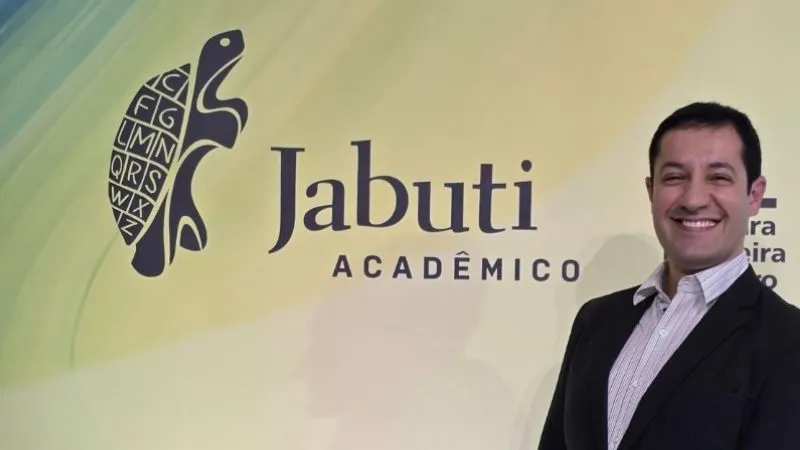
O ESEG professor, Marino H. Catarino, He was one of the five finalists for the 2026 Jabuti Academic Prize in the Computer Science category with his book Neural Networks. The work presents fundamental concepts related to artificial neural networks, Machine Learning, and Artificial Intelligence, combining theoretical foundations and practical applications.
Published by Editora Freitas Bastos, the book arose from the professor's experience in producing academic content in the field of computer science. His journey began in 2022 when Marino was invited by the publisher to write a work on Computational Theory. This work resulted in the book published in 2023 and, subsequently, in Graph Theory, released in 2025.
After the publication of his second work, the professor proposed the development of Neural Networks, with the intention of contributing to the available bibliography on the subject. Throughout 2025, the material underwent revisions and was shared with professionals in the field, who highlighted its didactic nature.
Registration for Jabuti Academic Prize It happened in early 2026, at the publisher's initiative. The book advanced in the awards and reached the... Top 5 in the Computer Science category, This recognition, according to Marino, represents an important validation of the technical and didactic quality of the work.
“"When writing, I didn't aim to participate in the award, but rather to successfully convey the knowledge discussed in the book," Marino stated.
The professor's academic output is also directly related to the work developed in ESEG College. Marino teaches courses in the Data Science cycle, from Data Science 1 to Data Science 3, in addition to Machine Learning and Hackathon.
For him, understanding Neural Networks also involves understanding the entire process of data processing and exploration that precedes machine learning. In this context, the quality of the data used in training is fundamental to the performance of an artificial neural network.
“By learning how to put data processing and exploration into practice, as seen in Data Science 2, and by fully understanding the importance of a solid foundation for machine learning, we will better understand that the quality of an artificial neural network's work depends heavily on the quality of the data presented to the network during its learning process,” he explains.
The connection between theory and practice is one of the distinguishing features of the education offered by Faculdade ESEG. Instead of focusing learning on a specific tool, the program seeks to develop in students a broad understanding of concepts related to Artificial Intelligence and Data Science, using Python as a language for practical application.
“"Even though new tools and methodologies have emerged, some have also fallen out of favor. Students who learn how to work effectively in all aspects of Data Science and Machine Learning with Python will be able to use any new tool that emerges, because they will have a solid understanding of the concepts through practical application," he states.
This approach also brings students closer to professional reality. For Marino, by moving beyond textbooks and putting knowledge into practice, students are able to better understand what it's like to work with data and visualize possibilities for their professional careers.
For the professor, receiving the Jabuti Academic Prize also represents an opportunity to share with students the experience of research that has achieved national prominence.
“It is a great joy to be able to share that the teaching I provide in my classes has national recognition. That the classes, the practical parts, the cases discussed are not merely academic embellishments, but rather the result of extensive research and study,” he emphasizes.
Created by the Brazilian Book Chamber (CBL) in 2024, the Jabuti Academic Prize seeks to recognize academic works from different areas of knowledge. For Marino, the award contributes to establishing an important quality benchmark for academic productions published in book format.
By reaching the top five finalists in Computer Science, Neural Networks will have its content evaluated and recognized by experts in the field, something the professor considers especially significant given his role as an author and teacher.
The experience with publishing also becomes an incentive for students who wish to produce technical content, develop research, or publish their own work.
According to Marino, many professionals already share knowledge in forums, specialized portals, and materials produced for their work teams. This movement, he believes, can be the first step towards transforming accumulated knowledge into a publication.
“Write without pretension. Write for pleasure and explore ways to get the material printed,” advises the professor. Computer Engineering course at ESEG College.
The professor also highlights the importance of seeking guidance and publication opportunities, whether through other professors or advisors, in the case of articles and research, or through direct contact with publishers for book publication, and thus, achieving their dreams.
Marino's career path also highlights an important aspect of the education offered by ESEG: the knowledge brought to the classroom is continuously built and updated. Professors who research, publish, participate in projects, and follow the transformations in their fields bring this experience to the subjects, bringing students closer to the discussions and knowledge that are in motion in the market and in academia.
By sharing the production and experience of its faculty, ESEG reaffirms the importance of having professors who remain in constant development and knowledge production. For students, this connection means learning from professionals who not only teach about their fields of expertise but also continue to actively contribute to them.

Stay informed about relevant topics and what's happening at ESEG College.
Your data is safe.
Unavailable
Institutional
Infrastructure
Entry methods
Relationship
Key differentiators
We use cookies to improve your browsing experience.