Lecture presents a funding proposal for infrastructure and discusses challenges of the public budget.

By Karina Smargiassi
02/09/2026
Browse by topic
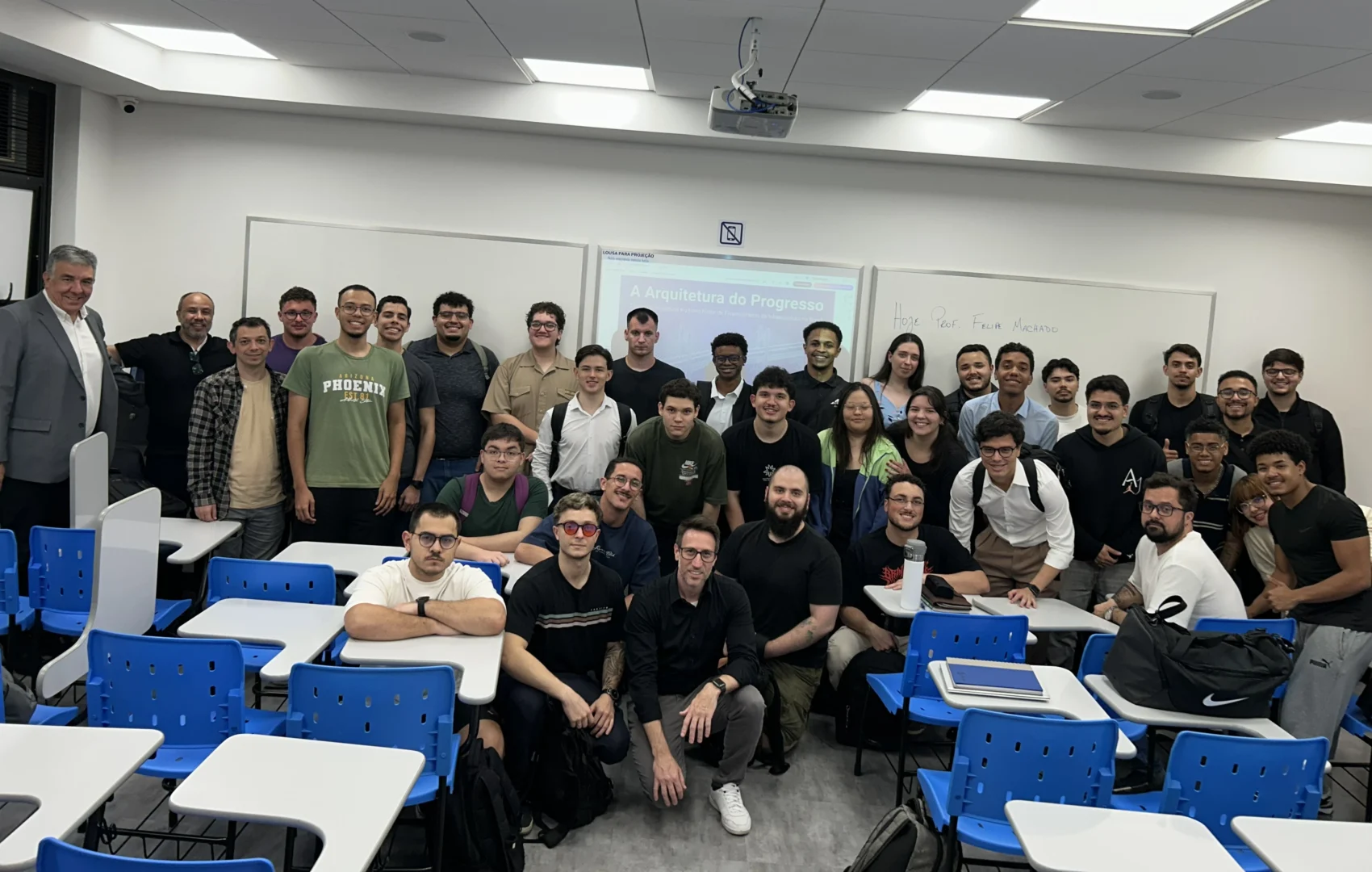
On Monday, August 31, 2026, ESEG College held another lecture in its "Contemporary Topics in Economics" series, which includes 13 meetings dedicated to current issues related to economics, the market, and society. Led by Professor Robson Pereira, the event featured Professor Felipe Machado from BrasilPrev, who discussed infrastructure, investments, and the challenges of the Brazilian institutional framework.
During the meeting, held at the Paraíso Campus, Economics and Business Administration students learned about a financing proposal for infrastructure projects developed by Machado in his master's thesis. The idea presented is part of the creation of a participatory bond focused on infrastructure, which could bring together public and private resources to expand the country's investment capacity without directly contributing to Brazil's public debt.
“"Today, we're actually going to talk about an infrastructure project that I developed, including in my master's thesis, to try a new, participatory approach to infrastructure, to develop Brazil's infrastructure," explained Professor Felipe.
According to him, the proposal considers an alternative in the face of difficulties in maintaining public investment in infrastructure. He highlighted that this area is usually one of the first to suffer cuts when budget adjustments are needed. "It's basically a security that doesn't enter into Brazilian debt, doesn't make up Brazilian debt, and helps, with both public and private money, to build and assemble the country's infrastructure, which is normally the first line item cut from the budget: investment," he stated.
Based on this scenario, the presentation addressed how such a proposal could fit into the Brazilian institutional framework, considering existing fiscal rules and mechanisms to enable long-term investments.
Speaking about the importance of the topic for students, Machado emphasized that understanding how the public budget works is fundamental to analyzing decisions that affect the country's economic development. "For young people starting their academic lives, understanding the complexities and inconsistencies of the Brazilian public budget is essential, first to diagnose problems and also to hold our leaders accountable," he highlighted.
The professor also drew attention to the importance of understanding not only the actions of elected representatives, but the entire set of laws and institutions that structure public decisions. “We like to talk, and I think it’s right to hold those in power accountable, but this also involves monitoring the rules established within this entire institutional framework. Not only the actions of the representatives we elect, but also the norms that are being proposed and created, whether by those we vote for or those we don’t, need to be monitored by society,” he stated.
The discussion then moved on to concession models, public-private partnerships (PPPs), and bidding processes, highlighting the difficulties involved in structuring these projects and in the participation of the private sector.
Machado also addressed the relationship between fiscal rules and financial innovation, showing students how budgetary constraints can influence the ability of the government to develop new mechanisms to finance infrastructure projects.
The meeting also brought the concepts discussed in the classroom closer to situations present in the financial market. Among the topics covered were stock analysis, investments, and risk management, with emphasis on the need to evaluate different scenarios before making decisions.
When discussing the evolution of the market, the professor explained that various financial instruments have been created and improved over time to meet new economic demands.
Artificial intelligence (AI) also came up in the conversation. Machado acknowledged the potential of these tools to aid analysis and broaden perspectives, but stressed that their results need to be critically evaluated. "AI has come to help with many things, but it doesn't get everything right," he stated.
As an example, the professor explained that an AI tool can provide an assessment of a particular investment, but the answer will be directly related to how the question is formulated and the criteria considered. Therefore, aspects such as timeframe, economic scenario, risk profile, and investment purpose need to be part of the analysis.
This advice also applies to financial content available on social media. At the end of the lecture, Machado and Robson Pereira reinforced with the class the importance of not automatically believing investment recommendations found on the internet, in addition to highlighting the role of studies and a solid education in building a career.
The teachers also spoke with the students about emotional intelligence and professional preparation, emphasizing that technical knowledge and personal development go hand in hand in the career path of those who intend to work in the market.
For Nicolas Rodrigues, an 8th-semester Economics student at ESEG College, the lecture provided an enriching perspective on the relationship between investments and other professional areas. “I really enjoyed this topic because, having worked in civil engineering, it’s important to have contact with architecture and understand how investment works. It’s interesting to learn about the different types of dynamics involved. I can only express my gratitude for such an enriching lecture.”
At the end of the meeting, Professor Robson Pereira thanked Felipe Machado for his participation and reinforced the importance of meetings like this for the students' professional future, even during their undergraduate studies.
The Contemporary Topics in Economics program will feature further lectures over the next few Mondays. This initiative brings ESEG students closer to professionals with market experience and promotes discussions on issues that are part of the contemporary economic and professional landscape.
With this series, ESEG College, part of the Etapa Group, expands students' opportunities to engage with different perspectives on economics, business, investment, and society, connecting academic training to the challenges and transformations of the professional world.

Karina Smargiassi
Stay informed about relevant topics and what's happening at ESEG College.
Your data is safe.
Unavailable
Institutional
Infrastructure
Entry methods
Relationship
Key differentiators
We use cookies to improve your browsing experience.