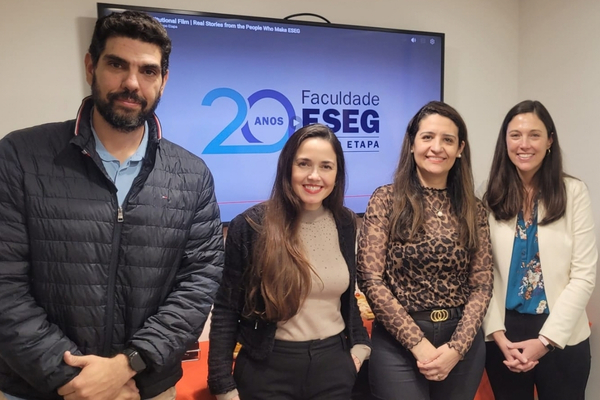
Professor Rodrigo Aquino demonstrated how machines can learn from data.
What can students expect from the Data Science course? The answer to this and other questions was presented at the inaugural open lecture, held on August 18th, with the theme "Introduction to Machine Learning and its applications.".
Professor Rodrigo Aquino, coordinator of the Computer Engineering course at ESEG and one of the professors of the Data Science course, opened the introductory class by talking about the modules that will be applied in the course – programming with Python; statistics and modeling; business and design – but the focus of the discussion was on Machine Learning. This data analysis technique automates the construction of analytical models, in a branch of Artificial Intelligence (AI) that is based on the idea that systems can learn from information.
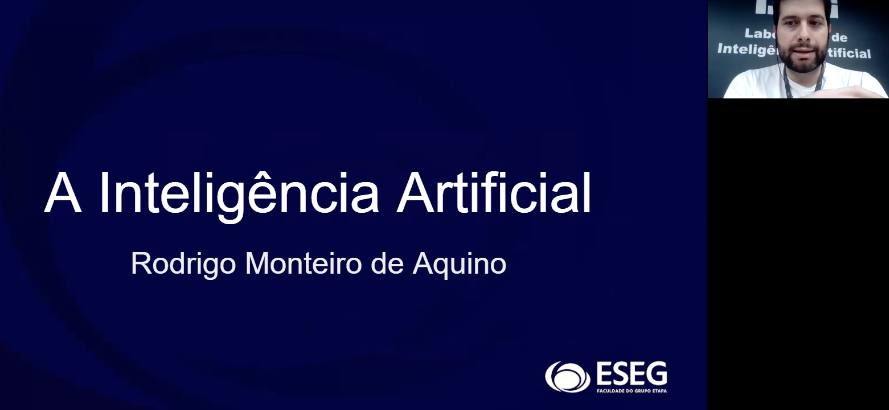
Aquino explained about AI and the myths surrounding this topic. “It’s not magic, nor is it some miraculous thing that solves all your problems. We have the vision that it’s something incredible, that researchers are involving us, or the propagated vision that it’s horrible and will destroy our jobs, our functions, and kill us in the future.” In reality, what we must understand is that there are more problems to solve than we imagine. AI is not perfect; there is still much to evolve, but always with the well-being of the population in mind. “Artificial Intelligence isn’t that intelligent. In fact, it’s a series of tools that we apply in the hope of trying to make a statistical mathematical model learn and identify certain profiles, certain patterns,” explains Rodrigo.
In data science, these applications are studied to generate useful results, since information, relevant or not, has always been accumulated. Today, data processing is much greater than it was 10 or 20 years ago. Techniques have evolved, and it's necessary to use them correctly so that companies can increase profits and solve complex problems more easily. "For example, a bank can decide whether or not to grant credit to a person and know if they will repay it within the agreed timeframe," illustrates the professor. This information is important in the banking system to determine in the future if a person with a similar profile to the one studied matches the same data.
The applications of this technology through robotics can be seen in everyday evolutions. We have several processes happening in the world that are changing the way we think and live, such as:
Given all that Artificial Intelligence can offer us through machine learning, the Data Science course aligns with the new technologies in the job market. Rodrigo explains the training stages: “To function in the real world, we use statistical techniques combined with computing techniques. In the first module, we will learn to program, training the student in the Python language so that they can solve simple problems. In the second module, we will provide a strong theoretical foundation in statistics to determine the best model to use for a given problem, and whether or not we can implement the applications,” explains Aquino. The third module will focus on expanding the knowledge already acquired, exploring neural network models and many other tools. Finally, the fourth module will focus on data presentation and how to present data for better decision-making.
Machine learning utilizes already categorized data, training algorithms for classification and regression. It's important to use as much information as possible. For example, one of the most commonly used applications of machine learning today is in games, creating a system of rewards and penalties. There are actions, probabilities, and barriers determined by the environment, and the player learns from each mistake until they pass the levels.
Given the numerous possibilities for using data, upon completion of the course, students can apply the rules and techniques learned in Data Science to various fields. This training is introductory, and there are many other niches to be explored, so it's important to always seek new knowledge. "The idea is that we provide the foundation, training in Data Science and knowledge of the Python programming language, so that students can create models using the techniques learned, neural networks, and algorithms," concludes the professor.
About the Data Science course
Starting on August 25, 2021. With online and interactive classes designed by industry professionals and academics, the course allows students a unique learning experience – regardless of their background.