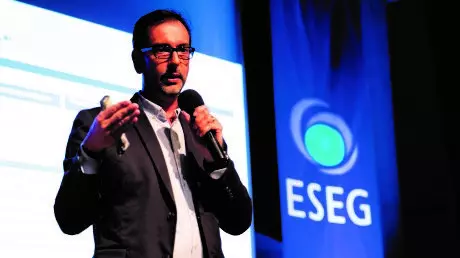
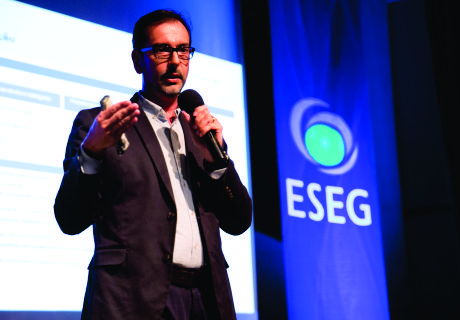
On March 9th, the inaugural lecture for the first semester of 2017 at ESEG was held for evening students. The lecture featured José Borges Frias Júnior, Director of Strategy, Market Intelligence, and Business Excellence at Siemens in Brazil, who spoke about the concept of Industry 4.0 and its importance for the recovery of Brazilian industry. A graduate in Mechanical Engineering and Business Administration, the guest speaker was welcomed by ESEG coordinator and professor Silvia Boarin, and professor João Ferreira Netto.
The term Industry 4.0 refers to a fully digitalized form of production. It was developed by the German government together with major business leaders in the sector to indicate that they had taken the lead in implementing the "Industry of the Future" – as it is also called.
Although it alludes to a possible 4th Industrial Revolution, still underway, the expert considers the current moment more of an evolution than a revolution, since the technologies enabling this advancement are already available in everyday life. "It's not technology discovered now, it's about combining the virtual with the real world. Simulating and testing in a virtual environment what one wants to apply in the real world, with the Internet of Things being one of the most significant examples," he explained.
He pointed out that globalization and mass access to information have greatly contributed to accelerating the process. It has become more difficult to please the consumer. In the classic consumption model, the company created and offered the finished product to the consumer – known as business-to-customer (B2C). Now, the consumer specifies to the company what they want – customer-to-business (C2B). The challenge is to be able to offer different, high-quality products to each consumer quickly.
According to Borges, the first step in creating a 4.0 Enterprise is to have a holistic view of the production chain, observing everything from the design phase to the final consumer. Next, there must be a standardization of security and information technology systems that allow for the digitization and integration of all production processes. When this is achieved, the company can simulate all the changes in the virtual world.
“Online simulation allows for the prediction and correction of errors that would occur in practice, which speeds up production, makes the creation of new products more flexible, reduces implementation errors, makes the process more fluid, and makes more efficient use of available resources, without waste. This is what gives us greater competitiveness against competitors,” he stated.
But there's no need to fear Industry 4.0. During the lecture, Borges cited a case where a robotic arm on a machine grabbed an object but couldn't release it in the correct place because it formed a kind of vacuum between the machine and the product. It took the person responsible for the sector noticing the problem, identifying the cause (the vacuum formed), and programming the machine to perform a different movement that prevented the vacuum from forming.
“"The Industry of the Future is here to improve the quality of human life. It will allow us to focus on nobler activities, requiring greater reasoning and creativity," he commented.
When questioned by ESEG students about how to stay updated for this change, Borges said that it is essential to develop a “holistic view of business. It is necessary to be creative and move across various disciplines. The professional of the future is not focused on just one area: they know about technology, they think about the environmental and social impact, etc.”, he stated.
Although the country is going through a period of crisis, with a strong process of "deindustrialization," Borges argues that Brazil can take advantage of this "turning point" to become a strong international competitor. "Industry 4.0 will be the great lever for a leap in productivity. The country needs to use the advantages of this technology to insert itself into this global value chain with products that are not so expensive and that have high quality. Otherwise, it will remain dependent on commodities," he said.
According to the speaker, Brazilians possess many characteristics seen worldwide as positive and that can facilitate the implementation of new industrial models aligned with the demands of the 21st century. "We are curious, we readily accept new technologies, and we don't tend to reject innovation. Furthermore, sectors of Brazilian industry such as automotive, aerospace, chemical-pharmaceutical, and food and beverage are already showing significant progress in adopting this format," he says.
Borges concluded by saying that companies of all sizes can benefit from this industry model, but that it's not something that happens overnight. "It's something that must be thought about and adopted gradually, without harming budgetary sustainability and while complying with current legislation," he noted.
Check out the video about the event. here.