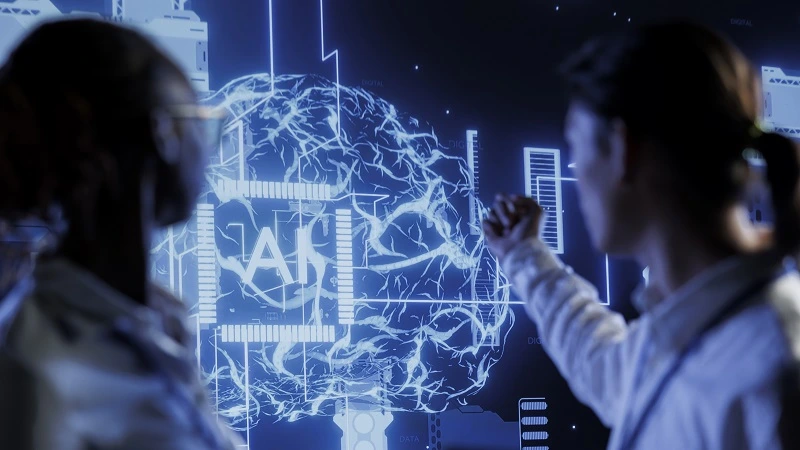




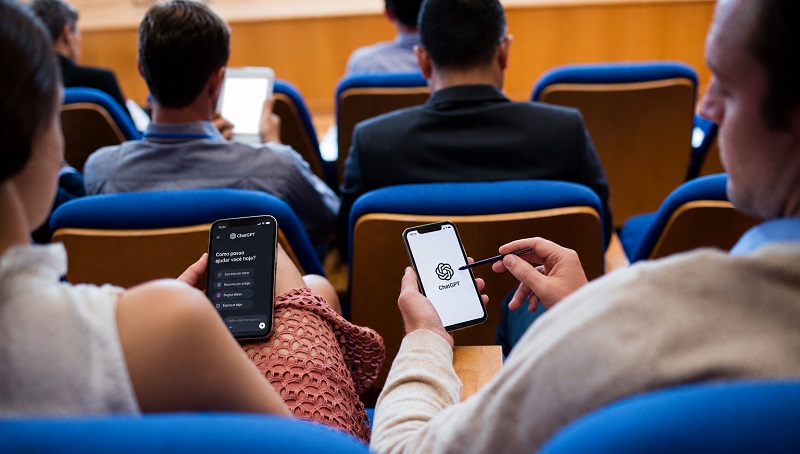
Artificial intelligence is no longer a technology restricted to laboratories and research centers. Today it participates in everyday activities: writing texts, analyzing data, producing code, summarizing documents, identifying patterns, and even helping us make decisions.
Therefore, it is up to us to realize or reflect that we have been in a period of great transformation for some time now. We are beginning to effectively coexist with machines capable of performing activities that, until recently, we associated exclusively with human intellect.
In this scenario, the relationship between artificial intelligence and education is becoming increasingly relevant, especially given the changes in how we learn, work, and make decisions.
Technology has always been a way to enhance human capabilities.

To understand why artificial intelligence represents such an important transformation, it is worth looking at the history of science and engineering itself.
At some point, thousands of years ago, human beings realized that reality could be represented in an abstract way. Geometry allowed for the measurement of land. Mathematics and its formulas helped us predict phenomena. Physics allowed us to understand the forces of nature. And engineering transformed these abstract ideas into concrete things.
Bridges, engines, airplanes, satellites, rockets, and computers arrived.
There is an interesting pattern in this trajectory: Technology has always enhanced some aspect of human capability.
The engine amplified our strength, the airplane allowed us to fly, and the computer greatly expanded our computing power.
But now, for the first time, we are building something different: A machine that thinks and is intelligent.
And why is this different?
When an artificial intelligence converses, writes a poem, produces code, or solves a mathematical problem, a different feeling arises. It seems to understand and act in a way very similar to how we act.
And this brings us to an important question:
What exactly does it mean to be intelligent? And is intelligence the same thing as consciousness?
If intelligence is the ability to solve problems, learn from experiences, recognize patterns, use language, or plan, then yes, one could say that AI is intelligent. It can, in fact, do all of that.
But there is another word that we often confuse with intelligence: consciousness. And perhaps they are quite different things.
A machine can recognize the word "risk," but it has never had to make a decision under pressure. It can analyze thousands of engineering projects, but it has never been involved in a construction project on-site. It can accurately describe how a negotiation works, but it has never had to reconcile conflicting interests in a meeting room.
And this point is crucial.
There is a difference between to describe a situation and have practical experience with it.. Artificial intelligence can process enormous volumes of information, identify patterns, and produce sophisticated responses, but that doesn't mean it understands context in the same way as someone who has deeply studied a problem, accumulated experience, and had to deal with its consequences.
That's precisely where education, experience, and critical thinking become even more important.
The more powerful the tool becomes, the more important our ability to assess the quality, limitations, and implications of what it produces becomes.
The criteria used to determine what is right, appropriate, or responsible do not come from technology alone. They depend on the knowledge, experiences, and judgment we develop over time.
To think or to outsource thinking?
This brings us to one of the most important questions in this discussion: Are we going to use artificial intelligence to think better or to think less?
Perhaps one of the greatest risks of artificial intelligence is not that it will become too intelligent. Perhaps it is that we will increasingly accept exercising less of our own [skill/power]. critical thinking.
In this new context, it will become increasingly easy to ask a machine:
Solve this problem. Analyze this data. Create this code.
And often she will do it very well.
The temptation will be enormous. After all, why dedicate hours to studying, analyzing, or solving a problem if a machine can produce an answer in a few seconds?
But there is a fundamental difference between using AI to broaden our thinking and use it for Think for us.
A GPS can help someone reach a destination faster. But, if used excessively, it can also cause a person to gradually lose their ability to orient themselves.
Perhaps artificial intelligence could produce something similar on a much larger scale.
We can use it as a kind of new and more powerful computer: a tool capable of helping us explore hypotheses, compare alternatives, and organize information.
But we can also use it as a shortcut to avoid things that require effort.
Thinking requires effort. Learning requires time. And questioning requires knowledge.
And that's precisely why... Training, experience, and human skills remain just as important.
Education becomes even more important.
Therefore, it might be wrong to imagine that artificial intelligence will diminish the importance of education.
Actually, it seems to me quite the opposite.
If machines can produce increasingly better answers, we need to train people who are increasingly capable of evaluating them correctly.
And here's an interesting point:
The better the answers produced by artificial intelligence become, the more important the knowledge and education of those who need to judge them becomes.
Because we can only identify a flawed premise if we know the subject well enough.
Thus, the importance of education lies in building good and solid foundations.
Teaching mathematics, physics, programming, statistics, economics, science, history, philosophy, and so many other areas is very important. Because now, more than ever, We need people with critical thinking skills.
But education cannot be limited to theoretical knowledge. It also depends on practical experience, living in society, and developing essentially human values such as ethics, empathy, responsibility, respect, and the ability to coexist with different perspectives.
It is the combination of knowledge, experience, and values that forms the intellectual and human repertoire necessary to evaluate, question, and utilize what machines produce. Artificial intelligence can offer answers, but it is up to people to understand the context, judge its consequences, and decide how this knowledge should be applied.
In this sense, the use of artificial intelligence in education should not be thought of merely as a way to make learning faster, but as an opportunity to expand knowledge without replacing the development of intellectual autonomy.
And perhaps this is one of the main missions of education in this new scenario: To train people capable of working with increasingly intelligent systems without sacrificing their own intellectual autonomy.
The impact of artificial intelligence on education.
So we return to the central question of this text: Will we use artificial intelligence to enhance our capacity for thought, or will it replace our own thinking?
The answer will not come from the technology itself, nor from more sophisticated models, but rather from how we choose to use it.
It is in each small moment that we question a ready-made answer, when we verify its premises, understand the limits of the machine's thinking, and recognize when it may be wrong.
Artificial intelligence will certainly change the way we study, work, and solve problems. The impact of artificial intelligence on education will also be seen in how students and professionals develop knowledge, evaluate information, and use new tools to learn and solve problems.
Some activities that seem complex today will become trivial. And new possibilities will emerge precisely because we will have much more powerful tools at our disposal.
But it seems that the big question in education now is no longer about teaching people how to find answers.
It will be teaching them to To ask good questions, to deeply understand the problems, and to have enough knowledge to recognize when an answer, whether human or artificial, is wrong.
Because, in a society where answers will be increasingly abundant, the ability to think deeply may become one of the most valuable skills of all.
We then conclude with what appears to be the great opportunity for education in the age of artificial intelligence:
The opportunity lies not in competing with machines that can respond faster than humans, but rather in training people who know how to think and evaluate the quality of those responses.
Professor Thales Sakamoto
Looking for training in artificial intelligence? At ESEG College, Artificial intelligence is part of the education of students in different areas of knowledge.
The courses include subjects and content that cover AI, programming, data analysis, and new technologies, preparing students to understand and use these tools critically, responsibly, and in a way that is connected to the needs of the professional market.
Discover the courses offered by ESEG College., Join Grupo Etapa and discover how technology and knowledge can be part of your education.