





A production engineering in person It is one of the most sought-after training programs in Brazil. For those who wish to work in strategic areas of planning, control, innovation, and management of industrial and service processes.
Unlike other engineering courses that have a more technical focus on machines or constructions, production engineering It deals directly with the efficiency of production processes, quality, and cost reduction.
In this article, you will understand what production engineering is, how the course works in the face-to-face format, and the main advantages of this modality.
Keep reading to learn more about this topic!
What is Production Engineering?
Production engineering is the area responsible for To integrate knowledge from engineering, administration, and economics to optimize production processes.
Production engineers can work in a variety of sectors, from the automotive industry to hospitals, banks, and technology companies.
The goal is always to improve the use of resources — whether material, financial, or human — so that results are achieved with quality, efficiency, sustainability, and of course, economy.
What does a production engineer do?
Among the main functions of a production engineer they are:
- Supply chain and logistics management.
- Production planning and control.
- Implementation of quality and productivity systems.
- People and process management.
- Sustainability in industrial projects.
Because of this versatility, many people discover that it is a broad career path, with different career options and good job opportunities.
What is the in-person Production Engineering course like?
O in-person production engineering course It has an average duration of 5 years (10 semesters) and is offered full-time, during the day or at night, depending on the institution.
A The curriculum for production engineering is quite diverse, as it combines foundational engineering subjects such as calculus, physics, and statistics with management-related subjects like economics, administration, and logistics.
Among the most common subjects in a production engineering degree are:
- Differential and integral calculus.
- Probability and statistics.
- Operations research.
- Production and operations management.
- Economic engineering.
- Quality systems.
- Logistics and supply chains.
- Production planning and control.
- Ergonomics and workplace safety.
In addition to theoretical subjects, the on-campus production engineering course requires the completion of supervised internships and practical projects, such as the Final Course Project (TCC).
Read also: Does Production Engineering involve a lot of calculations?
What are the advantages of attending an in-person Production Engineering program?
Many students are unsure whether to do one. in-person or distance learning course.
In the case of andin-person production engineering, The advantages extend far beyond the classroom.
See 6 benefits of attending an in-person Production Engineering program below!
1. Access to laboratories and equipment
Unlike distance learning, in-person learning allows for direct and frequent contact with specialized laboratories, such as:
- Laboratory for simulation and production processes: to test production flows and create solutions for bottlenecks.
- Applied physics and chemistry laboratories: important for understanding the experimental basis of engineering.
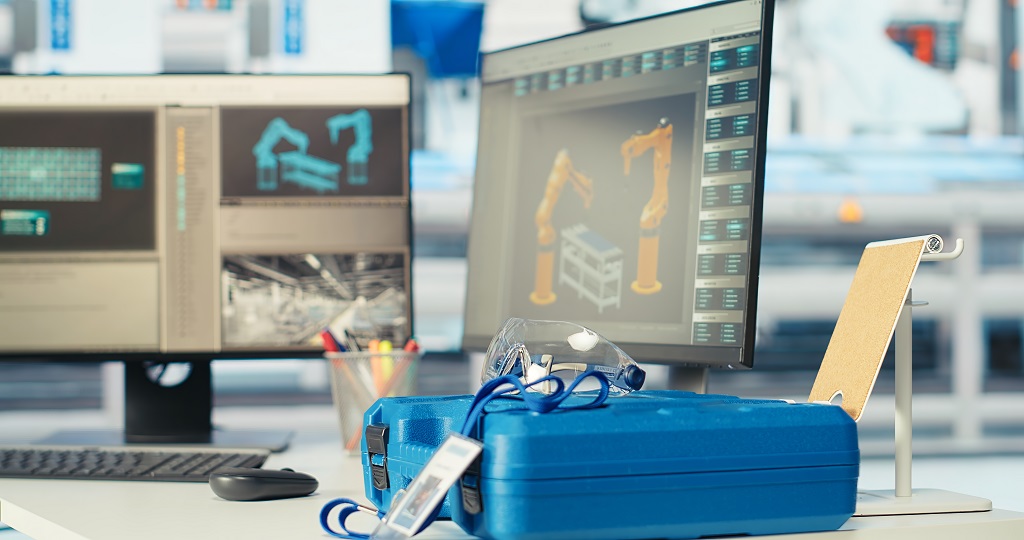
- Computer labs with management software: Used for learning planning and analysis tools, as well as innovation and technology labs.
- Ergonomics and occupational safety laboratories: to evaluate and propose improvements in the production environment.
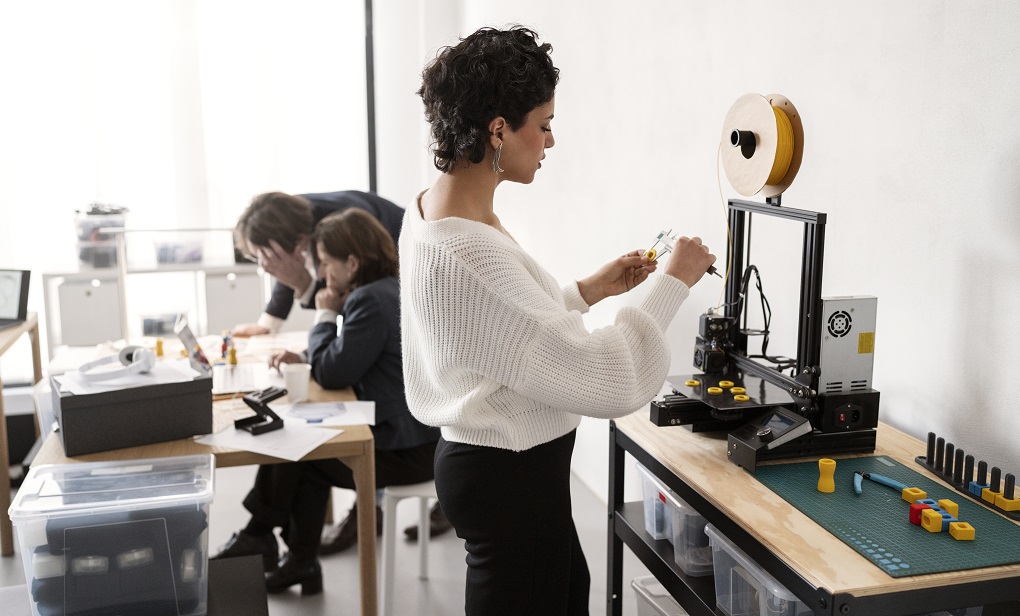
- Spaces equipped with 3D printers and prototyping technologies: which make it possible to develop models and validate solutions in a practical and innovative way.
These environments allow students to experience the challenges of the profession in practice, acquiring skills that would be difficult to develop in online courses.
2. Direct contact with teachers and colleagues
Face-to-face interaction enriches learning., since teamwork allows for the combination of different skills and perspectives.
Each student can contribute their strengths, complementing the others and resulting in more complete and creative solutions for the projects.
Furthermore, attending college in person expands networking opportunities., Essential for securing internships and future job opportunities.
3. Development of soft skills
In the in-person format, the student has the chance to work in groups, give presentations, and face practical situations in the classroom or laboratory.
This fosters the development of interpersonal skills., such as the well-known soft skills, like communication, leadership, teamwork, and time management.
These skills are increasingly valued by companies. They are acquired naturally through daily life or in an in-person degree program.
Furthermore, soft skills make all the difference when it comes to securing a job in the labor market.
4. Focus and Immersion
Studying in a physical environment, such as classrooms and laboratories, helps the student to... To fully concentrate on learning, away from distractions that may arise at home or elsewhere.
Being on campus allows for complete immersion in the content, encouraging participation in debates, practical work, and group projects.
Furthermore, Being physically present stimulates focus and engagement with academic life., such as events, lectures and complementary activities, strengthening the learning experience and making the training richer and more meaningful.
5. Clarification of doubts
Because it is a somewhat complex profession, the The in-person format allows students direct access to teachers, making it easier to ask questions during class and deepen their knowledge.
This instant interaction allows complex concepts to be explained in a personalized and practical way, ensuring that learning is more solid and efficient.
Furthermore, the Proximity to teachers allows for individualized guidance. in projects, assignments, and internships, better preparing students for real-world challenges in the job market.
6. Better preparation for the job market
Production engineers need to combine theory and practice to be competitive.
Therefore, attending college in person guarantees a more solid and complete education.
Direct contact with laboratories, professors, and colleagues. It allows students to become familiar with real-world industry challenges, developing not only technical knowledge but also practical management, negotiation, and real-world decision-making skills.
In this way, the student arrives at Production Engineering job market better prepared to handle complex situations and excel in selection processes.
Colleges with Production Engineering
There are several colleges with Production Engineering In Brazil, both public and private.
In São Paulo, Some institutions stand out for their infrastructure, quality of teaching, and student employability.
At ESEG College, part of the Etapa Group, You can find an updated curriculum, designed with the future of professions and employability in mind.
See below for more information about the Production Engineering course from ESEG College!
Production Engineering in-person course at ESEG College
ESEG College in São Paulo is one of the best options for those who wish to study Production Engineering in person.
Located in an easily accessible area, next to the Paraíso metro station, ESEG offers a updated curriculum, experienced teachers and innovation and technology labs, such as those at ESEG, which provide practical learning that is connected to market demands.
What sets ESEG apart for those seeking a degree in Production Engineering:
- State-of-the-art laboratories, including simulation rooms, computer labs, and 3D printing facilities for developing robots and other models.
- Practical projects and real-world challenges in partner companies and other challenges.
- Qualified teaching staff, with masters and doctoral degree holders active in the market.
- Personalized service, which guarantees support for the student throughout their academic journey.
- Employability: The college maintains strategic partnerships that increase the chances of internships and professional placement; 98% of the students graduate with jobs or as entrepreneurs.
For those seeking the best Production Engineering colleges in São Paulo, ESEG is a leading institution, combining tradition, innovation, and a focus on career development.
Where can I find in-person Production Engineering courses?
If you are unsure about Where can I find in-person Production Engineering courses?, The answer is simple: look for institutions recognized by the MEC (Brazilian Ministry of Education), which offer good infrastructure, qualified faculty, and connections to the job market.
In addition, consider factors such as:
- Location of the college.
- Quality of evaluations at the MEC (Brazilian Ministry of Education).
- Available physical and technological infrastructure.
A ESEG College It is recognized by the MEC (Brazilian Ministry of Education) and meets all these criteria, making it an excellent choice for those who want to study Production Engineering in person, with all the necessary infrastructure to excel in the market.
Conclusion about in-person Production Engineering
A in-person production engineering It is a strategic training for those who want a A broad and promising career path, with opportunities in various sectors of the economy.
Despite requiring more time, the practical learning in laboratories, the solid preparation for the job market, and the direct contact with colleagues and professors are all advantages. This makes this the preferred method for many students.
If you are still evaluating which Which Production Engineering college to choose in São Paulo?, ESEG College stands out for its quality of teaching, complete infrastructure, and focus on developing professionals prepared to face the challenges of industry and services in the future!
Visit our website and discover our courses!
The undergraduate program typically lasts five years and includes subjects such as calculus, physics, statistics, logistics, production management, economic engineering, and operations research. In addition to theoretical classes, students undertake practical activities, projects, and supervised internships.
A production engineer works with production planning and control, logistics, quality management, process improvement, supply chain management, team management, and the development of projects aimed at increasing productivity.
Yes. The course includes subjects such as calculus, statistics, physics, and operations research. This knowledge is used for data analysis, planning, and decision-making throughout the undergraduate program and career.
A bachelor's degree typically lasts five years, spread over ten semesters, although this may vary depending on the institution.
When choosing an institution, it is recommended to check its accreditation by the MEC (Brazilian Ministry of Education), the quality of its infrastructure, the available laboratories, the faculty, internship opportunities, and the college's connection to the job market.