
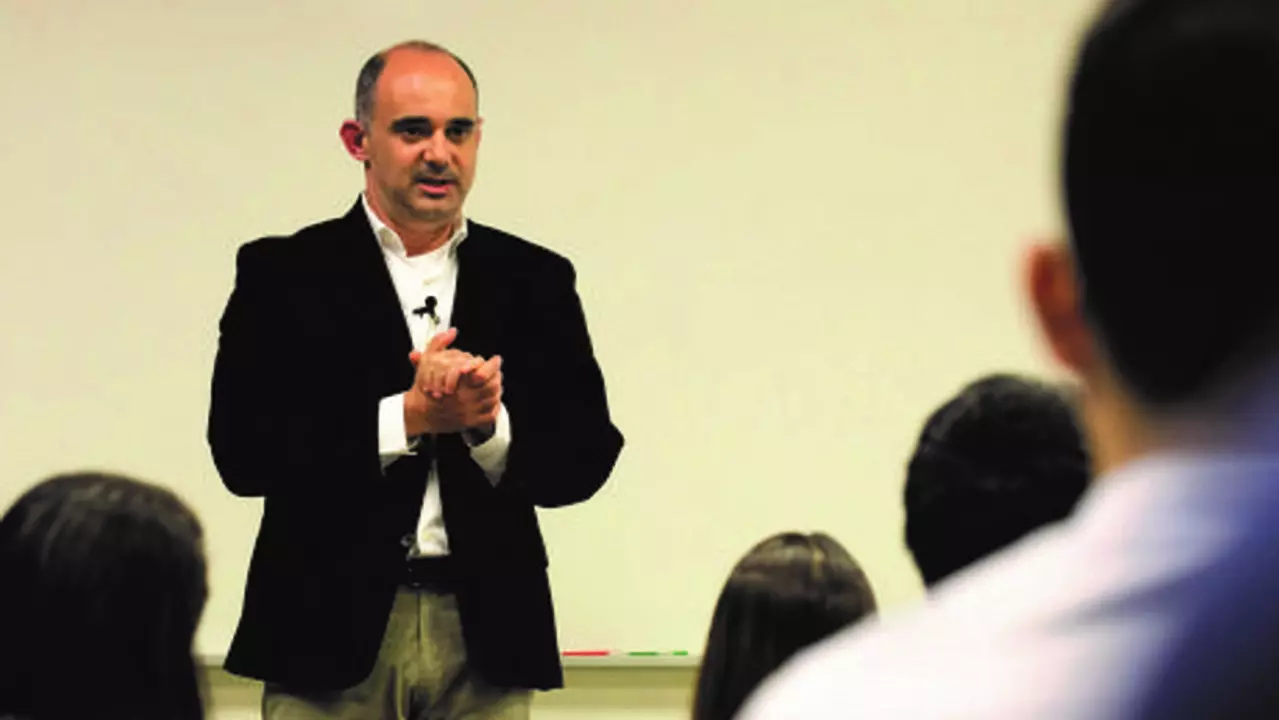
Guilherme Moreira, an economist from Fiesp and Ciesp, presented an overview of the Brazilian industrial sector to ESEG students taking Economics and Entrepreneurship courses on March 14th.
The expert indicated that the "deindustrialization of Brazil" (the share of industry in GDP was once 22% and today represents only 11.5%) occurred due to a series of macroeconomic issues such as, for example, the low exchange rate (in an attempt to control inflation), the focus on the production/export of commodities, and the high cost of production in Brazil.
With the low exchange rate, imports increased, and domestically manufactured products needed to maintain their prices to compete with those from abroad. However, the service sector (hairdressers, restaurants, etc.) significantly increased its prices. In other words, production costs increased, but industry cannot pass the cost on to the product. Basing industry solely on commodity production is detrimental because it's a short production chain process that doesn't involve many people between raw materials and the final product, generating fewer jobs and less economic activity.
Furthermore, the economist criticized the bureaucracy that companies face when producing in Brazil: “It’s a much more difficult, more expensive business environment, with higher taxes than in other countries. Companies stop exporting and lose their place in the domestic market,” he explains.
The big problem with "deindustrializing the country" is that, especially during times of crisis, the multiplier effect of industry decreases. If the sector's share of GDP has halved, the ability to emerge from the crisis with its help is also reduced by a similar proportion.
Nevertheless, Guilherme is optimistic about the emergence of new opportunities starting this year. He believes the worst is over and that growing 0.5% in 2017 is already very positive. For him, Brazil will always need a strong industry, since imports alone are not capable of meeting the demands of a sophisticated economy with high purchasing power like ours.
According to the economist, the government can help reverse this scenario more quickly. "The government's role is to facilitate business activity as much as possible without favoring one sector over another. It needs to reduce bureaucracy and lower the tax burden on producers. This boosts the economy as a whole, as it generates gains that spread across all sectors of society through job creation," he said.
As advice for ESEG students graduating this year and next, he pointed to the importance of qualification. “Every recovery from a crisis means that things have been destroyed and new things will have to be built. Therefore, starting in 2017 the country will return to growth, and those who are qualified will have many opportunities, especially in technical fields,” he concluded.
Watch here to a video about the event.