




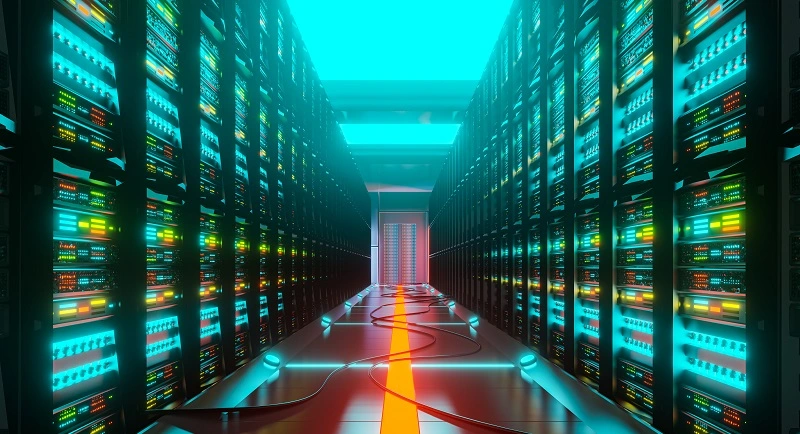
There is a physical place behind virtually everything we do in the digital environment.
When a video call happens without interruptions. When an app responds instantly. When a company analyzes millions of pieces of information in seconds. None of this happens in a vacuum.
For a long time, the expression "in the cloud" helped create the feeling that the digital universe exists somewhere abstract, far removed from physical reality. But the truth is almost the opposite.
Behind the cloud lie entire buildings designed to operate without interruption. Environments that concentrate electrical power, high-speed connectivity, advanced cooling systems, and thousands of pieces of equipment processing data all the time.
This structure is what we call a Data Center. Although it often remains invisible to those who use technology, it has become one of the most important foundations of the digital economy.
Today, understanding digital infrastructure is no longer just of interest to technology professionals. The topic helps explain how companies scale operations, how digital services work, and why entire countries have begun competing for investments in this sector.
This transformation also explains why topics such as digital infrastructure have come to occupy space in discussions about business, innovation, and professional training. It is in this context that initiatives such as... ESEG Talks They bring the market closer to conversations that help us understand the future of technology.
This article was based on the episode of ESEG Talks with Victor Arnaud, president of Equinix Brasil. In it, you will understand what a Data Center is, how this infrastructure works, and why it has become one of the most important gears in the connected world.
What is a Data Center?
A data center is a physical structure designed to store, process, and distribute data continuously.
Also known as a data processing center, this environment brings together servers, network systems, power, cooling, and advanced monitoring mechanisms.
But this technical definition still doesn't fully capture what a Data Center represents today.
Because a data center doesn't just store files. It sustains experiences.
Every time a company runs a management system, processes payments, or uses artificial intelligence, there is a digital infrastructure working to make it happen.
Read also: Artificial intelligence: how will AI impact your profession?
In practice, data centers have become the modern equivalent of a large power grid. You don't see it, but you depend on it all the time.
And the more connected a society becomes, the more critical this infrastructure becomes.
A few years ago, large organizations maintained their own internal environments.
Today the scenario has changed.
The growth of the cloud has enabled companies to use infrastructure on demand, increasing the speed of innovation and reducing barriers to expansion.
Therefore, the data center market has stopped growing solely in terms of capacity.
It began to grow in relevance.
How does a data center work?
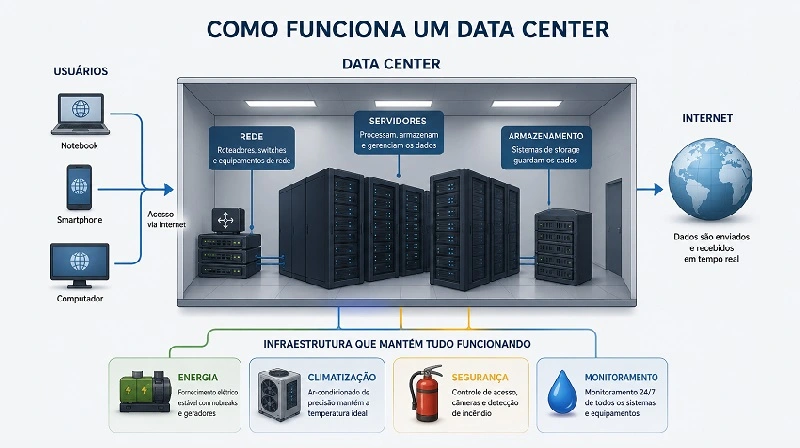
To understand how a data center works, it's helpful to imagine a city.
A city needs energy, roads, supplies, control, and maintenance to continue operating.
A data center works in a similar way.
At the heart of this operation are the servers.
They receive requests, process information, and return responses in fractions of a second.
When someone accesses a website or uses an application, an almost invisible sequence of events takes place.
- The system receives a request.
- Process.
- Look up data.
- Returns a response.
All this in just a few moments.
But the server alone doesn't solve the problem.
There is an entire infrastructure in place to ensure that this operation remains stable.
And that's precisely what differentiates a typical corporate environment from a high-availability data center.
Physical infrastructure and air conditioning: The challenge that almost no one sees.
There's a curious aspect to data centers.
In many cases, the biggest challenge isn't processing capacity. It's the heat.
Each server in operation generates thermal energy. Now imagine thousands of them running at the same time.
Without proper environmental control, the consequences appear quickly:
- Performance decline;
- Increased wear and tear on equipment;
- Greater operational risk;
- Reduced energy efficiency.
For this reason, the physical infrastructure of a Data Center receives the same level of attention dedicated to its computing capacity.
The entire environment is designed to maintain operational stability and continuous efficiency.
Among the main elements of this structure are:
- Organized corridors to direct heat flow;
- Strategic distribution of refrigerated air;
- Continuous monitoring of temperature and humidity;
- Sensors that monitor performance in real time.
This need has become even more evident with the advancement of artificial intelligence.
More robust models require greater processing power.
More processing power requires more energy.
And more energy demands increasingly efficient cooling solutions.
Therefore, when we talk about the future of technological infrastructure, limiting the discussion to servers no longer makes sense.
The real difference lies in the efficiency of the entire operation.
Security and power redundancy
Few modern structures tolerate interruptions.
Data centers are among them.
- Think of a banking transaction.
- A streaming platform.
- A hospital.
- A connected industry.
Now imagine these systems being unavailable for a few minutes.
The economic impact would be immediate.
That's why the concept of energy redundancy exists.
If the power grid fails, the data center cannot simply shut down.
Therefore, the infrastructure includes uninterruptible power supplies (UPS), batteries, and generators prepared to take over operation immediately.
In practice, the user doesn't even realize there has been an interruption in the external power supply.
How do data centers drive digital transformation?
Digital transformation has become one of the most frequently repeated expressions in the market.
But there is an important question:
“"Where does this transformation take place?"”
The answer lies precisely in the infrastructure.
Every innovation needs a foundation.
Cloud applications require computing power.
Artificial intelligence requires processing power.
Digital experiences require low latency.
And data center companies make it possible for all of this to scale.
In the episode of ESEG Talks, one of the points that emerge in an interesting way, by President of Equinix Brazil, Victor Arnaud, It is precisely this change in perception.
Infrastructure is no longer seen merely as technical support.
It came to be considered an enabler of growth.
This completely changes the strategic role of the sector.
Companies are not only looking for technology.
- They seek speed to innovate.
- They seek proximity between systems.
- They seek the ability to respond quickly to the market.
At the heart of it all is the digital infrastructure.
What are the largest data centers in Brazil?
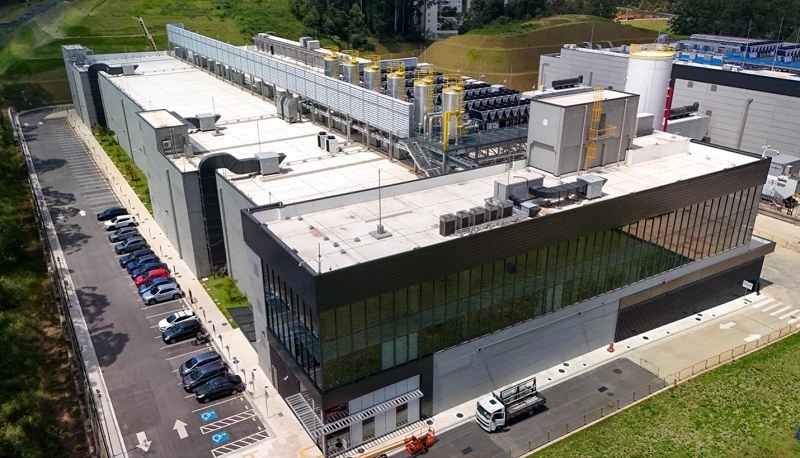
Brazil has established itself as one of the most important markets for the expansion of digital infrastructure in Latin America.
This growth is accompanied by profound changes in the behavior of companies and consumers.
Operators such as Equinix, Ascenty, ODATA, Scala, and Elea represent the largest data centers in Brazil, while companies like Amazon Web Services (AWS), Microsoft Azure, Google Cloud, and Oracle Cloud Infrastructure are among the largest data centers in the world.
More than just physical size, these companies help build complete connectivity ecosystems.
And there's an interesting point here.
The more infrastructure remains within the country, the greater the local processing capacity, the generation of skilled jobs, and the technological development tend to be.
Therefore, data centers have also become part of national economic discussions.
Read also: Check out 15 areas to work with technology.
What is ReData and why has it gained strategic importance?
In recent years, the debate about data centers has gone beyond the technology sector.
The government began discussing ways to encourage investment in digital infrastructure.
In this context, ReData emerged, a program created from the provisional measure for data centers proposed by the federal government.
The initiative became known as the Data Center Provisional Measure and seeks to stimulate the expansion of installed capacity and strengthen Brazil's position within the economy.
However, the measure expired in February 2026, and the government is studying alternatives to reinstate the program.
The reasoning is relatively simple.
If data has become an economic resource, then processing power will become one as well.
Countries that are able to develop infrastructure gain competitiveness.
Therefore, this topic should gain even more relevance as artificial intelligence and digital services increase computational demand.
The future of data centers will be less invisible.
For decades, data centers remained hidden.
Few people thought about them.
Today, that is changing.
The growth of artificial intelligence, cloud computing, and connectivity has placed infrastructure at the center of the conversation.
Because all innovation needs a place to exist.
And this place remains physical.
Perhaps this is the most interesting point to remember:
The more digital the world becomes, the more important the infrastructure that supports it all becomes.
Understanding what a data center is has become a way to understand where the economy is heading.
If you want to accelerate your progress and build a promising future in this field, investing in a quality, structured education could be the missing piece.
A ESEG College It includes courses related to technology and innovation, so that your training is aligned with market demands.
Visit our website and discover the undergraduate courses that can help you achieve your professional goals.
Watch the full episode about Digital Infrastructure and the AI Revolution:
Frequently Asked Questions about data centers in Brazil
What is a Data Center in simple terms?
A data center is a physical structure where data from websites, applications, and systems is stored, processed, and protected.
In practice, it functions as the "brain" of the internet, using servers and infrastructure to keep digital services running securely and continuously.
Are data centers and the cloud the same thing?
No. A data center is the physical structure where data is stored and processed. The cloud, on the other hand, is the service that allows access to these resources via the internet. In short: the cloud operates on top of data centers.
What is the role of data centers in digital transformation?
Data centers support digital transformation by providing infrastructure for applications, artificial intelligence, data storage, and connectivity, ensuring the performance, scalability, and availability of digital services.
Is Brazil experiencing growth in this market?
Yes. Brazil has been increasing investments in digital infrastructure and attracting new data center operations to meet the growing demand for digital services, cloud computing, and data processing.