




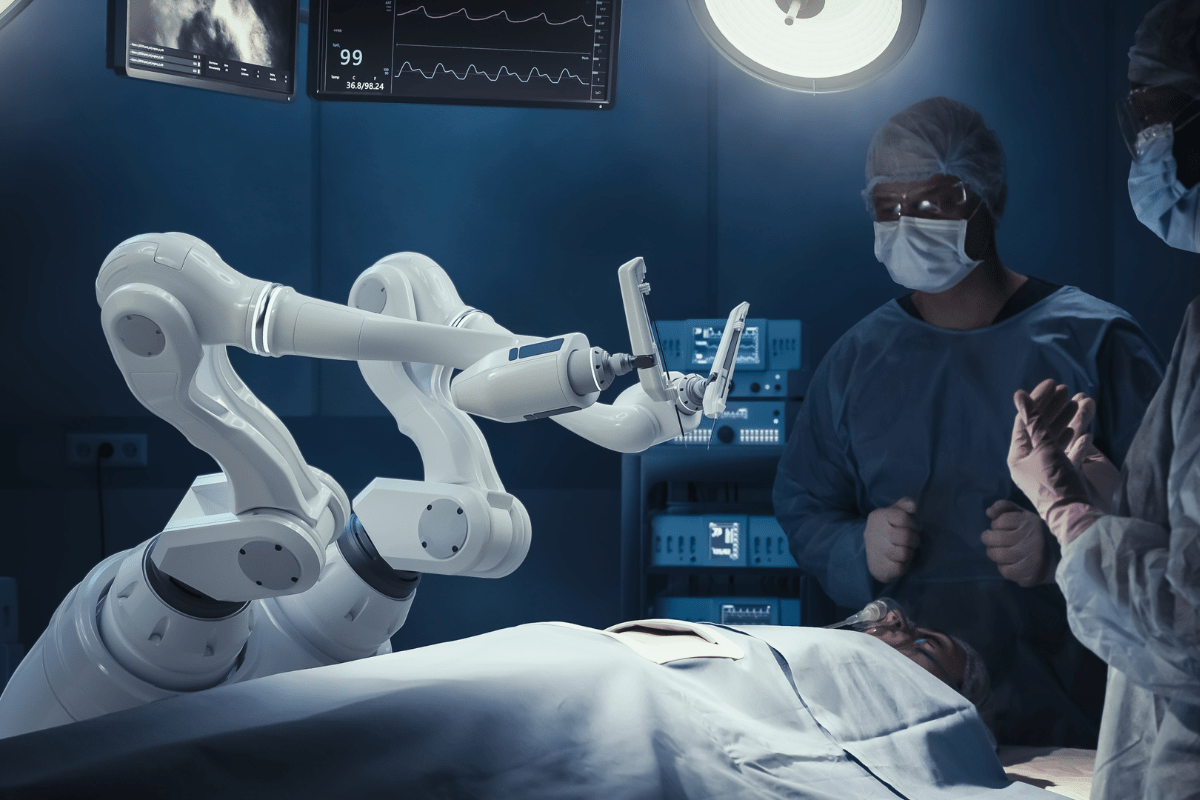
Advanced robotics applied to medicine.
In the contemporary era of medicine, We have witnessed remarkable advances driven by the convergence of technology and medical science, and among them emerges... robotics advanced, raising the standards of precision and effectiveness in clinical procedures.
This article explores the innovations and applications of robotics in medicine, highlighting how these technologies are shaping the future of patient care and opening new frontiers in the field of healthcare.
Come with us?
Read more: Robotics: what it is, what it's for, and why work in this field.
Definition of robotics
A robotics It is an interdisciplinary field that encompasses the design, construction, programming, and operation of robots, combining engineering principles, science of computing and the promising advances in artificial intelligence.
Robots, in turn, are programmable devices that can perform tasks autonomously, if coded to do so, or be controlled by humans.
These tasks can range from industrial and surgical operations to space exploration and assistance in domestic settings.
When we talk about advanced robotics, we are talking about a set of refined technologies capable of performing increasingly complex tasks.
These are machines and equipment that perform tasks that were previously carried out by humans, or even tasks that were impossible for human hands to perform.
Advanced Robotics in Medicine
A robotics Advanced technology has been applied to various areas of the field in recent years. Medicine, especially with regard to surgeries.
Robotic surgical systems allow for minimally invasive surgeries, with smaller incisions, shorter recovery times, and a lower risk of postoperative complications.
One of the best-known systems used by hospitals around the world is the Da Vinci system.
Developed by the company Intuitive Surgical, It was designed to assist surgeons in various specialties, including urology, gynecology, cardiac surgery, and others.
It consists of a surgeon's workstation and a robotic unit composed of mechanical arms equipped with surgical instruments.
The surgeon's station allows the professional to remotely control the movements of the instruments, offering a three-dimensional, high-definition view of the surgical field via a console.
Currently, many hospitals are successfully using this technology to improve healthcare.
Read more: Artificial Intelligence in Medicine
Robotics has also been applied in other areas of Medicine as:
Advanced diagnostics
Robots They are used to obtain more accurate and faster diagnoses.
Autonomous systems can analyze medical images, such as X-rays and MRIs, identifying patterns and assisting healthcare professionals in diagnosing medical conditions.
Therapy and rehabilitation
Robotic devices are used in rehabilitation therapies to help patients regain mobility after injuries or surgeries.
These adaptable systems can offer personalized therapies, adjusting to the individual progress of each patient.
Interested in studying abroad? Check out ESEG's international department!
Medical training
Robotic simulators can be used in the training of healthcare professionals.
They provide realistic simulated environments for practicing surgical procedures and training clinical skills.
In conclusion, the merger between robotics Advanced medicine not only represents technological evolution, but also outlines a promising horizon for excellence in healthcare.
Millimeter precision, the ability to perform complex procedures, and risk minimization are just some of the remarkable contributions of this symbiosis.
As we continue to explore and refine these technologies, it is evident that we are facing an era in which robotics not only assists but also leads the transformation of the medical landscape.
Do you want to be part of this future?
Enroll in undergraduate courses at Computer Engineering and of Production Engineering From ESEG College, part of the Etapa Group, invest in powerful and up-to-date learning that meets the demands of the job market.