



Do it yourself. How many times have you heard or read that phrase? Just open YouTube or Instagram and thousands of videos with that expression will appear in the search results. social media. It has gained even more popularity in recent years with the increased value placed on humans as part of the production process, based on what we call Maker Culture.
When we talk about Maker Culture, what comes to mind? In this article, you'll discover how the movement has transformed organizational relationships and the school environment. Read on.
What is Maker Culture?
Maker Culture is a movement that encourages the creation of tools for personal use, utilizing creativity and products already available. In other words, it's about getting hands-on and developing ideas in practice.
It emerged in the late 1960s, inspired by punk culture, which had a habit of breaking the rules and establishing its creations through its own materials — so much so that part of its promotion was based on the musicians' own productions.
Despite this inspiration, the concept became more popular after the launch of Make magazine in 2005 and the Maker Faire event in 2006, which brought together hundreds of creators. This showcased a new way of producing and undertaking projects.
But this movement wasn't limited to the entrepreneurial market. Education also began to embrace Maker Culture as a strong ally. Next, we'll explore how this has positively impacted educational initiatives.
What is the objective of this movement?
In the Maker movement, there is a basic premise: learning through action. In this sense, the act of "getting hands-on" is essential for absorbing knowledge. In general, we can summarize the main goal as making the student the protagonist of their intellectual development.
Challenging activities, stimulating creativity and out-of-the-box thinking These would be essential for solving current problems. Furthermore, this serves as an incentive to find more efficient answers to the main issues surrounding society, whether in the educational or organizational sphere.
In short, the idea is to encourage contact with other contexts by engaging students, regardless of the environment they are in, and bringing a more dynamic reality to everyday life.
What are the benefits of maker culture?
Maker culture has been increasingly explored and celebrated in different areas—and for good reason. Practices based on this concept help individuals to be more active and develop actions that lead them to their goals. goals and objectives.
Discover below some of the main benefits of embracing Maker Culture.
ENGAGEMENT
Engagement initiatives are highly relevant, both in the educational field and in the business context. Engaging people is more than just maintaining their presence—it also means attracting, involving, and ensuring greater commitment to the project or team.
In schools and colleges, engagement allows even the most disinterested student to connect with others and participate in assigned tasks. An engaged student is more participative, motivated, and able to become the protagonist of their own learning process.
Learning to work in a team is also essential in professional life. It's not just about being part of a group, but about aiming for a common purpose and making a difference as a team member. In this sense, Maker Culture contributes to increased engagement—with the team and the project—and increases the success of work results.
PROTAGONISM
With Maker Culture, individuals are empowered to develop and implement solutions to the problems presented. This gives students or professionals a leading role, as they need to manage their own projects without receiving specific orders or instructions.
Being proactive is a valuable skill and aligns with expectations of labor market Currently, as a consequence of recognizing their autonomy, people feel more motivated to overcome the challenges presented to them. This dynamic of valuing and "hands-on" involvement remains a driving force that propels individuals further forward.
CRITICAL THINKING
One skill that sets an individual apart in any environment is critical thinking. In a society with so many pre-formed opinions, easily disseminated and "bought" with little or no basis, adopting a critical perspective before formulating one's own arguments is a highly valuable trait.
Critical thinking gives rise to a more questioning perspective, seeking objective answers. This is an important factor for achieving excellence in any field, as it allows one to break free from "ready-made recipes" and broaden the possibilities for individual action.
How is maker culture changing people's daily lives?
Reality has changed, forcing people to create alternative solutions. The world has become more connected, with new... technologies Emerging every day. With the consumer dictating the rules, old business and education models have also had to change in order to give true protagonism to those who will actually experience all the experiences.
MAJOR DIALOGUE
One of the important points, reflecting the Maker Culture, is that companies have begun to have greater dialogue with people, which helps in creating products more quickly. This has opened up space for new businesses to emerge; just look at the rise of startups in the market.
DYNAMIC TEACHING
In the field of education, teaching has ceased to be something so rigid, in which the student acted only as a passive subject. In this new scenario, the student has become one of those responsible for their own knowledge, capable of creating elements for personal use and, from this, acquiring essential skills for later inventions.
What is the importance of its application in educational institutions?
Educational institutions that have adopted Maker Culture in the design of their educational projects are reaping favorable results in student engagement and achievement. See below for areas of improvement in this area.
Strengthening the transformative role of the institution
Educational institutions should play a transformative role in people's lives—at least that's the idea that should guide their educational proposals. However, not all of them fully implement this concept, due to investment limitations and potential curricular rigidity.
Therefore, by incorporating Maker Culture into the school and academic environment, the transformative duty that the educational institution should have is reinforced. Alignment with this premise enables the institution to move forward in line with global sustainability issues and meet the demands of new generations, who are increasingly aware and want to have a positive impact on the world they live in.
DEVELOPING 21ST CENTURY SKILLS
The classroom is not, and no longer needs to be, a space where knowledge is merely reproduced by one person and others must accept it without question. The environment can (and should) focus on valuing practice, stimulating critical thinking, and developing knowledge that brings students closer to the demands of the real world.
With the help of Maker Culture, educators have tools to develop, together with their students, the so-called 21st-century skills, which includes the union of the triad "cognition, interpersonal skills, and intrapersonal skills," based on student protagonism.
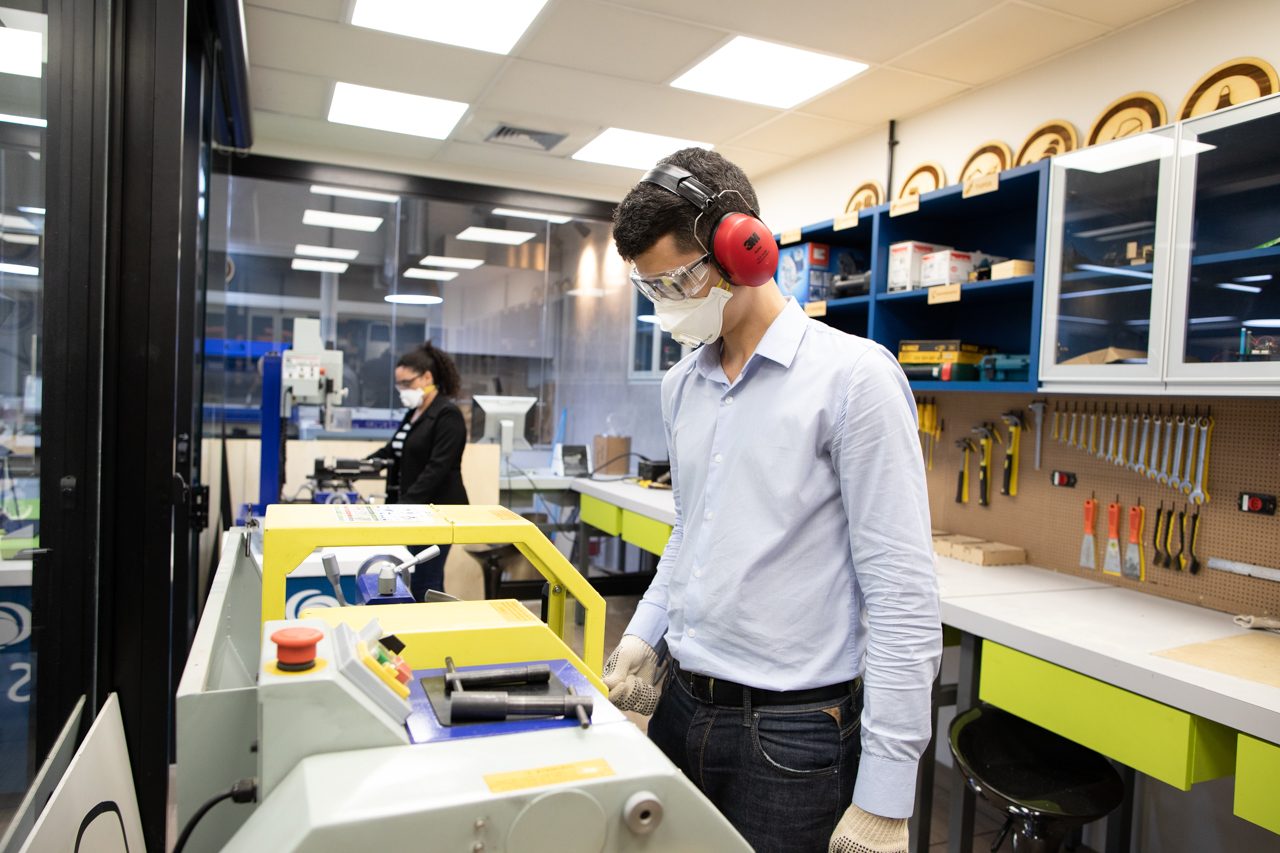
At ESEG, for example, the Technological Innovation Laboratory (LITE) It has a complete structure for creating prototypes and developing projects. Ideas are put into practice from the initial design to the final product.
And in companies, how does the process work?
In the business world, Maker Culture has also led to improvements, both in the performance of professionals and in the overall results of organizations. Understand the positive impacts of this concept when applied to business processes.
BUILDING BUSINESS SOLUTIONS
Companies' dedication to Maker Culture can bring about significant transformations in the market. Reserving space within organizations for this type of development allows employees to easily experiment with and build tangible business solutions.
Raising awareness about waste.
The process begins well before what has been described above. Through awareness of waste, a culture is introduced into the organizational environment, ensuring that the products created there are made according to demand. The development of customized items strengthens the bond between the employee and the product, helping to avoid premature disposal and planned obsolescence.
IMPROVING EMPLOYEE SKILLS
Another interesting point is the opportunity to better utilize the skills of employees. In other words, when there is an adaptation to "do it yourself," the professional It ceases to be just another employee and becomes a key element for the development and growth of the business.
Such practices stimulate creativity and the development of artistic skills, which can serve as therapy for him. This means a greater possibility of engagement in pursuing company projects and also ensures his satisfaction. collaborator.
As seen, Maker Culture has the capacity to renew not only pedagogical practices, creating new forms of learning, but also to transform the market. Regarding the latter, there is a break from the traditional production model, making people more important in creating what they want to see in their fields of work.
So, did you enjoy our article? Share this information with your network and help spread the concept of Maker Culture. To do so, simply share this post on your social media.