




In recent years, higher education has undergone a major transformation. In 2024, for the first time, distance learning became the modality with the highest number of undergraduate enrollments in Brazil, representing 50.71% of the total, according to [source needed]. Inep Higher Education Census.
This scenario raises a question that is becoming increasingly common among students: Is in-person college still worth it?
The answer is yes, provided that the experience offered by the institution goes beyond classroom lessons. Daily contact with professors and colleagues, networking, practical activities, campus life, and proximity to companies continue to be important differentiators for many careers.
When this experience happens in a city like São Paulo, In a region that concentrates some of the country's leading companies, innovation centers, and professional opportunities, in-person education can offer advantages that are difficult to replicate in other formats.
Throughout this article, you will understand when the On-campus undergraduate programs in São Paulo It makes more sense to consider the benefits it offers and how ESEG College transforms this experience into a market-ready education. Happy reading!
What changed when distance learning became the majority?
This data is recent and will affect any candidate's decision. In the last decade, enrollments in Distance learning grew by 286.71%, while in-person learning shrank by 22.31%. during the same period.
Distance learning has played a real role: it has brought college education to those who live far from any campus and to those who balance studying with a demanding work schedule.
However, "most" doesn't necessarily mean it's the best choice for everyone. The same census presents a little-discussed counterpoint: the cumulative dropout rate in distance education reaches... 65%, compared to 47% in the in-person setting.
In other words, more than half of those who enroll in a distance learning course do not complete it. Understanding the reason for this difference helps in making a more informed decision.
What does in-person college offer besides a diploma?
Imagine two people graduating from the same course. One attended classes alone, pausing the video whenever possible. The other spent years sharing labs, projects, and hallway conversations with colleagues and professors. In the first job interview, whoever arrives with a repertoire of interpersonal skills has a head start.
In-person interaction offers benefits that are difficult to replicate on a screen.
- A network of contacts built daily, with colleagues who received internship and job referrals;
- Laboratory hands-on experience and group projects, with errors and corrections happening on the spot;
- Direct access to the professor, who answers the question the moment it arises.
None of this is exclusive to a beautiful classroom. It's a consequence of being in the same space, at the same time, with people who are following the same path as you.
It's important to remember this when comparing tuition prices: part of the cost of in-person classes lies precisely in what happens outside of the classroom.
Why does São Paulo weigh in favor of in-person classes?
Herein lies a unique advantage that no other Brazilian city offers on the same scale. São Paulo is the largest economic center in the country., Studying near companies changes the routine for those seeking internships.
The job you're looking for is probably just a few subway stops from campus.
This proximity becomes an advantage: career fairs, lectures with industry professionals, and job interviews are all within easy reach during a free afternoon. Studying in the city where the opportunities are located shortens the distance between the classroom and your first job.
One private college in São Paulo Well-located, it transforms the city map into part of the curriculum.
When is in-person learning more worthwhile (and when is distance learning the solution)?
It would be dishonest to say that in-person learning is always the best option. There are situations where distance learning works well, and recognizing this helps you make a clear-headed choice.
Distance learning makes sense for those who live far from any campus, have work schedules incompatible with fixed hours, or are seeking a second, more theoretical degree. In these cases, flexibility is more important than physical presence.
In-person learning is worthwhile when the course requires intensive practice, when you are at the beginning of your career and need to build a network, or when the field has strict exams and regulations.
If your goal is to quickly enter the São Paulo job market, sitting next to someone who already works there accelerates the process. Oh, and one detail that changes everything: not all courses can be taken remotely.
The weight of the new MEC rules
There is a regulatory change that determines the modality for you in some courses. The new framework for distance education, with rules that will come into effect in 2027, has vetoed fully online offerings in careers that depend on practical experience, such as Law, Medicine, Nursing, Dentistry, and Psychology.
For those thinking of entering Law school, For example, in-person learning is not a preference: it's part of the training requirement. Courses with internships, laboratory work, and supervised practice gain depth when they take place in the same space, under the supervision of someone already working in the field.
Before finalizing your enrollment, please check if the modality you want is allowed in the chosen course, okay?
How does ESEG offer on-campus college programs in São Paulo?
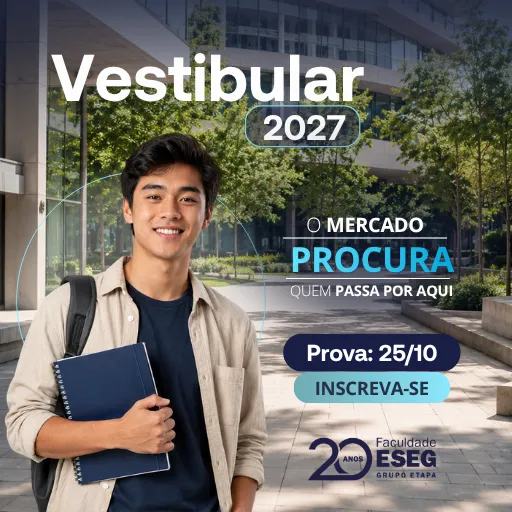
The time has come to move beyond theory and look at a concrete option. ESEG College, Etapa Group's private college in São Paulo treats in-person learning as a method, not a formality. It has two campuses on Rua Vergueiro, in the Paraíso and Ana Rosa neighborhoods, both served by subway, which solves a significant part of the city's commuting problem.
The undergraduate program combines Business Administration, Law, Economics, Computer Engineering, and Production Engineering, with classes offered during the day, at night, and full-time. Business Administration and Production Engineering have received a grade of 5, the highest possible score in the MEC (Brazilian Ministry of Education) evaluation.
The structure aligns with this proposal: laboratories for Artificial Intelligence, Technological Innovation, Computer Science and Robotics, in addition to the Legal Practice Center for law students.
O Career Development Center It brings students closer to the job market from their first semesters, with mock interviews, support in building resumes, and connections with companies for internships. It's the kind of support that only makes sense when there's a close presence and follow-up.
Frequently asked questions about on-campus college in São Paulo
Attending a traditional university in São Paulo is especially worthwhile for those starting their careers and wanting proximity to the job market. The city is home to many companies, internships, and events, and in-person learning guarantees a network of contacts and practical experience that distance learning rarely replicates. And the ESEG College is a face-to-face college in São Paulo.
In-person college takes place in a classroom, with a fixed schedule, direct contact with professors and classmates, and use of laboratories. Distance learning is done through an online platform, with more schedule flexibility, but less in-person interaction and practical work.
Yes. Many on-campus universities in São Paulo offer evening classes for those who work during the day. At ESEG, for example, there are courses in daytime, evening, and full-time schedules.
No. The new rules from the Ministry of Education (MEC) have prohibited fully online courses in Law and other careers that require a lot of practical experience, such as Medicine and Psychology. Therefore, the Law course continues in the face-to-face or blended learning model. And the ESEG College, a face-to-face college in São Paulo., offers one of the most renowned courses in the field of Law in São Paulo.
If you've made it this far, you already have the criteria to decide. The next step is to take a closer look at an on-campus college in São Paulo that combines location, practical experience, and career support. Learn more about them. ESEG undergraduate courses and begin your registration.