




If you've already chosen this course or are unsure if it's the ideal career for you, this post will present a wealth of valuable information to help you make an informed choice. Everything should be considered: from the job market to the salary and the activities that can be performed.
Keep reading and check out all the information we've compiled to help you kickstart a promising future.
What is the profile of a computer engineering professional?
Throughout your life, you've certainly witnessed many technological changes. The format of TVs, the functions of smartphones, innovative apps, and internet speeds are just some of the digital tools that are constantly transforming.
Did you know that at least one of the many professionals responsible for making this magic happen certainly has a degree in Computer Engineering? To excel in this field and make significant contributions to society, certain characteristics need to be developed. Can you guess what they are?
Logical reasoning is one of them, perhaps the most important. The area involves logic, numbers, and equations. Even so, you don't need to be an expert in physics or mathematics. However, you should be aware that you need to live in harmony with numbers. After all, depending on the area you choose, calculations may not occupy such a significant part of your routine.
If you think you weren't born with this talent, don't worry. A quality academic education guarantees the development of these skills. See below the abilities that should be developed during your undergraduate studies to achieve the ideal profile of an engineer:
- ease in learning and absorbing new technologies;
- stimulating critical thinking for problem-solving;
- understanding, comprehending, and solving problems related to political, economic, social, environmental, and cultural aspects;
- The ability to view situations from a humanistic perspective and with an ethical outlook;
- Understanding of administrative and legal issues;
- Ability to create and analyze products, systems, and processes related to software and hardware;
- Knowledge and experience to plan, supervise, develop and coordinate projects;
- Reading practices for textual and graphic interpretation;
- aptitude for managing, operating and ensuring the maintenance of systems, equipment and processes;
- Knowledge to master the concepts, technologies, and tools necessary to work professionally;
- social, ethical and moral responsibility;
- ability to conduct and interpret results;
- To awaken the entrepreneurial spirit.
Remember that you don't have to be an expert and master all of these situations, of course. If you are a dedicated, hardworking, and curious person, it will be easier to succeed in developing these skills and adopt the posture of a successful engineer.
What are the main areas of activity?
Computer Engineering is considered one of the most comprehensive courses in the technology field. It emerged when Computer Science, Information Technology, and Information Systems were already well-established—which is why not everyone is familiar with it. It is relatively recent: it emerged in the late 1990s in the United States. In Brazil, it was only a branch of Electrical Engineering until recently.
Due to the wide range of career paths, students begin their academic journey studying mathematics, physics, and basic engineering. They then move on to subjects focused on software development and maintenance, automation, hardware assembly and configuration, computer components, and robotics. We will explain these issues in more detail in the following sections.
We're bringing this up early so you can better understand the reasons for graduating as a qualified professional. The fact is, in the corporate world, an engineer's work isn't limited to computer maintenance—it's actually much more complex. You can even take on roles in other fields, such as Electrical Engineering and Telecommunications Engineering.
How about checking out the specializations you can pursue after graduation? Don't miss out!.
Administration
Yes, a Computer Engineer can specialize in management and work in institutions that value managerial areas — such as banks and other financial entities, e-commerce companies, and technology consulting firms.
The role of this professional is highly valued in these environments. Those involved in these sectors understand that the knowledge acquired in processes and projects, in an intertwined way, allows for strategic and competent performance, aimed at achieving results.
Development and production of equipment
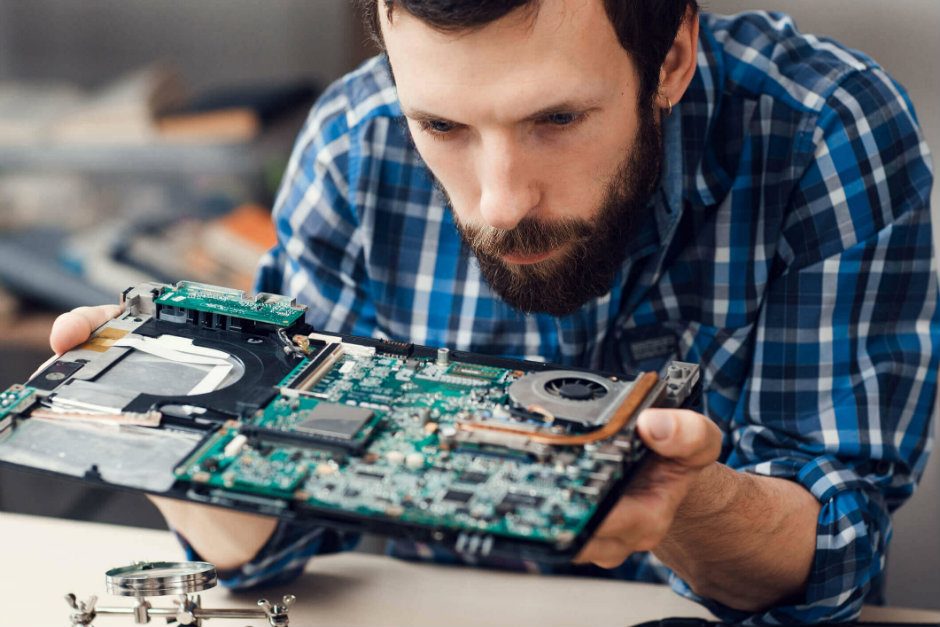
In the hardware field, the main task is the design and construction of computers, peripherals, parts, and other instruments that comprise the world of technological machinery.
Program development
Computer programs refer to the software field. While those who study hardware work with physical equipment, here the professional plans and creates the systems to be used with those tools. The good news is that you don't have to limit yourself to the well-known operating systems aimed at businesses. In this scenario, applications, programs, games, virtual environments, and whatever else your creativity allows come into play.
Control and automation
In addition to managing machines and systems, engineers can also work in large industries. Almost like inventors, they are involved in creating devices, robots, and other tools that promote the automation of processes.
Technical support
If you're a professional who assembles devices, it's only fair that you're the right person to maintain them. Working in technical support, you'll be responsible for the installation, updating, and repair of computers and other electronic tools.
Entrepreneurship
An engineer can also be a entrepreneurThere are many possibilities for those who want to start their own business. These include: software development companies, franchise representation, hardware assembly, and mobile app development. But other opportunities exist; you just need to research your area of greatest interest.
Marketing and sales
Just as you can start your own company, you can also coordinate marketing and sales efforts for computer systems and equipment. These two areas can work together and attract many clients, as they have a very promising market—and always require qualified professionals.
Teaching
From d
Once you complete your undergraduate degree, you can begin postgraduate studies. By investing in a Master's degree and, later, a Doctorate, you can become a leading expert in a field and teach at public and private educational institutions.
It's worth remembering that updating techniques and skills is always important. Good professionals invest in continuing education to remain active and a reference in the market. Since Computer Engineering is based on technology, the engineer must keep up with its dynamism through knowledge updating.
What is the job market like?
Major media outlets and IT experts in Brazil are optimistic about the continued growth of the Information Technology sector in the country. Research indicates that the market is expected to hire more and more specialists in Computer Engineering and related fields.
If you do an analysis, it's not very difficult to reach that conclusion. In general, business owners are increasingly convinced of the benefits of tools like Big Data, the importance of cultivating a good management system for their companies, and the power of applications when it comes to the consumption of their products. User (or customer) experience has become highly valued.
The trend is for Computer Engineering to keep pace with future market demands. As artificial intelligence becomes increasingly present, along with advancements in software and machines, the course is an excellent option for those considering their professional future.
Computer engineers have opportunities in various fields, such as:
- automotive industry;
- computing;
- pharmaceutical industry;
- banks;
- telecommunications companies.
To fill these job positions, what is expected for the future are professionals with increasingly high levels of technical and theoretical skills. In other words, after graduation, it is important to continue investing in training.
Some personal characteristics should also not be overlooked. It is important that the engineer be able to relate appropriately to their team, contributing to a positive work environment and project completion.
Social skills are highly valued in any field, especially those where working with more people is common. After all, just because computing is a science geared towards machines doesn't mean professionals are exempt from human interaction. Quite the opposite! Large projects are often carried out in teams. Keep that in mind from the start!
Job openings and salaries
These new market configurations and the possibility of working in a range of segments make Computer Engineering a highly valued profession. This is especially true when compared to the average remuneration of other occupations. The result is a field with a wealth of job opportunities and satisfactory salaries. According to the website... LoveMondays, The average salary for an intern exceeds R$ 1,800 per month.
A senior professional can earn more than R$ 20,000, depending on the job specifications and complexity of the tasks performed. Make no mistake: companies are willing to pay whatever it takes to have the best team in their system.
For systems analysts and programmers, the vacancies offer salaries between R$4,000 and R$7,000 in various regions of the country. Meanwhile, the National Employment Bank is advertising vacancies for Computer Engineers with monthly salaries exceeding R$8,000 in the southern region of the country.
The requirements are to have registration in Engineering Council (CREA) active, graduation and a period of experience that can be easily acquired with the mandatory internships carried out at the college.
With this data, there's no denying that the Computer Engineering market is quite attractive and generous. And the best part: there's no shortage of jobs, as you can see. There's a noticeable lack of qualified professionals to meet the demands of companies. Therefore, there's the possibility of negotiating salaries and securing excellent opportunities.
What will I study in this course?
To train successful professionals, Computer Engineering courses typically teach theoretical and practical concepts in industrial automation, robotics, artificial intelligence, network management, support for large companies, marketing, sales, and career development for teachers.
Institutions concerned with the education of their students offer partnerships with large companies so that they can complete their mandatory internships. In addition, they maintain modern laboratories to make learning more effective—not to mention the provision of extracurricular activities and investment in scientific research.
The course has an average duration of 5 years and its curriculum includes subjects designed to prepare future professionals to meet the most complex demands of the technology field. Examples include:
- Software and application development;
- software engineering;
- artificial intelligence;
- control and automation;
- systems software;
- computer graphics;
- Game design;
- telecommunications;
- control and automation.
The range of subjects studied allows the graduate to deal with both the world of hardware and software. As a result, they become an expert in the field, capable of working in multiple roles and prepared to face the challenges of new technologies.
It is worth highlighting that Computer Engineering also offers technical visits, allowing students to meet professionals and companies that are leaders in the market. This provides an opportunity to see which areas are most relevant to each student's interests.
What are the main activities?
So far, you've seen that there are many activities attributed to a professional with a degree in Computer Engineering. When it comes to the technological world, the main activities are concentrated in:
- specify;
- to develop;
- to conceive;
- implement;
- adapt;
- produce;
- industrialize;
- Install and maintain computer systems.
Furthermore, this professional is responsible for integrating physical and logical resources, seeking to meet the information, computing, and automation needs of companies.
In which areas can I specialize?
Those who wish to secure good job opportunities should invest in continuing education, as we've already discussed in this post. To make this point clear and to help you truly understand how open the Computer Engineering market is, we've outlined some specializations you can pursue after graduation.
Development of Applications and Games for Mobile Devices
Brazil is a large market
The consumer's reliance on mobile devices, such as tablets and smartphones, is growing. Due to the popularity of social networks and apps, companies are becoming increasingly aware of the need to adopt tools to cater to their audience, according to their routines. Therefore, if actions such as in-app purchases are already a reality for customers, it means that businesses must adapt as soon as possible.
From there, a new market emerges: the development of applications and games for mobile devices. The course prepares professionals who seek to work in a specialized way in these processes, developing the resources that the client needs so as not to be swallowed up by the competition.
The student then learns in greater depth about the fundamentals of the internet, is trained to perform performance tests, and takes care of application security.
Software Development
It's true that you graduate already prepared to work in software development and marketing. However, it's no secret that the market values specialists.
Investing in a postgraduate degree in software development allows you to further deepen the knowledge acquired in the classroom, ensuring your resume is competitive and putting you a step ahead of the competition.
Software Engineering and Quality
Similar to specialization in software development, there is a course called Software Engineering and Quality. This degree grants the student the responsibility of managing the development of a given software, ensuring the highest quality in its operation and the productivity of the programmers responsible for the process.
Another objective of the course is to ensure that products are created at the lowest possible cost, without compromising quality. Therefore, the specialist is not only concerned with technical aspects, but also with the standardization of creation processes. Because of this, the curriculum includes subjects such as leadership, conflict management, automation of functional and performance tests, and quality metrics.
Information Security
With the increasing use of technology in companies, the trend is for these organizations to become more and more concerned with the security of their data. In this context, specializing in information security can guarantee a promising career in Computer Engineering.
The course is based on 4 pillars:
- confidentiality;
- availability;
- authenticity;
- integrity.
The curriculum includes subjects such as cryptography systems, perimeter security, forensic analysis, contingency planning, and legal aspects. It prepares professionals to prevent system failures that could result in leaks of confidential information.
Who are the most famous technology professionals in our history?
To help you understand the importance and significance of Computer Engineering, we've compiled a list of some of the greatest professionals and true inspirations in the technological field (some of whom are computer engineering graduates). See below.
Alan Turing
Alan Turing lived for only 34 years — but that was enough to be considered one of the fathers of computing and a pioneer when it comes to artificial intelligence.
Turing worked for British intelligence during World War II, breaking German codes and deciphering secret messages encrypted by a machine called Enigma.
His studies were entirely dedicated to the field of computing. The young man spent his days questioning and seeking answers to discover how far it was possible to go through machines. Thanks to this curiosity and the complexity of his discoveries, today we have Computer Engineering.
Steve Wozniak
Stephen Gary Wozniak, better known as Steve Wozniak, is one of the founders of Apple Computer, alongside the icon Steve Jobs.
Wozniak's passion for electronics led him, while still young, to create a device capable of tricking the telephone system and making free calls, the so-called Blue Box.
With an estimated fortune of over $150 million, he met Jobs after graduating from the University of California, where he studied Computer Engineering in 1975. Later, he developed a hardware, integrated circuits, and operating system project that would become the Apple 1, founding Apple Computer in 1976.
Linus Torvalds
Have you ever heard about the LinuxIt's an operating system, just like Windows (from the giant Microsoft) and Mac OS (from Apple). Its development was undertaken by a software engineer named Linus Torvalds. Born in Finland, he understood very well the importance of investing in his academic training. After graduating, he pursued a master's degree in the field, and it was in academia that he began developing Linux.
It's worth noting that the system was published under a license granted by the GNU project—in fact, Torvalds had the opportunity to learn about it at a free lecture at the university.
The wide range of career paths allows people with very different profiles to venture into this profession, as we have seen. And don't worry. You don't necessarily need to be a computer genius: you can simply have fantastic and creative ideas to be developed alongside a team of programmers.
When it comes to Computer Engineering, ESEG is an institution prepared to give you all the necessary skills to advance your career. With a faculty qualified in both theoretical subjects and market experience, the college provides students with hands-on experience in the field—in addition to personalized, top-notch support.
Are the opportunities for the future clearer now? Do you know someone who's having doubts like you? Then share this post on your social media and inspire your friends. Who knows, you might just find a brilliant partnership and become the next tech multimillionaire, right?
Computer Engineering: Discover the curriculum of the course at ESEG.
Technology has never been so present in our lives. From mobile applications to artificial intelligence systems, everything is developed and maintained by professionals in the technology field.
In this scenario, one course that stands out is... Computer Engineering, A comprehensive training program that combines theory, practice, and innovation.
If you've ever wondered What is computer engineering?, How does the curriculum work and what are the... differences in relation to IT, Software Engineering or Hardware, This content will clarify everything.
Given that it is a degree program that is constantly in demand and growing, we decided to show how the course at Faculdade ESEG – one of the best private colleges in São Paulo – It can help you enter this very dynamic market.
Keep reading and learn all about this field!
What is Computer Engineering?
Computer Engineering is an undergraduate degree that combines knowledge of electrical engineering, computer science, and applied mathematics.
The goal is to train professionals capable of developing both software (programs, applications, and systems) and hardware (electronic equipment and devices).
Unlike other courses focused solely on programming, such as Computer Science, or infrastructure management, such as IT, Computer Engineering is multidisciplinary.
It prepares students to work in cloud computing, artificial intelligence, computer networks, embedded systems, and even in the development of robots and smart devices.
In short, it's the ideal course for those who enjoy technology and innovation and want a comprehensive degree in the technology field that opens doors in various areas.
Read also: Computer Engineering: A Complete Guide to the Course
What does a computer engineer do?
Many students wonder: what does a computer engineer do?
This professional can work in different areas, such as:
- Software development: Creation of customized applications, operating systems, and digital solutions.
- Hardware engineering: Development of circuits, processors, boards, and electronic devices.
- Information and network security: Construction of secure and efficient machine-to-machine communication systems.
- Cloud computing: Developing scalable solutions that run on platforms such as AWS, Google Cloud, and Azure.
- Artificial intelligence and data science: Creation of machine learning algorithms, big data analysis, and development of virtual assistants.
- Automation and IoT (Internet of Things): Smart systems projects for connected homes, cities, and industries.
In other words, a computer engineer can work in technology companies as well as in industries, banks, startups, and even in academic research.
What is the curriculum like for the Computer Engineering course?

A Computer Engineering curriculum at ESEG It was structured to offer a solid education, balancing theory and practice.
It goes beyond the basics, integrating innovative disciplines that stand out among the... computer engineering colleges in São Paulo.
In ESEG College, part of the Etapa Group, In this field, students encounter subjects that combine science, technology, and innovation. Among the subjects in computer engineering are:
- Fundamentals of Programming
- Applied Mathematics and Calculus
- Linear Algebra and Analytic Geometry
- Computer Architecture and Organization
- Digital Systems and Microprocessors
- Software Engineering
- Database and Cloud Computing
- Artificial Intelligence and Machine Learning
- Data Science and Big Data
- Information Security
- Robotics and Embedded Systems
- Entrepreneurship and Technological Innovation
This program offers a comprehensive degree, preparing students to work with modern technologies and excel in promising fields such as... Cloud computing and hardware engineering.
Furthermore, the course includes subjects in humanities and management, such as administration and entrepreneurship projects, enabling computer engineers to lead teams and create new businesses.
IT, Software Engineering, Hardware Engineering, or Computer Engineering: what's the difference?
Another common question among students is about the real difference between IT, Software Engineering, Hardware Engineering, and Computer Engineering?
So here we go:
- Information Technology (IT): IT professionals typically manage networks, servers, and digital security. They usually provide services focused on managing technological infrastructure, technical support, and maintaining information systems in companies.
- Software Engineering: This course focuses on the creation of programs and systems, covering everything from requirements analysis to testing and maintenance.
- Hardware Engineering: A specialty dedicated to the development of electronic equipment, such as chips, processors, video cards, and mobile devices.
- Computer Engineering: It combines all these areas into a single training program. Professionals learn both software programming and the design of circuits and physical devices, such as robots, drones, autonomous vehicles, apps, virtual assistants (AI), and the development of algorithms to protect against intrusions and fraud in digital banks.
Read also: Computer Engineering, Computer Science, or IT? Understand the differences.
Who earns more: IT professionals or software engineers?
In Brazil, the Software engineers generally have a higher salary than IT professionals., since their work is directly linked to the development of digital products and innovative solutions.
According to recent surveys, the average salary for a software engineer ranges from R$7,000 to R$12,000, while in the IT field, especially support and infrastructure, salaries can range from R$3,000 to R$7,000.
However, It is worth highlighting that Computer Engineering further expands this range., since the professional can work both as a software engineer and in areas of research, hardware, and innovation.
What is the difference between IT and Software Engineering?
The main difference is that IT is more focused on the maintenance and support of technology within companies, while Software Engineering is geared towards the creation of systems, applications, and digital platforms.
In other words: IT ensures that the technology works; Software Engineering creates new solutions.
Computer Engineering, on the other hand, is even more comprehensive, as it prepares professionals to work in both areas and also in hardware development.
Faculty of Computer Engineering at ESEG

ESEG College, located in São Paulo, stands out among private colleges offering one of the best... undergraduate degrees in Computer Engineering.
Its distinguishing features include:
- Updated curriculum, with subjects in cloud computing, data science, and artificial intelligence.
- Modern infrastructure, with laboratories equipped for experimentation in software, hardware, and even robotics.
- Highly qualified professors with academic and professional experience.
- Integration between theory and practice, preparing students to solve real-world problems.
- Focus on employability, with partnerships that increase the chances of entering the job market.
This means that upon completing a Computer Engineering degree at ESEG, students will have a differentiated education, capable of competing with professionals in fields such as Computer Science or Systems Analysis and Development, but with much greater technical preparation and a vision for the future.
At ESEG College, the curriculum is comprehensive and up-to-date, offering subjects that are often not found in other institutions, such as information security, robotics, and data science.