



Industry 4.0 – How technological advances are changing the profile of the engineer.
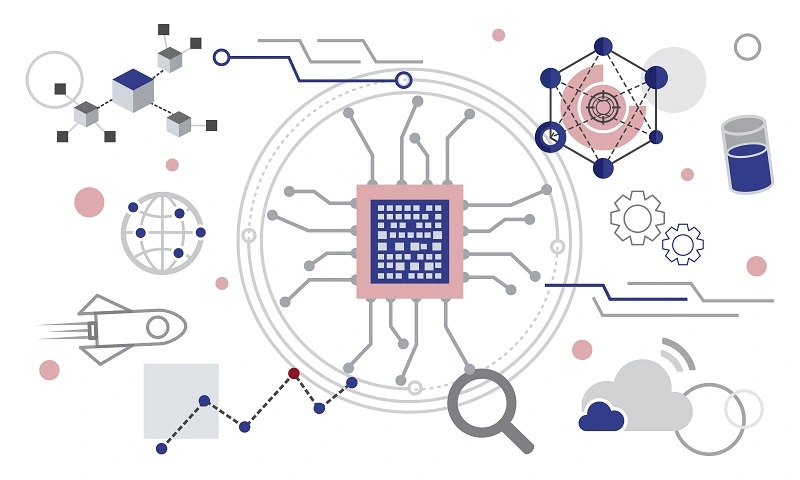
Additive manufacturing, Artificial Intelligence, Internet of Things, synthetic biology, and cyber-physical systems. These are the main technologies involved in the concept of Industry 4.0, The Fourth Industrial Revolution, which enables the merging of the physical and digital worlds, represents a leap in company productivity, as it allows for process optimization and increased competitiveness through innovation.
But do you know the path the industry took to get here?
Here? What is the impact of innovation on
Job market? How can future professionals prepare for the job market?
In this context? Read our post and find out the answers.
From mechanics to Big
Date
The first Industrial Revolution, which occurred at the end of the 19th century.
The 18th century was centered on mechanical energy. With the emergence of steam engines,
Initially in the textile industry, the scale of production expanded.
significantly. Mechanization extended to transportation, which meant that
so that logistics would become more efficient and products would arrive more quickly.
to distribution centers and points of sale.
The emergence of electricity and the exploration for oil.
These were the milestones of the Second Industrial Revolution in the 19th century. At that time,
Driven by the growth of the chemical and steel industries, they were created.
automobiles and early telecommunications systems. The model lines of
production designs created by Taylor and Ford also emerged during this period, as a way of
to specialize professionals in a single function and scale the generation of
wealth.
Automation was the productive gain of the 3rd Revolution.
Industrial. The computerization, generated with the emergence of personal computers.
From the 1970s onwards, it made mechanical and repetitive tasks possible
to be performed by machines and no longer by people. This process is
It extends to the present day, gaining strength with advances in the field of robotics and with the
Software development.
More efficient use
of the resources
Today, the job market is experiencing the 4th Industrial Revolution.
The so-called Industry 4.0 is the one that makes production processes even more efficient.
autonomous, customizable, and efficient through technologies such as
Artificial Intelligence. The ability to make real-time decisions based on...
The use of data generated by intelligent machines is changing the entire chain of
production and logistics systems for factory operations.
Products become more easily traceable and...
The mechanism behind the processes becomes more assertive. The Internet of
Things, for example, allows objects to be connected to the network, thus
It is possible to carry out actions in a coordinated manner. This represents a leap forward.
a very significant qualitative difference compared to how the industry operated until now.
current events.
The adoption of new processes impacts the reduction of labor.
In this way, there are savings in construction and in the costs of storage and distribution.
resources for the company, and these can be used in the implementation of
improvement processes, creation of new products or investments in other areas.
technologies. Industry 4.0 thus fosters a virtuous cycle that makes
More competitive corporations and generate returns for the economy.
Innovation as a
opportunity
Although the changes brought about by Industry 4.0 represent
a challenge for professionals who will work in this context,
Opportunities are created for those familiar with these technologies.
They tend to be substantial. A multidisciplinary education aligned with the vision.
Systemic processes will favor employability.
Production Engineering is one of the most promising fields.
for those who wish to work in the industrial sector, or even in the service sector,
which has already been using integration and customization as a way to create a new
work model. This professional is responsible for managing the
production processes and the integration between technology and people. Therefore
In this way, the chances of employability are quite high for those who graduate from
course.
According to Luiz Durão, professor of ESEG – Higher School of Engineering And with a background in Management and Innovation, young people who intend to enter this market must constantly seek to update their knowledge and be willing to find new solutions to challenges. “Creative activity will never be replaced. Institutions are increasingly seeking to train people capable of thinking about the problem and not acting mechanically, as a machine can do,” says Durão.
Profile of the 4.0 engineer
The ability to operate software and simultaneously manage the people involved in the processes will be one of the biggest challenges for future production engineering professionals. At ESEG, students have access to... Lite – Technological Innovation Laboratory, This space is equipped with the most modern equipment for maker culture. This environment fosters the creation of projects and prototypes and trains students to deal with the challenges they will face in the job market, in smart factories.
The course guidelines for Production Engineering They must follow the trend of innovations and thus favor the professional development of individuals in a context where learning will be continuous. In addition to technical skills, the World Economic Forum listed some essential skills for survival in the market during the 4th Industrial Revolution. At the top of the ranking are complex problem-solving, critical thinking, and creativity. At ESEG, the academic coaching Professional training is offered from the first semester and helps students develop these skills and enter the job market.
On the assembly lines, the engineer will work side by side.
with participatory robots. Business productivity will therefore come from
The ability of humans and machines to optimize the process.
productive. Repetitive tasks tend to be replaced almost entirely.
entirely computer-based, but the role of the engineer will not disappear from
Factories. The Industry 4.0 professional will focus on project control.
and in strategic functions, such as the generation of innovative products and
Customizable.
The landscape of smart factories will be challenging, and to stand out, you need to be open to change, flexible, and willing to step outside your comfort zone. A degree that combines a strong technical foundation with the development of interpersonal skills is essential for entering the digitized industry. Want to learn more about how to prepare for a strong entry into the job market? Follow our social media channels and receive more content like this.