ESEG students visit the Central Bank and explore the inner workings of the national economy.

By Renata Heining
23/06/2026
Browse by topic
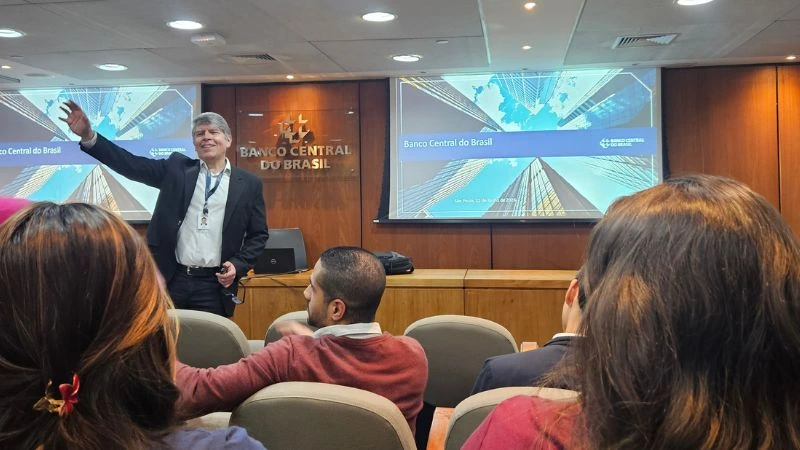
On June 22, 2026, students from law courses, The Administration and Economics departments of ESEG College participated in an institutional visit and exclusive lecture at the regional headquarters of... Central Bank of Brazil (BCB), in São Paulo.
The activity provided an immersive experience into the workings of one of the country's most important institutions, bringing students closer to the professional reality and challenges of the Brazilian financial system.
The lecture was given by Marcos Praxedes da Silva, an auditor at the Central Bank in the Department of International Affairs.
In a didactic and accessible way, the speaker led the students on a true tour of the institution's universe, presenting its structure, main functions, and the impact of its decisions on the daily lives of the population.
Marcos Praxedes, who has a special fondness for Group Stage Having studied at one of the group's institutions, he emphasized that the doors of the Central Bank will always be open to young people.
“The Central Bank has always been concerned with maintaining close ties with academia and schools. The more people understand how the institution and organizations function, the more capable they are of developing important solutions for society. Our goal is to show, in an accessible way, the work done here and contribute to the training of future professionals,” he emphasized.
During the presentation, students learned about the main responsibilities of the Central Bank, such as preserving the purchasing power of the currency, maintaining liquidity in the financial and credit markets, and preventing risks and fraud in the banking system.
Marcos also explained how the BCB's directorates are organized and how different areas work together to ensure the proper functioning of the financial system.
Among the highlights was the Inspection Directorate, responsible for monitoring and verifying whether financial institutions comply with the rules established by the Central Bank.
Furthermore, the work of the BCB's financial education department was highlighted, as it collaborates with teachers by suggesting essential content for schools, such as teaching compound interest so that the subject is addressed from high school onwards.
Innovation was also present in the conversation. Marcos presented the development trajectory of Pix, showing how the tool transformed the way payments and transfers are made in Brazil, making financial transactions faster, more accessible, and safer.
The students were also able to understand how technology has been transforming the financial sector over the years.
Although automation has reduced some operational functions, the Central Bank highlighted that the presence of qualified professionals remains essential for developing, operating, and improving the technological solutions used by the market.
Thus, even with technological advancements, human intervention remains indispensable to ensure the functioning and evolution of these innovations.
The visit also allowed students to learn about career possibilities within the Central Bank, the requirements for entry through public competition, and the professional development opportunities offered by the institution.
Throughout the presentation, Marcos shared examples of professionals who began their careers in entry-level positions and rose to leadership roles, demonstrating the growth opportunities that exist within the organization.
The visit sparked the interest of many students in the possibilities of working in the financial sector. For Joyce Correia Gregório, a 5th-semester student of Business Administration course, The experience broadened his perspective on the field.
“When he mentioned the public service exam, I became very interested. Currently, I don't work directly in the financial area, but it's a sector that sparks my interest. Understanding how the Central Bank works, learning about growth opportunities, and the dynamics of the work made me consider the possibility of pursuing a career in this area. It was a very enriching experience,” said the student.
According to Professor Maurício Nakahodo, who is responsible for the Integrated Project I course in Administration and... Economics at ESEG, Experiences like this strengthen the connection between theory and practice.
“It is important for students to have contact with companies and institutions in the real economy. Often, what we discuss in the classroom takes on a new meaning when they can see firsthand how professionals work and how organizations function. This interaction is part of ESEG's mission to prepare students for the challenges of professional life,” he concluded.
At the end of the activity, the students participated in a question-and-answer session and were able to clarify doubts about the role of the Central Bank, the financial market, public careers, and professional opportunities.
The visit reinforces ESEG College's commitment to providing practical experiences and direct contact with leading organizations, broadening students' perspectives on the job market and different career possibilities.
Stay informed about relevant topics and what's happening at ESEG College.
Your data is safe.
Unavailable
Institutional
Infrastructure
Entry methods
Relationship
Key differentiators
We use cookies to improve your browsing experience.