put Allison
26/11/2025
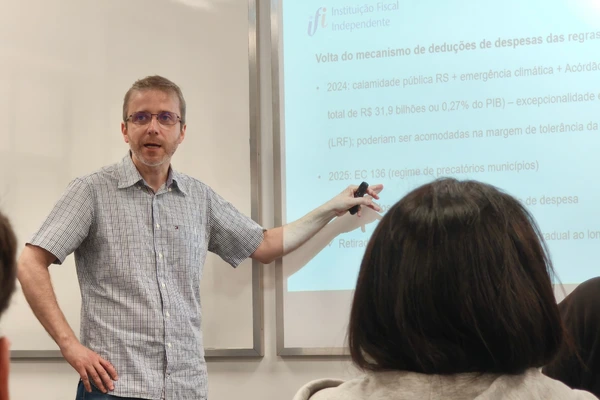
On the evening of November 24th, ESEG College hosted the lecture. “"Budgetary rigidity and prospects beyond 2027", The presentation was given by Alexandre Augusto Seijas de Andrade, director of the Independent Fiscal Institution (IFI), a body of the Federal Senate responsible for producing analyses, projections, and studies on the country's public accounts.
The meeting was organized by Professor Robson Pereira, in conjunction with other faculty members from ESEG, such as Professors Francisco Carlos (Economics) and Edison Feghali (Business Administration).
At the start of his presentation, Alexandre emphasized that the lecture aimed to make economics a more enjoyable and accessible subject, as well as presenting real-world scenarios and sharing professional experiences with the students.
To that end, he brought up essential topics for understanding the current state of public finances, such as:
“"Understanding these scenarios helps students and future professionals visualize the real impact of government decisions on the fiscal framework."”, "Alexandre highlighted.".
During the lecture, students learned that to perform fiscal projections, it is always necessary to work with three scenarios: the base scenario, an optimistic scenario, and a pessimistic scenario. This methodology is used to build more accurate estimates and guide technical analyses.
By presenting forecasts of different economic scenarios, the speaker showed how government decisions directly influence the country's fiscal future. Alexandre further summarized the topic with the following phrase: “"In politics, what is approved is what is possible, not what is ideal."”
Student Alberto Lúcio Barbosa Jr., in his 8th semester of Economics and pursuing his second degree, highlighted the importance of the topic: “Tax issues are complex and are always on Brazil's agenda. I, personally, was very interested in the legal discussions and how economics, law, and politics connect. ESEG providing this for us was very interesting.”, said the student.
The event reinforces ESEG's commitment to bridging the gap between theory and practice through discussions with leading professionals in the national economic landscape.
Stay informed about relevant topics and what's happening at ESEG College.
Your data is safe.
Monthly fee of ESEG students attend lecture on budgetary rigidity and fiscal projections.
Unavailable
*Prices valid for enrollment in the second semester of 2026.
You can get a discount based on your performance in one of the ESEG College selection processes.
Institutional
Infrastructure
Entry methods
Relationship
Key differentiators
We use cookies to improve your browsing experience.