
*Written by: Auro de Jesus Cardoso Correia, lecturer in the Computer Engineering course at ESEG Faculty
Computer networks are part of virtually everything you do today, from sending a message on your cell phone to accessing a system at work. Without even realizing it, we are constantly connected by different types of networks that allow the exchange of information in real time.
But how do these networks actually work? What types exist? And what's behind this entire structure that keeps people, companies, and even countries connected?
In this content, you will understand what computer networks are, learn about their main types and topologies, and explore the elements that make up their architecture and operation.
We'll also see how these networks connect to the internet and why this area continues to grow in the technology market.
Keep reading and learn more about the subject!
What are computer networks?
Computer networks are structures that allow connection between different devices, enabling the sharing of data, resources, and services.
In practice, we are interacting with computer networks whenever we use:
- Internet;
- Messaging apps;
- academic or corporate systems.
These networks are fundamental to the functioning of digital society, being present in contexts such as education, health, industry, and entertainment.
What are the 4 types of networks?
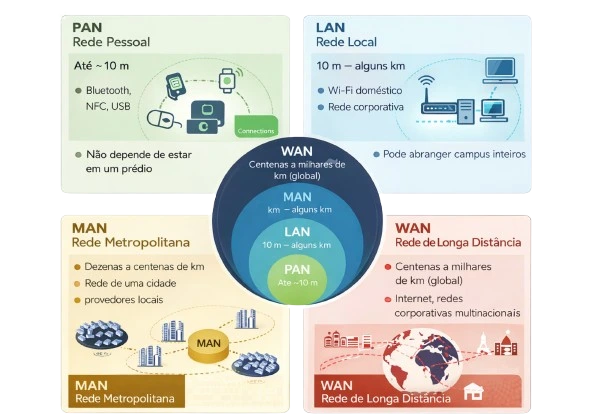
Networks can be classified according to their geographic scope. See below for the main types.
1. Personal Area Network (PAN)
It is characterized by very short-range connections, generally used by a single user.
Examples:
- Bluetooth
- NFC
- USB connection
Typical coverage: up to ~10 meters
2. Local Network (LAN – Local Area Network)
Used in restricted environments, such as homes, businesses, and educational institutions.
Examples:
- Home Wi-Fi
- corporate networks
Typical coverage: from a few meters to a few kilometers
3. Metropolitan Area Network (MAN – Metropolitan Area Network)
It covers urban areas, connecting different regions within a city.
Examples:
- local provider networks
- interconnection between units of an institution
Typical coverage: tens to hundreds of kilometers
4. Wide Area Network (WAN)
It connects networks on a global scale.
- Internet
- multinational corporate networks
Typical coverage: hundreds to thousands of kilometers
Computer Network Topologies
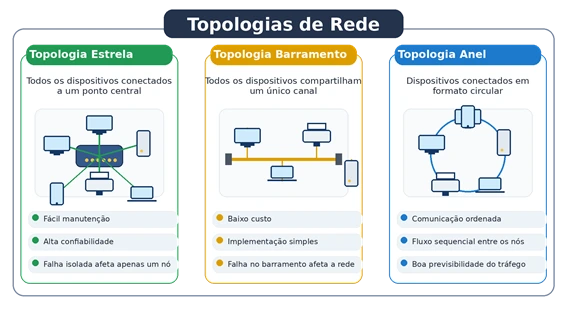
Network topology defines how devices are organized and connected. Below are 3 computer network topologies.
1. Star Topology
All devices are connected to a central point.
Advantages:
- ease of management
- greater reliability
2. Bus Topology
The devices share a single means of communication.
Advantages:
- low cost
- simplicity
Disadvantage:
- Bus failure affects the entire network.
3. Ring Topology
The devices are connected in a circular configuration.
Feature:
- sequential communication between nodes
Network structure and organization
An efficient network depends on proper planning and organization.
Important elements include:
- network segmentation;
- Access control;
- traffic management;
- security.
In corporate environments, this structure is essential to ensure performance and reliability.
Network architecture and infrastructure
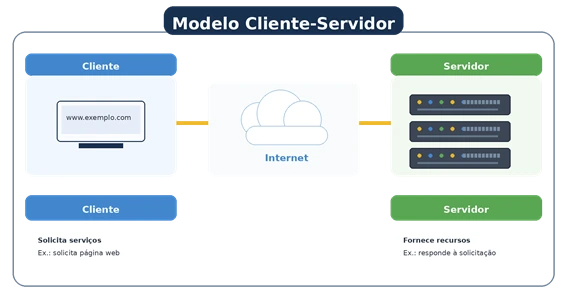
The architecture defines how communication occurs between devices.
Client-Server Model
- Customer: requests services
- Server: provides resources
Practical example:
When accessing a website, the browser (client) requests information from a web server.
Network infrastructure: what does it consist of?
Infrastructure refers to the physical and logical components that enable communication.
Main elements:
- cables (fiber optic, copper);
- routers;
- switches;
- access points;
- servers;
- data centers.
Network devices
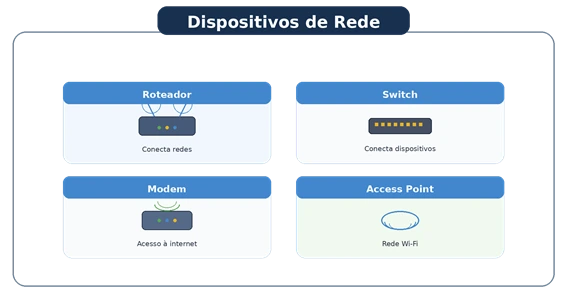
The devices are responsible for directing and managing data traffic.
Main devices:
- Router: connects distinct networks;
- Switch: connects devices on the same network;
- Modem: communication with the provider;
- Access Point: It provides Wi-Fi.
Network Protocols
Protocols are rules that define how data is transmitted.
Examples:
- HTTP/HTTPS;
- TCP/IP;
- FTP.
They ensure that different devices can communicate correctly.
Computer Networks and the Internet
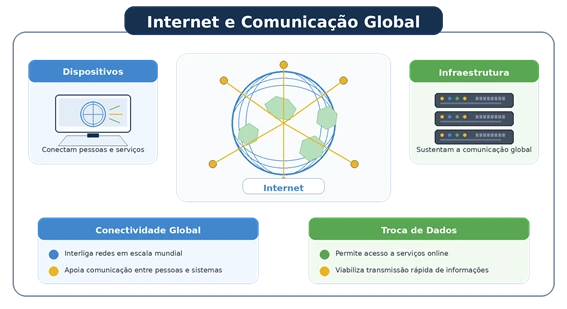
The internet is a large global network composed of various interconnected networks.
It depends on:
- physical infrastructure
- protocols
- network devices
The Importance of Networks in Today's World
Networks are present in virtually all areas:
- digital education;
- banking services;
- streaming;
- Industry 4.0;
- digital health.
They are the foundation of digital transformation.
Job Market in Computer Networks
The area has high demand, driven by technologies such as:
- cloud computing;
- IoT;
- 5G;
- Cybersecurity.
Main career paths:
- network analyst;
- network engineer;
- security expert.
Conclusion
Computer networks are essential for modern communication, connecting people, systems, and organizations on a global scale.
Understanding its fundamentals is an important step both for the conscious use of technology and for developing a career in the field.
By exploring the layers that make up computer networks, from personal connections to the vastness of the internet, it becomes clear that the topic transcends a simple discussion about cables, routers, or protocols. We are, in fact, examining the fundamental structure that underpins modern life and global technological innovation.
The robustness of a network is what enables the most impactful technologies of today.
Without the Client-Server architecture or the efficiency of modern topologies, there would be no agility in Industry 4.0, no precision in Remote Medicine, or omnipresence in Artificial Intelligence.
Networks represent the vital element that allows raw data to be transformed into intelligence and action in real time, regardless of the application sector.
Mastering these fundamentals is a strategic advantage for anyone wishing to operate in a market that is rapidly moving towards 5G, 6G, and the Internet of Things.
Understanding the dynamics of data traffic is the indispensable foundation for designing smarter cities, more efficient production processes, and a truly connected society through ultra-low latency and highly reliable communications.
Therefore, this supporting material serves as a foundation for understanding a constantly evolving ecosystem. Network technology is a field where the stability of fundamental knowledge meets the speed of new discoveries.
The invitation proposed by this study is not only to use these networks, but to master the engineering that makes them possible, secure, and absolutely essential for the future.
Want to master network engineering?
ESEG College offers Bachelor's degree in Computer Engineering, bringing to its curriculum current topics and disciplines required by the job market, such as Artificial Intelligence, IoT, Data Science, automation, computer security and software development.
Interested? Then talk to one of our representatives, ask your questions, and come visit us! private college in São Paulo which is growing the most!