
Understanding how societies occupy territories, analyzing environmental transformations, interpreting urban phenomena, and discussing global challenges such as climate change are some of the responsibilities of those who choose... Study Geography.
More than just memorizing maps or locating countries, a degree in Geography trains professionals capable of understanding the relationships between space, society, and nature, as well as preparing future educators to contribute to the critical education of new generations.
In a world marked by environmental issues, rapid urbanization, and constant social transformations, geographical knowledge becomes increasingly relevant both inside and outside the classroom.
Today, you will understand how a degree in Geography works, what the professional opportunities are, what the job market is like, and what it entails. ESEG College It offers opportunities for those who wish to build a career in the field.
Enjoy your reading!
What is a degree in Geography?
A degree in Geography is a qualification for those who wish to work in education, teaching the subject in the final years of elementary school and in high school. More than transmit content Regarding maps, territories, or natural phenomena, professionals trained in this field help students understand the relationships between society, space, and the environment.
Throughout the course, students develop knowledge in areas such as physical geography, human geography, cartography, climatology, urbanization, environmental issues, and territorial organization.
In parallel, they also receive pedagogical training, learning how to plan lessons, develop teaching strategies, and conduct learning processes in different educational contexts.
This combination of technical knowledge and preparation for teaching is what differentiates a teaching degree from other forms of education. The focus is not only on training specialists in Geography, but on professionals capable of transforming this knowledge into meaningful learning experiences for different audiences.
With an average duration of four years, The degree program includes theoretical subjects, teaching practices, and supervised internships in schools, allowing students to experience the reality of the profession even before completing the course.
Upon completion of their training, graduates are qualified by the Ministry of Education (MEC) to work in public and private educational institutions, participate in public service examinations, and continue their studies in specialization programs, master's degrees, and other stages of academic training.
What is studied in a Geography degree?
The curriculum is organized into three main blocks, which complement each other throughout the four years of the course.
Geographical training disciplines
These are the subjects that build the spatial reasoning skills of future teachers. They usually include:
- General and thematic cartography — reading, creating and interpreting maps;
- Geomorphology and Climatology — physical processes that shape landforms and climates;
- Human Geography — population dynamics, urbanization, and socioeconomic relations;
- Geopolitics and Regional Geographyl — analysis of the relationships between territory, power and the organization of space;
- Geoprocessing — use of geographic information systems (GIS) in spatial analysis.
Pedagogical disciplines
This section is what distinguishes a teaching degree from a bachelor's degree. The student learns how to teach, not just what to teach.
- Didactics — Lesson planning and teaching strategies for different age groups;
- Educational Psychology — how students learn and develop;
- Educational Policies and the BNCC (National Common Core Curriculum) — the regulatory framework for basic education in Brazil;
- Teaching Methodologies for Geography — Specific techniques for the subject, such as field trips and the use of satellite imagery in the classroom.
Supervised internship and teaching practice
The internship is a mandatory part of the course and cannot be done haphazardly. The student observes real classes in schools, plans and executes their own teaching sessions under the guidance of experienced teachers.
This contact with teaching practice before graduation is, for most undergraduate students, the moment when the course ceases to be theory and becomes a profession.
Profile of those who excel in the course.
There is no single profile for those who choose a degree in Geography, but some characteristics are usually present among students who most identify with the field.
Curiosity about how societies and territories function is one of them. Questions related to the organization of cities, the use of natural resources, environmental transformations, and the relationships between different regions of the world are part of the daily study of a geographer.
It is also common for Geography students to be interested in current topics such as climate change, geopolitics, human mobility, urban development, and sustainability. The degree provides tools to understand these phenomena in a critical and contextualized way.
Another important skill is communication. As the teaching degree prepares professionals for teaching, the student develops the ability to present complex concepts in a clear, accessible way that connects to the students' reality, contributing to the construction of knowledge within the classroom.
It is worth highlighting that it is not necessary to arrive at the course with complete mastery of the content studied in high school. The training is built throughout the degree program, with a progressive deepening of theoretical and practical knowledge in the field.
More than prior knowledge, what makes the difference is the interest in understanding the world, the willingness to learn continuously, and the desire to share knowledge with others. These characteristics are usually present among professionals who find in Geography a career aligned with their purpose.
Job market: where can a Geography teacher work?
The job market for those who have completed a degree in Geography is more diverse than it seems. Teaching in schools is the most common entry point, but it is not the only one.
Teaching in basic education
Public and private schools are the main destination for graduates in Geography.
Brazil currently has a real deficit in this area: data from School Census 2024 (INEP) They show that Geography is one of the subjects with percentages above 75% of classes taught by teachers with adequate training, which still leaves a relevant margin for replacement and growth.
Projections from the Semesp Institute indicate that Brazil could face a shortage of up to 235,000 teachers in basic education by 2040, which, in practice, means guaranteed demand for those graduating now.
Public competitions
Public service exams are one of the most sought-after career paths for those who graduate with a degree in Geography.
State and Municipal Departments of Education periodically open selection processes, and a bachelor's degree is a mandatory requirement to participate.
The exam boards test both the specific content of the subject and that of educational legislation.
Non-formal education and other activities
Museums, non-governmental organizations, environmental education projects, and environmental agencies also hire professionals with a background in geography.
For example, combining a bachelor's degree with a specialization in geoprocessing further expands the range of possibilities.
How much does a geography teacher earn?
Compensation varies according to the level of education, the state, the type of school, and the professional's experience. According to data from... Salary Portal based on CAGED data., A geography teacher in elementary school earns an average of R$$5,294.86 per month for a 24-hour work week.
In high school, the average salary is around R$$4,952.81 per month for 23 hours per week.
The starting salary for a Geography teacher in elementary school can reach R$$5,150.25, with maximum salaries exceeding R$$13,000 for more experienced professionals in public school systems with established career plans.
Those who advance to higher education, which requires postgraduate studies, work with higher age ranges.
It's worth remembering that public school teachers' salaries tend to increase through career progression and seniority bonuses, making this career a more predictable long-term career choice than many other fields.
Why study Geography at ESEG?
A ESEG College, The institution, part of the Etapa Group, offers a Bachelor's degree in Geography with a grade of 4 from the MEC (Brazilian Ministry of Education), a score above the national average, which attests to the quality of the pedagogical project, the faculty, and the infrastructure available for the course.
Furthermore, ESEG is not just a classroom.
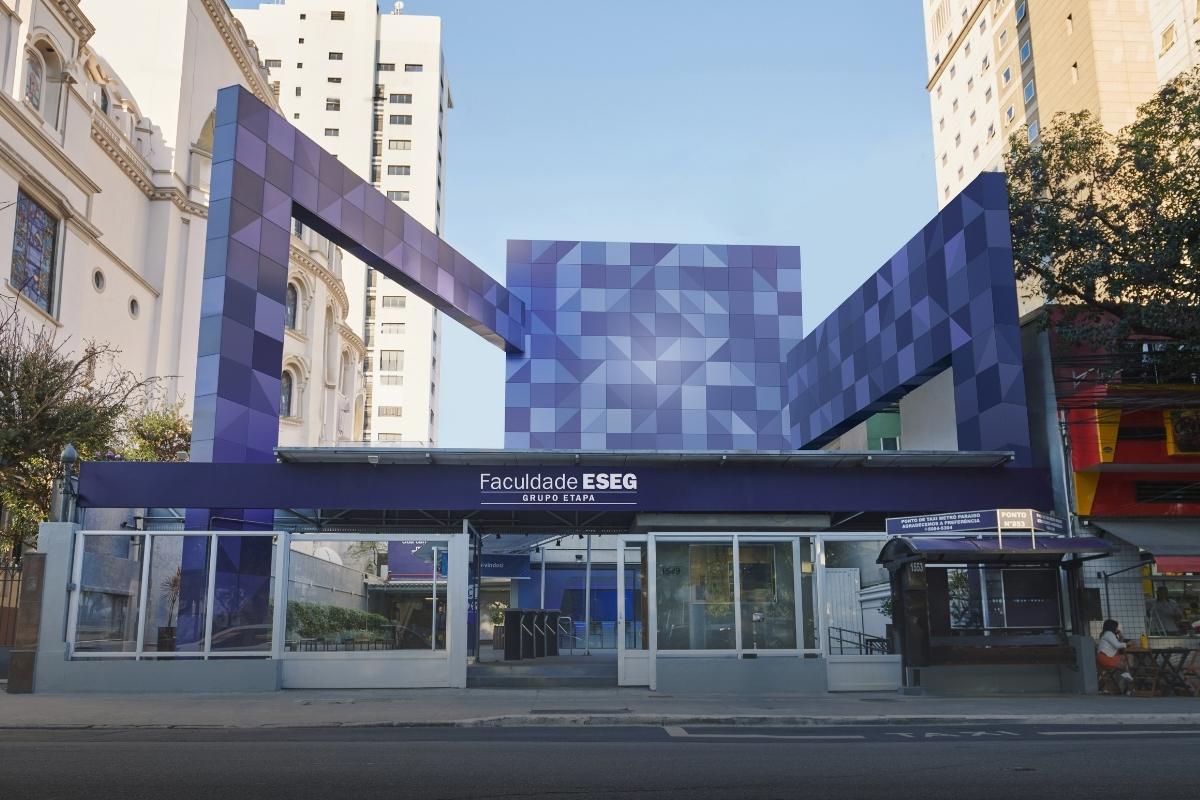
The institution has two campuses near the Paraíso and Ana Rosa metro stations, just a few meters from Avenida Paulista, which facilitates access for working students who need to balance their routines. Master's and doctoral level professors who are active in the market ensure that the content is not limited to theory.
The ESEG Career Development Center connects students to the job market from their first semester, offering simulated selection processes, job postings, and support for those who want to enter a public or private career while still in school.
For those who want to advance after graduation, ESEG also offers... postgraduate studies which allow specialization in areas complementary to teaching, thus expanding both knowledge and career possibilities.
Duration, type and admission methods
The Bachelor's Degree in Geography at ESEG lasts four years (eight semesters) and is taught in person. The total workload follows the MEC (Brazilian Ministry of Education) guidelines for undergraduate courses, including 400 hours of supervised internship and 200 hours of complementary activities.
The available entry methods are: our own entrance exam, use of ENEM scores, transfer from another institution, and second degree.
Applications can be made directly on the institution's website. The selection process calendar is updated periodically, and the ESEG support team answers questions via WhatsApp (11) 2187-1056 or email. fale_conosco@eseg.edu.br.
Frequently asked questions about the Geography degree.
A graduate in Geography works as a teacher in basic education, teaching in the final years of elementary school and in high school. A degree in Geography also qualifies professionals to participate in public teaching positions and to work on environmental and non-formal education projects.
Yes. A degree in Geography meets a constant demand from both the public and private education systems. Data from INEP shows that there is still a shortage of adequately trained teachers in a large part of Brazilian municipalities, which guarantees opportunities for those who complete the course in the coming years.
The Bachelor's degree in Geography lasts four years, divided into eight semesters. The total workload includes specific and pedagogical subjects, mandatory supervised internship, and complementary activities according to the guidelines of the Ministry of Education (MEC).
Yes. A degree in Geography is the required qualification to participate in competitive examinations for Geography teachers in state and municipal education systems. Public service examinations are one of the most sought-after paths for graduates, especially due to the job security and career plans with salary progression over time.
The Geography degree program at ESEG has a grade of 4 from the MEC (Brazilian Ministry of Education), an evaluation that attests to the quality of the course in terms of its pedagogical project, faculty, and infrastructure. A grade of 4 is above the minimum required (3) and is recognized as an indicator of excellence by the Ministry of Education's evaluation system.
Choosing a degree defines not only your career, but also the type of impact you will make. If the idea of educating new generations with spatial, critical, and civic thinking resonates with you, the Geography degree at ESEG is a concrete path to achieving that. Learn more about the program. ESEG undergraduate courses And take the next step.