Circular economy and its impact on the production chain.
A economy circular It has emerged as an innovative approach, transforming the way companies operate in the production chain.
Have you ever wondered what a world would be like where nothing is wasted and everything is transformed?
Imagine a scenario where every resource used in our daily lives is reused, recycled, and valued, completely transforming our production chain.
But how could this be achieved in practice?
This article explores the significant impacts of this paradigm shift promoted by economy circular, highlighting how the sustainability, Resource reuse and eco-efficient practices are reshaping business strategies.
Let's explore how the transition to... economy circular not only preserves the environment, But it also drives efficiency and competitiveness in the production landscape.
What is a economy circular?
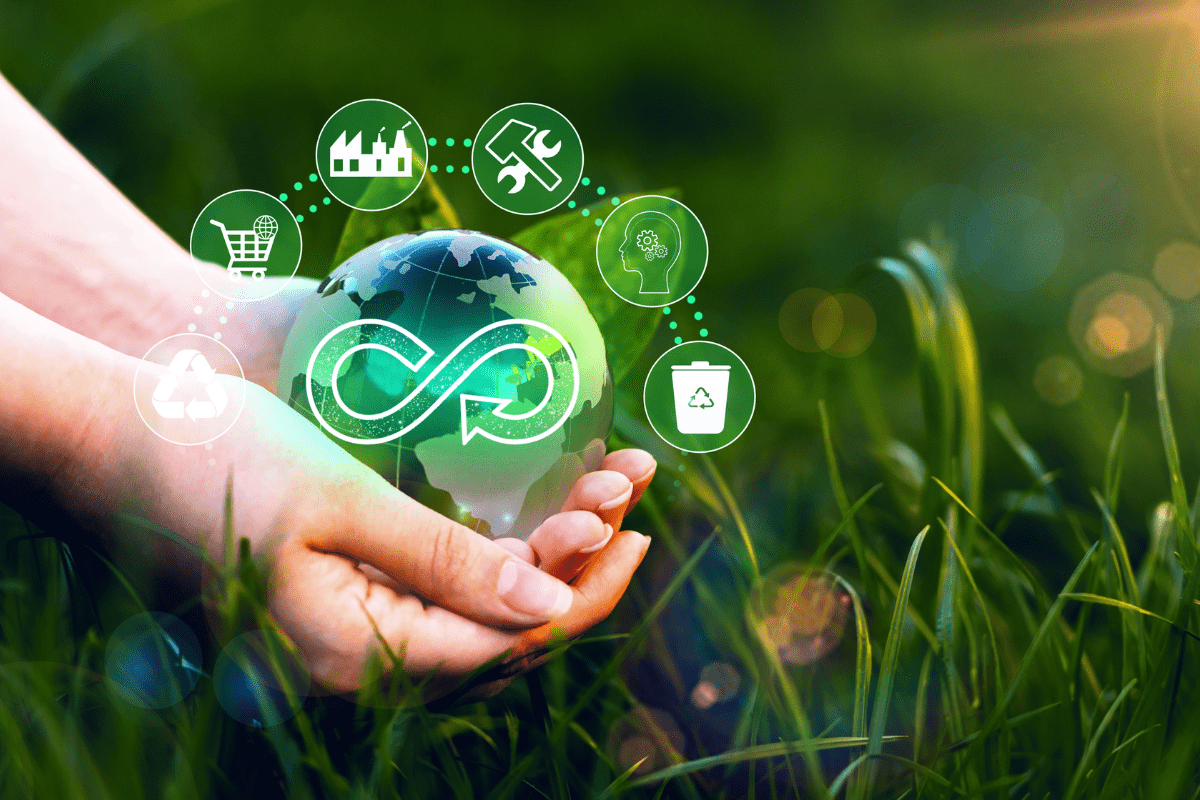
A Economy Circular It is an economic model that seeks to optimize the use of resources, minimizing waste and promoting sustainability.
In contrast to the traditional linear model, which involves extraction, production, use, and disposal, it proposes a continuous cycle of reuse, recycling, and renewal of materials.
Read more: Learn what ESG is and the importance of this concept.
For example, in an effort to adopt the economy circular, A company that sells light bulbs has started a program of “lighting as a serviceand”, where, instead of selling light bulbs, the company offers lighting as a service.
This means that the company retains ownership of the light fixtures and is responsible for their maintenance and upgrades.
When the light fixtures reach the end of their useful life, the company recycles them, reusing the materials to produce new products.
This model not only reduces waste, but also transforms the production chain, from manufacturing to end-user consumption, encouraging more sustainable practices and more efficient use of resources.
And what is a production chain?
A production chain, In turn, it represents the set of steps involved in the production of a good or service, from the extraction of raw materials to the delivery of the final product to the consumer.
This chain encompasses different sectors and processes, involving manufacturers, suppliers, distributors, and consumers.
How to economy Does circularity impact the production chain?
The implementation of Economy Circular It has a positive impact on the production chain in several ways.
First and foremost, it promotes efficiency in the use of resources, as it encourages the reuse of materials and the recycling of products.
This reduces dependence on natural resources and lowers the environmental footprint of production.
Furthermore, it stimulates innovation, encouraging the creation of more durable, repairable, and recyclable products.
This drives demand for new technologies and more sustainable production practices, creating opportunities for companies that invest in environmentally conscious solutions.
This approach also has a positive impact on waste management, reducing the amount of solid waste destined for landfills.
By promoting recycling and reuse, it contributes to reducing environmental pollution and preserving ecosystems.
In the context of the production chain, the Economy Circular It fosters partnerships between companies, strengthening cooperation throughout the supply chain.
Read more: What is maker culture and why is it important for education?
The reuse of by-products and the integration of production processes can generate synergies, benefiting both the economy and the environment.
However, the transition to this model of economy It presents challenges, such as the need for infrastructure investment for recycling and raising consumer awareness about the importance of sustainable choices.
Nevertheless, the long-term benefits outweigh the initial difficulties, contributing to a more sustainable and resilient future.
How can companies implement a model of economy circular?
1. Sustainable design
To create durable, repairable, and recyclable products from the start.
2. Reverse logistics
Establish systems to recover and recycle products after consumer use.
3. Collaboration in the supply chain
Working together with suppliers and partners to promote sustainable practices.
4. Circular business models
Explore models that emphasize services, sharing, and leasing, rather than just selling products.
5. Consumer awareness
Educating consumers about the importance of the circular economy and encouraging sustainable choices.
Economics: everything you need to know about the course
These strategies promote sustainability and minimize environmental impacts, while also potentially generating economic benefits.
With this understanding about circular economy Given its transformative impact on the production chain, I invite you to be an agent of change.
Start by questioning your consumption and disposal habits.
It can be as simple as opting for products with recyclable packaging or choosing companies that adopt sustainable practices.
Furthermore, share your knowledge. Talk about it. circular economy with friends, colleagues, and on social media.
Every conscious choice, every discussion we initiate, brings us closer to a more sustainable future.
What will be your next step on this journey?