By ESEG Team
12/08/2025
Browse by topic
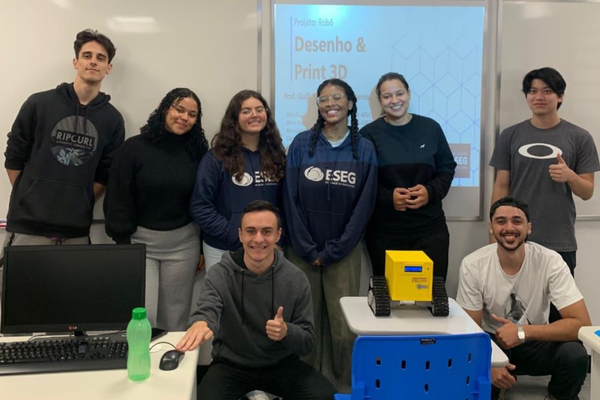
Students Mara Rubia Carvalho, Ana Luiza, Alex Manhone, Aline Bueno, Daniel Kenzo, Lucas Silva, and Natalia Souza, from the Production Engineering course at ESEG College, developed an innovative project: an autonomous robot capable of safely and efficiently transporting toxic or laboratory loads in industrial environments.
Guided by Professor Guilherme Duarte de Barros and named Wall-E EPR3, the robot was conceived and built using knowledge acquired in subjects such as Internet of Things (IoT), technical drawing, and 3D printing. The project had the direct support of the faculty and the infrastructure offered by ESEG, including specialized laboratories.
“We produced the Wall-E EPR3, an autonomous robot whose function is, for example, to transport toxic loads in industries. It was incredible to see a concept come to life, demonstrating the power of creativity, teamwork, and 3D printing,” commented student Mara Rubia Carvalho, highlighting the project's relevance to the future of industry and workplace safety.
According to Professor Guilherme Barros, practical projects like this are fundamental to the learning process. “In my understanding, working with practice helps students develop content covered throughout the semester. This teaching strategy is supported by Bloom's Taxonomy, in which cognitive thought is divided into remembering, understanding, applying, analyzing, evaluating, and creating. The professor further adds, “In practical projects, students can work with all the other stages and develop a tangible result from the content and stages developed previously. Additionally, students can simulate the professional environment in which they will be placed during their internship or after graduation, developing behavioral skills such as leadership, communication, management, negotiation, among others.”
To make the project possible, ESEG provided all the necessary filaments for 3D printing, as well as the Autodesk Inventor software license for testing and simulations. Technical support from the professionals at LITE (Laboratory of Technological Innovation) was also essential at each stage of development. The students reverse-engineered the project and used some components available on design platforms. This type of development is common in automotive mechanical projects.
According to the professor, "the tools that the students used in the 3D Design & Print course were: Autodesk Inventor Professional, a CAD and CAM software; 3D model slicing software, such as Cura 3D and others; in addition to the LITE 3D printers. These were the main resources used by the students."“
In addition to technical learning, the project also provided a great academic gain, as the professor explains. “Working in a team, managing time for project execution, aligning theory with practice, utilizing technical and behavioral skills.
“We are proud to be part of ESEG, because we learn in the classroom and put it into practice in the laboratories,” highlighted student Aline Bueno.
ESEG College remains committed to training professionals capable of proposing innovative solutions and positively impacting the country's industrial and technological landscape.

ESEG Team
Stay informed about relevant topics and what's happening at ESEG College.
Your data is safe.
Unavailable
Institutional
Infrastructure
Entry methods
Relationship
Key differentiators
We use cookies to improve your browsing experience.