By ESEG Team
12/05/2026
Browse by topic
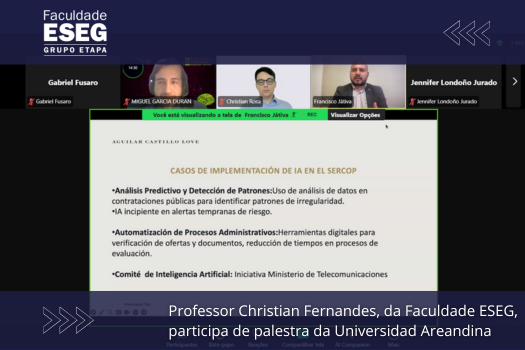
On Tuesday (November 12th), Professor Christian Fernandes, from the Law degree program at ESEG Faculty, part of the Etapa Group, was invited by the Fundación Universitaria del Área Andina, from Bogotá (COL), to participate in an online event with professors from universities in Latin America. The initiative was made possible through a partnership established by ESEG International.
The event aimed to discuss the implementation and use of Artificial Intelligence (AI) in the public and private sectors. To address the topic, the Universidad Areandina invited professors and experts from universities in various Latin American countries, such as Mexico, Colombia, and Ecuador.
Representing Brazil, Professor Christian led a discussion with other professors, bringing up current topics such as the implementation of artificial intelligence in politics and the public sector.
“"Artificial intelligence can enable better, more informed decisions by public authorities. This could boost compliance with constitutional principles such as transparency and efficiency," explains the professor.
The topic generates debate, after all, however advantageous the use of AI may seem, the negative points must be highlighted and discussed. “The negative points relate to the potential lack of transparency regarding the programming criteria of artificial intelligence systems. There is also concern about the quality of the databases that will be used to teach the machine, as well as the data that will be processed for its operation,” comments Christian.
By listening to the points raised by professors from other institutions, it is possible to gain a broader understanding of the concepts, challenges, and responsibilities. The use of AI in the public sector can bring great benefits to the policies of emerging or underdeveloped countries, but it must be treated with great caution and requires efforts from various areas to reach a consensus.
“It is clear that we are all still figuring out how to apply artificial intelligence to solve typical problems in our countries, such as corruption and the efficiency of public activities. There is a clear effort to implement a higher level of technology in public activities, and this will also involve artificial intelligence. It is imperative, but its realization still needs to be designed with the effort of all social actors – Public Authorities, Market, Academia and Society,” the professor points out regarding the implementation of AI in the public sector.
Finally, when asked about the importance of ESEG's participation in a multinational event, Christian expressed his enthusiasm for the possibilities and opportunities that open up: “International events allow us to understand how other legal systems and public or private organizations around the world are addressing challenges very similar to those faced by Brazil. It allows us to compare solutions and share common concerns with other countries, accelerating the process of resolving them here as well. Furthermore, it gives international visibility to the studies being developed within ESEG, by its faculty and students,” he concluded.
The ESEG International sector seeks to forge bonds with different cultures to showcase new perspectives and challenges, and to create connections and networking opportunities worldwide. All of this is aimed at providing the highest quality education for our students and demonstrating that ESEG College truly makes a difference.

ESEG Team
Stay informed about relevant topics and what's happening at ESEG College.
Your data is safe.
Unavailable
Institutional
Infrastructure
Entry methods
Relationship
Key differentiators
We use cookies to improve your browsing experience.